
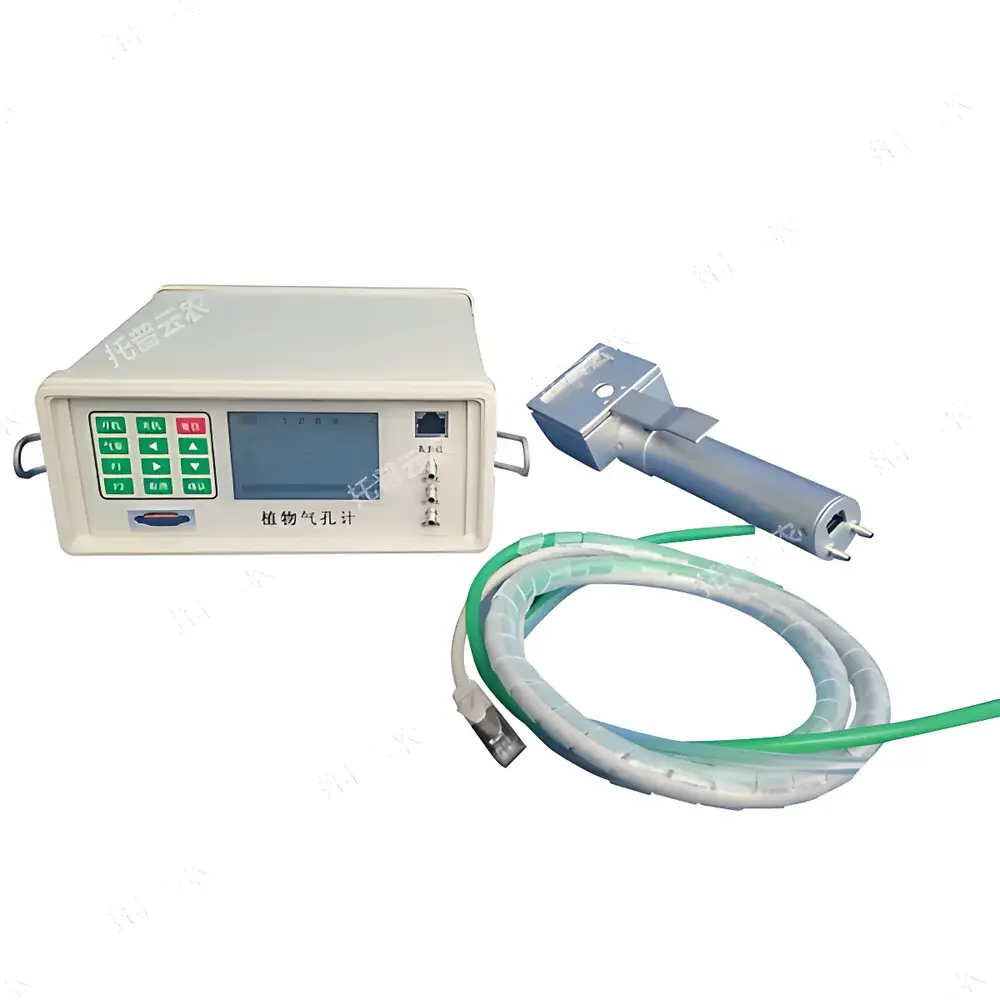
Top Cloud-agri TPQK-1000 Steady-State Porometer
| Brand | Top Cloud-agri |
|---|---|
| Origin | Zhejiang, China |
| Manufacturer Type | Direct Manufacturer |
| Model | TPQK-1000 |
| Measurement Principle | Open-Path Steady-State Diffusion Method |
| Air Temperature Range | 0–50 °C (±0.3 °C) |
| Relative Humidity Range | 0–100% RH (±1.8% RH, 0.1% RH resolution) |
| Leaf Temperature Range | 0–50 °C (±0.2 °C, ≤0.1 °C resolution) |
| PAR Sensor Range | 0–3000 μmol·m⁻²·s⁻¹ (±2%, 1 μmol·m⁻²·s⁻¹ resolution) |
| Flow Rate | 0.3–1.0 L/min (±2.0%, 0.01 L/min resolution) |
| Display | 256×160 graphical LCD |
| Data Storage | SD card, ≥150,000 records |
| Battery | 7.4 V / 10 Ah rechargeable Li-ion, ~10 h field operation |
| Operating Modes | Open-path and closed-path (auto/manual) |
| Weight | Portable, field-deployable design |
Overview
The Top Cloud-agri TPQK-1000 Steady-State Porometer is a precision field and laboratory instrument engineered for quantitative analysis of stomatal physiology in higher plants. It operates on the steady-state diffusion principle—measuring the rate of water vapor flux across a defined leaf chamber under controlled airflow conditions. By simultaneously monitoring ambient air temperature and humidity, leaf surface temperature, chamber humidity, and photosynthetically active radiation (PAR), the device calculates key physiological parameters including stomatal conductance (gs, mol·m⁻²·s⁻¹), stomatal resistance (rs, s·m⁻¹), and transpiration rate (E, mmol·m⁻²·s⁻¹). Unlike dynamic or transient-response porometers, the TPQK-1000 maintains constant boundary layer conditions during measurement, ensuring high reproducibility for comparative studies across genotypes, treatments, or time-series experiments. Its open-path configuration enables rapid, non-destructive assessment under natural or semi-controlled environmental conditions—critical for ecophysiological field campaigns and irrigation management trials.
Key Features
- Two operational modes: configurable open-path (real-time atmospheric exchange) and closed-path (controlled chamber equilibration), with user-selectable auto-triggered or manual sampling intervals
- Integrated multi-sensor array calibrated to traceable standards: dual thermistors for leaf and air temperature, capacitive RH sensor, quantum photodiode for PAR (400–700 nm), and thermal mass-flow meter
- High-capacity onboard data logging via removable SD card—supports timestamped storage of ≥150,000 complete measurement sets with full parameter arrays
- Rugged, handheld ergonomics optimized for extended field use: IP54-rated enclosure, anti-glare monochrome LCD (256×160 pixels), intuitive menu navigation, and hot-swappable battery support
- Firmware-upgradable architecture enabling future protocol expansions, calibration refinements, and compatibility with external environmental loggers or GPS modules
Sample Compatibility & Compliance
The TPQK-1000 accommodates broad leaf morphology—including dicotyledonous angiosperms (e.g., soybean, tomato, Arabidopsis), monocots (e.g., maize, rice, wheat), and woody species (e.g., poplar, grapevine)—via standardized leaf chamber gaskets adaptable to surface area ranges of 1.0–6.0 cm². All sensors comply with ISO 7726:2009 (ergonomic principles for thermal environments) and IEC 60751:2022 (industrial platinum resistance thermometers). RH accuracy meets ASTM E2654-20 requirements for hygrometric instrumentation used in plant stress phenotyping. While not certified for GLP/GMP-regulated clinical trials, its data structure supports audit-ready metadata tagging (operator ID, location, date/time, calibration status) required for FAIR-aligned agricultural research repositories.
Software & Data Management
Raw data export is supported in CSV format via USB interface or SD card extraction, preserving native sensor resolution and temporal metadata. Third-party integration is enabled through documented ASCII command protocol (RS-232/USB CDC), allowing scripted control from Python, MATLAB, or LabVIEW environments. Optional desktop software provides batch calibration correction, diurnal trend visualization, and export to common agricultural modeling formats (e.g., NetCDF for crop simulation inputs). All firmware updates are digitally signed and delivered via secure HTTPS endpoint, satisfying basic cybersecurity hygiene expectations for academic instrumentation networks.
Applications
- Quantifying drought-induced stomatal closure kinetics across breeding populations under progressive soil moisture depletion
- Evaluating efficacy of antitranspirant compounds or foliar-applied biostimulants on stomatal regulation under elevated VPD conditions
- Parameterizing stomatal conductance submodels (e.g., Ball-Berry, Medlyn) for process-based crop growth simulators (APSIM, DSSAT)
- Validating remote sensing indices (e.g., PRI, NDVI) against ground-truthed gs measurements in canopy-scale ecophysiology studies
- Teaching core plant water relations concepts—including coupling between hydraulic conductivity, leaf water potential, and stomatal response—in undergraduate plant physiology labs
FAQ
What measurement principle does the TPQK-1000 employ?
It uses the steady-state diffusion method, where stomatal conductance is derived from the water vapor concentration gradient across a leaf chamber at equilibrium airflow, per Fick’s first law of diffusion.
Can the instrument be used for conifer needles or small herbaceous leaves?
Yes—interchangeable chamber gaskets accommodate leaf areas from 1.0 cm² (e.g., Arabidopsis rosettes) to 6.0 cm² (e.g., mature maize blades); needle samples require custom mounting but remain within measurable conductance range.
Is the PAR sensor cosine-corrected for angular light response?
Yes—the quantum sensor features a precision diffuser meeting ISO 17166:2022 cosine response specifications (<5% deviation up to 75° incidence angle).
How is calibration traceability maintained?
Factory calibration certificates reference NIST-traceable RH and temperature standards; users may perform two-point RH verification using saturated salt solutions and ice-point temperature checks.
Does the device meet FDA 21 CFR Part 11 requirements for electronic records?
No—it lacks electronic signature capability and audit trail generation; however, exported CSV files with embedded timestamps and operator IDs satisfy basic data integrity needs for non-regulated agronomic research.
Related Products





