
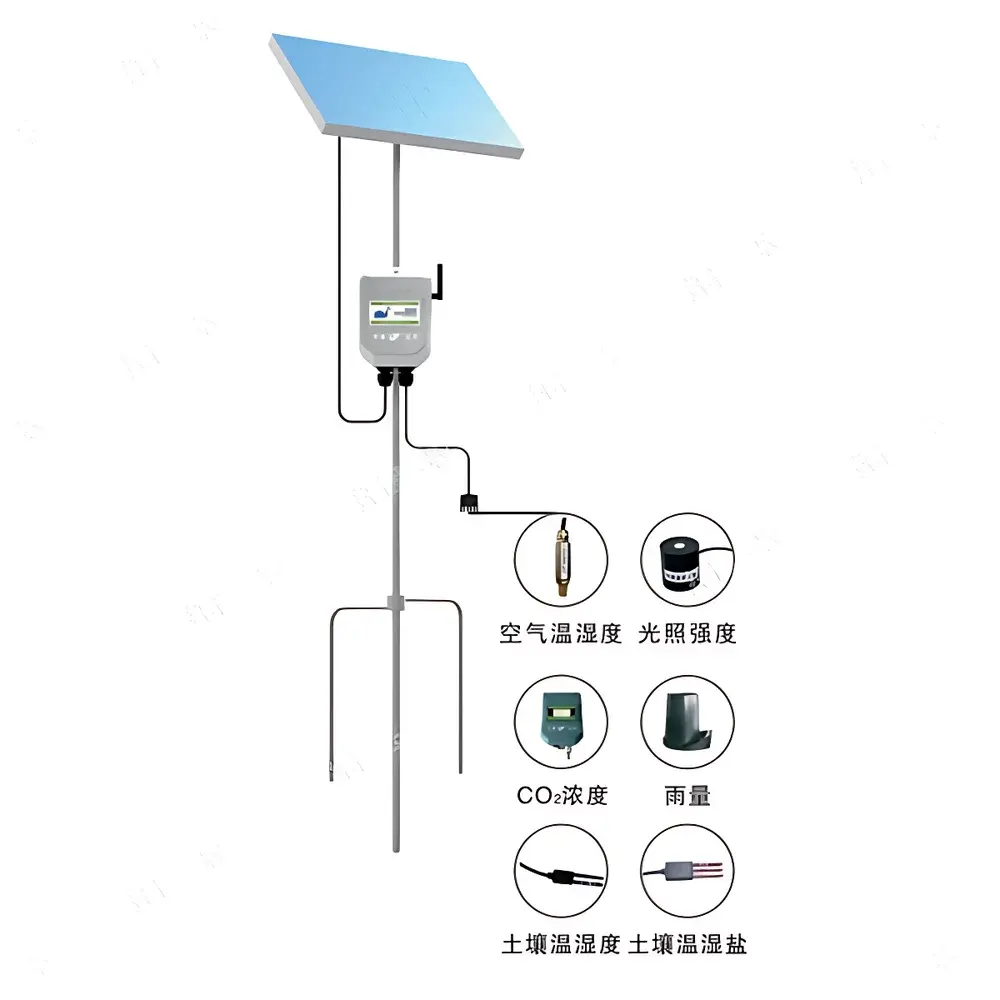
Top Cloud-agri TPSBL-GPRS Series Solar-Powered Agricultural Environmental Monitoring Station
| Brand | Top Cloud-agri |
|---|---|
| Origin | Zhejiang, China |
| Manufacturer Type | OEM/ODM Manufacturer |
| Country of Origin | China |
| Models | TPSBL-GPRS-4G, TPSBL-GPRS-6G, TPSBL-GPRS-7G, TPSBL-GPRS-8G |
| Power Supply | 3.2 V / 5 Ah LiFePO₄ battery with optional 6 V / 5 W solar panel |
| Standby Current | ~80 µA |
| Operating Temperature | −20 °C to +70 °C |
| Relative Humidity Range | ≤95 % RH (non-condensing) |
| GPS Positioning Accuracy | ±0.05 arcminute (≤50 m), coordinate resolution to 3 decimal places |
| Sensor Interface | Up to 32 wired analog/digital sensor inputs (configurable) |
Overview
The Top Cloud-agri TPSBL-GPRS Series is a field-deployable, solar-powered environmental monitoring station engineered for continuous, unattended operation in agricultural and peri-urban ecosystems. It implements a distributed sensing architecture based on calibrated analog and digital transducers, interfaced via standardized 4–20 mA, 0–5 V, or RS-485 protocols. Data acquisition is governed by programmable sampling intervals (1 min to 24 h), synchronized with real-time clock (RTC) and GPS-derived timestamps. Measurements are transmitted via GPRS (2G/4G LTE fallback supported) to a secure cloud-based platform compliant with HTTPS/TLS 1.2 encryption. The system adheres to the functional architecture defined in ISO 20922:2019 (Smart agriculture — Requirements for environmental monitoring systems) and supports traceable data logging aligned with GLP principles for field research documentation.
Key Features
- Solar-rechargeable power architecture with integrated LiFePO₄ battery (3.2 V / 5 Ah), featuring overcharge and deep-discharge protection circuits meeting IEC 62619 safety requirements.
- Robust environmental enclosure rated IP67 for dust and water immersion resistance; operating range certified from −20 °C to +70 °C ambient temperature.
- Embedded GPS module providing georeferenced metadata (WGS84 coordinates, accuracy ±0.05′), enabling spatial validation of sensor deployments and theft deterrence via geo-fencing alerts.
- Configurable sensor interface supporting up to 32 wired analog/digital inputs—compatible with industry-standard agricultural sensors (e.g., Vaisala HMP155, Decagon EC-5, Apogee SQ-500).
- Hardware-level system watchdog and automatic reset circuitry ensures operational continuity under voltage fluctuation or electromagnetic interference (EMI), minimizing field maintenance cycles.
- Remote firmware update capability via OTA (Over-the-Air) protocol, supporting version-controlled deployment and regulatory-compliant audit trails.
Sample Compatibility & Compliance
The TPSBL-GPRS series is validated for long-term deployment in open-field, greenhouse, orchard, and aquaculture environments. Sensor compatibility includes but is not limited to air temperature/humidity (capacitive polymer), photosynthetic photon flux density (PPFD) via silicon photodiode, CO₂ (NDIR), soil volumetric water content (FDR), and soil temperature (PT1000). All sensor integration follows ASTM D5208–22 (Standard Practice for Calibration of Field Sensors) guidelines. The platform supports export of time-series datasets in CSV and NetCDF-4 formats, facilitating interoperability with FAO WaPOR, USDA SCAN, and EU Copernicus Land Monitoring Service workflows. Device firmware and cloud API comply with GDPR Article 32 (security of processing) and enable pseudonymized data handling for multi-site collaborative trials.
Software & Data Management
Data ingestion occurs through a TLS-secured RESTful API into a cloud-hosted platform offering role-based access control (RBAC), configurable dashboards, and automated alerting (SMS/email) for threshold breaches (e.g., soil moisture < 12 % v/v, air RH > 92 % for >4 h). Historical data is retained for ≥24 months with immutable write-once storage architecture. Audit logs record all user actions—including parameter changes, calibration events, and device reboots—in accordance with FDA 21 CFR Part 11 electronic record requirements. Export functions support ISO/IEC 17025-compliant reporting templates, including measurement uncertainty estimates derived from sensor datasheet specifications and NIST-traceable calibration certificates.
Applications
- Irrigation scheduling optimization using real-time soil moisture deficit modeling and evapotranspiration (ET₀) estimation per FAO-56 Penman-Monteith methodology.
- Controlled-environment agriculture (CEA) process validation, including HVAC performance assessment and CO₂ enrichment efficacy monitoring in vertical farms.
- Long-term phenological studies requiring synchronized microclimate profiling across heterogeneous agroecosystems (e.g., slope-aspect gradients, canopy stratification).
- Regulatory compliance reporting for Good Agricultural Practice (GAP) certification and EU Common Agricultural Policy (CAP) eco-scheme verifications.
- Integration with farm management information systems (FMIS) such as FarmLogs, Granular, or local government agricultural extension portals via documented JSON API endpoints.
FAQ
What communication protocols does the TPSBL-GPRS support for sensor integration?
It accepts standard industrial analog signals (4–20 mA, 0–5 V) and digital interfaces (RS-485 Modbus RTU); custom protocols may be implemented via firmware customization upon request.
Is the cloud platform compatible with third-party SCADA or IoT middleware?
Yes—the system exposes MQTT and REST APIs with OAuth 2.0 authentication; full OpenAPI 3.0 specification is available under NDA.
How is measurement traceability ensured for regulatory audits?
Each sensor channel is assigned a unique ID linked to its calibration certificate; timestamped raw values and post-processed metrics are stored separately with SHA-256 hash integrity verification.
Can the device operate without cellular coverage?
Local data buffering is supported for up to 30 days (dependent on sampling frequency and sensor count); transmission resumes automatically upon network recovery.
Does the system meet EMC and radio type approval requirements for international deployment?
CE marking (EN 301 489-1/-17, EN 300 328) and FCC ID certification are available for EU and US markets; regional variants include ICES-003 (Canada) and RCM (Australia).
Related Products







