
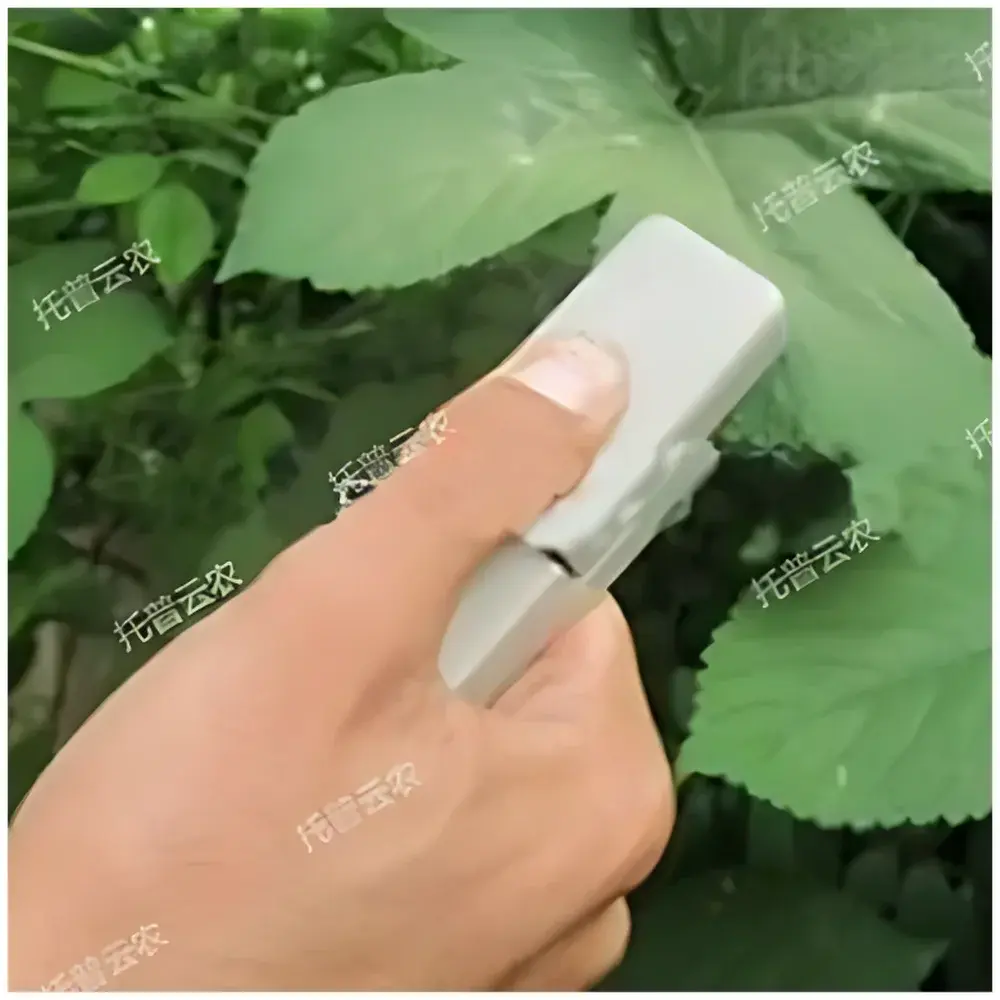
Top Cloud-agri TPW-A Leaf Surface Moisture Recorder
| Brand | Top Cloud-agri |
|---|---|
| Origin | Zhejiang, China |
| Manufacturer Type | Direct Manufacturer |
| Country of Origin | China |
| Model | TPW-A |
| Pricing | Available Upon Request |
| Measurement Range | 0–60 °C |
| Response Time | <3 s |
| Resolution | 0.1 °C |
| Accuracy | ±0.5 °C |
| Linearity Error | ≤1% full scale |
| Data Storage | Removable SD card |
| Power Supply | 4 × AAA batteries (operational life ≥6 months) |
| Display | Backlit LCD with Chinese interface |
| Auto Power-Down | Yes (after inactivity) |
Overview
The Top Cloud-agri TPW-A Leaf Surface Moisture Recorder is a field-deployable, handheld sensor system engineered to quantify the relative surface moisture status of plant leaves—expressed as a dimensionless index correlated with evaporative demand, dew formation, and cuticular water retention. Unlike volumetric soil moisture sensors or leaf water potential probes, the TPW-A operates on capacitive and thermal resistance principles: its integrated platinum RTD (Pt1000) measures localized leaf surface temperature while proprietary surface-contact electrodes detect dielectric shifts associated with thin-film water presence. This dual-signal approach enables indirect inference of surface hydration dynamics under ambient conditions—critical for phenological monitoring, irrigation scheduling, and early detection of microclimatic stress triggers. Designed specifically for agronomic and ecological fieldwork, the device does not measure absolute water content (g·m⁻²) but delivers a reproducible, temperature-compensated moisture index calibrated against standardized leaf surface wetness protocols used in plant pathology and precision horticulture.
Key Features
- Handheld ergonomic design with integrated sensor head for rapid, non-destructive leaf contact measurements
- High-stability Pt1000 thin-film platinum resistance thermometer (±0.5 °C accuracy, 0.1 °C resolution) for simultaneous surface temperature acquisition
- Capacitive moisture sensing element with automatic temperature compensation to minimize thermal drift
- Onboard data logging with SD card storage (FAT32 formatted, up to 32 GB), supporting timestamped sequential recording at user-defined intervals (1 min to 24 h)
- Low-power architecture: average current draw <150 µA in standby; battery life ≥6 months with typical field use (4 × AAA alkaline cells)
- Auto power-down after 5 minutes of inactivity; retains all logged data during battery replacement
- Backlit monochrome LCD with Chinese-language UI—optimized for field readability under variable lighting
Sample Compatibility & Compliance
The TPW-A is validated for use on broadleaf and needleleaf species with smooth or moderately pubescent surfaces (e.g., maize, wheat, tomato, apple, pine). It is not recommended for highly waxy, hairy, or crinkled leaves (e.g., cabbage, lamb’s ear) without empirical calibration. While not certified to ISO/IEC 17025 or ASTM E2889 (Standard Guide for Leaf Wetness Sensor Performance Evaluation), the instrument adheres to widely adopted field methodology frameworks described in FAO Irrigation and Drainage Paper No. 56 and the European COST Action FA1306 guidelines for plant water status monitoring. Its output supports GLP-aligned data collection when paired with traceable calibration logs and metadata annotation (date, time, species, leaf position, ambient RH/T).
Software & Data Management
Data export is performed via standard SD card readout using any Windows/macOS/Linux system. Raw files are saved in CSV format with columns: Timestamp (YYYY-MM-DD HH:MM:SS), Surface Temperature (°C), Moisture Index (unitless, 0–100 scale), and Battery Voltage (V). No proprietary software is required; files are compatible with Excel, R, Python (pandas), and statistical analysis platforms. For audit-trail compliance, users may manually record operator ID, calibration date, and environmental notes in the accompanying metadata log sheet—a practice aligned with basic GxP documentation expectations for non-regulated agricultural trials.
Applications
- Irrigation decision support in drip- and sprinkler-irrigated orchards and vineyards
- Monitoring dew duration and frequency in disease forecasting models (e.g., for powdery mildew, late blight)
- Field validation of canopy-level humidity simulations in crop growth models (e.g., APSIM, DSSAT)
- Controlled-environment studies on stomatal conductance–humidity feedback loops
- Long-term phenocam network calibration where leaf wetness serves as a proxy for micro-rain events
- Educational use in plant physiology labs for demonstrating transpiration–microclimate coupling
FAQ
Does the TPW-A provide absolute leaf water content in g·m⁻²?
No. It outputs a relative moisture index derived from dielectric and thermal properties—intended for comparative, longitudinal tracking—not gravimetric quantification.
Can it be used on wet or rainy days?
Yes, but readings reflect total surface water—including rain droplets. For dew-specific assessment, deploy only during pre-dawn or post-evaporation windows.
Is calibration traceable to NIST or other national standards?
The Pt1000 sensor element meets IEC 60751 Class B tolerance; however, full-system calibration is performed against reference leaf-wetness chambers per internal Top Cloud-agri SOP-LSM-01. Certificate available upon request.
What is the operating temperature limit for continuous outdoor deployment?
The unit is rated for ambient operation between −10 °C and +65 °C; extended exposure above 50 °C may reduce battery life and LCD contrast.
How frequently should the sensor head be cleaned?
Wipe gently with a lint-free cloth moistened with deionized water after each day’s use—especially following dusty or sap-rich measurements—to maintain electrode integrity and thermal contact.



