
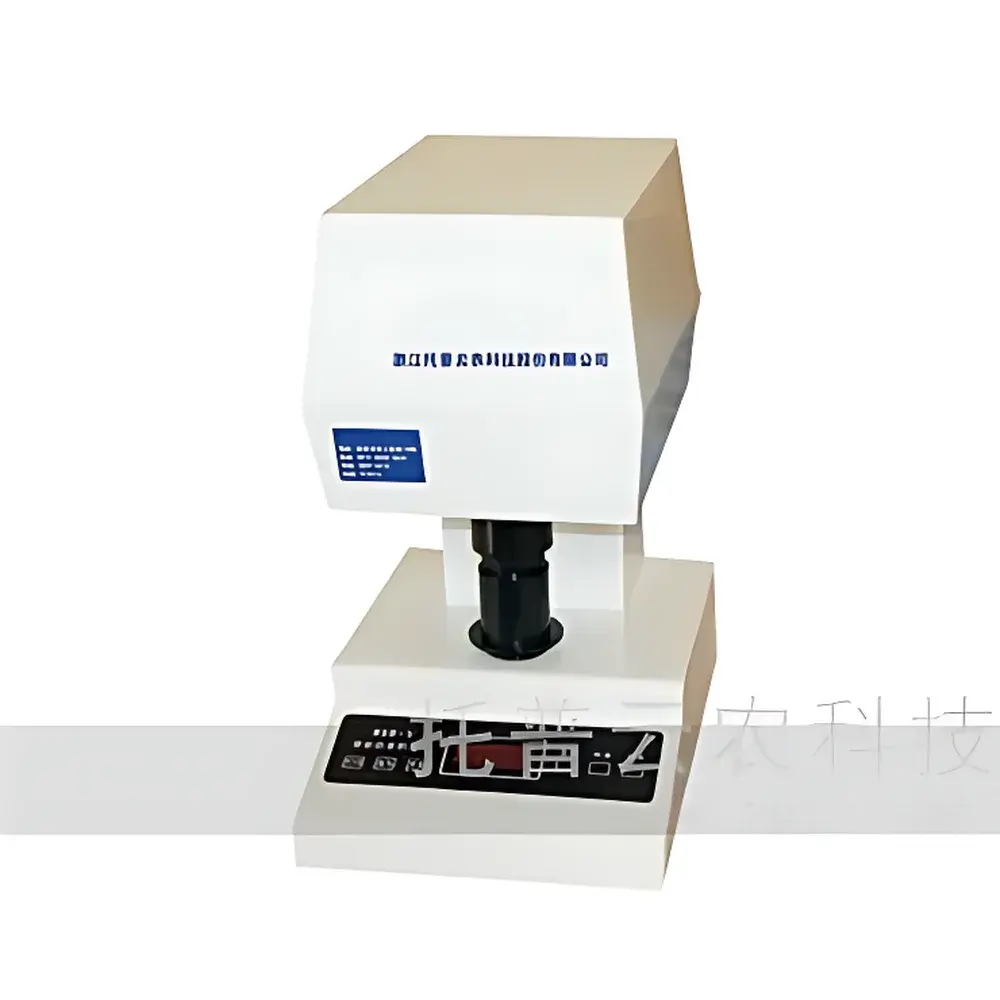
Top Cloud-agri WSB-V Intelligent Whiteness Meter
| Brand | Top Cloud-agri |
|---|---|
| Origin | Zhejiang, China |
| Manufacturer Type | Direct Manufacturer |
| Country of Origin | China |
| Model | WSB-V |
| Price | USD 700 (FOB) |
| Light Source | Simulated D65 Illuminant |
| Geometry | Diffuse Illumination / Normal Detection (d/0) |
| Sphere Diameter | φ120 mm |
| Aperture Diameter | φ20 mm |
| Sample Minimum Diameter | ≥φ30 mm |
| Repeatability | ≤0.1 |
| Zero Drift | ≤0.1 |
| Scale Drift | ≤0.1 |
| Measurement Error | ≤±0.5 |
| Resolution | 0.1 |
| Display | 3½-digit LED |
| Output | RS-232 interface (printer optional) |
| Compliance | JJG 512–2002, GB/T 3978–1983, GB/T 5950–2002 |
Overview
The Top Cloud-agri WSB-V Intelligent Whiteness Meter is a precision optical instrument engineered for quantitative assessment of whiteness in solid, non-transparent, and diffusely reflecting materials. It operates on the principle of diffuse illumination and normal detection (d/0 geometry), conforming to national metrological verification regulation JJG 512–2002 and Chinese standards GB/T 3978–1983 (Standard Illuminants and Viewing Conditions) and GB/T 5950–2002 (Methods for Determination of Whiteness of Paper and Paperboard). The device simulates the CIE standard illuminant D65 using a pulsed xenon flash source with spectral energy distribution optimized for blue-light reflectance measurement — specifically targeting the 457 nm wavelength band critical for evaluating optical brightener response. Unlike tristimulus colorimeters, the WSB-V isolates blue reflectance without chromatic decomposition, enabling direct, standardized quantification of “blueness-corrected whiteness” as defined in ISO 2470-1 and TAPPI T427. Its design eliminates specular reflection interference via an integrated light absorber and calibrated integrating sphere (φ120 mm), ensuring high reproducibility across heterogeneous industrial samples.
Key Features
- Stable pulsed xenon lamp with >100,000-hour service life — no warm-up time, minimal spectral drift, and immunity to ambient light interference.
- Hermetically sealed optical chamber — IP54-rated enclosure suitable for flour mills, starch processing lines, cement plants, and paint manufacturing environments.
- Embedded real-time operating system with on-board calibration memory — automatic zero-setting and full-scale white calibration (using certified ceramic reference tile) retained across power cycles.
- Digital signal processing architecture featuring fast-converging numerical algorithms — measurement completed within 2 seconds with <0.1 unit repeatability (n=10, same sample position).
- High-precision d/0 optical path: 120 mm integrating sphere with matte BaSO₄ coating, 20 mm measurement aperture, and geometrically aligned photodetector array for uniform spatial response.
- Compliant analog-to-digital conversion with 0.1-unit resolution and RS-232 serial output — supports integration into QC data logging systems or optional thermal printer (sold separately).
Sample Compatibility & Compliance
The WSB-V accommodates flat, rigid, or lightly compressible planar samples with minimum diameter ≥30 mm and surface roughness <5 µm Ra. Validated applications include wheat flour, rice starch, cornmeal, titanium dioxide-pigmented coatings, bleached pulp sheets, white Portland cement clinker, and polymer-based masterbatches. All measurements adhere to the D65/10° observer condition per GB/T 3978 and align with international whiteness index definitions (CIE Whiteness, Ganz Whiteness, ASTM E313 Yellowness Index cross-reference capability). Instrument validation includes traceable calibration against NIM (National Institute of Metrology, China)-certified standards; full compliance documentation supports GLP-regulated laboratories and ISO/IEC 17025-accredited testing facilities.
Software & Data Management
While the WSB-V operates as a standalone benchtop meter, its RS-232 interface enables bidirectional communication with external PCs running custom or third-party data acquisition software. Raw reflectance values (R₄₅₇), calculated whiteness indices, timestamp, and operator ID (if configured) are transmitted in ASCII format. Audit trail functionality is supported when paired with compliant laboratory information management systems (LIMS) that enforce 21 CFR Part 11-compliant electronic signatures and change control. Firmware updates are delivered via UART bootloader protocol — no proprietary software installation required.
Applications
- Quality control of cereal-derived products: monitoring bleaching efficacy and detecting over-bleaching in flour and starch production.
- Raw material acceptance testing for TiO₂, CaCO₃, and zinc oxide pigments used in architectural coatings and plastics.
- In-process verification of whitening agent dosage in papermaking wet-end chemistry.
- Batch release testing of white cement and gypsum board — correlating whiteness with sulfate content and calcination consistency.
- R&D screening of novel optical brighteners in textile auxiliaries and detergent formulations.
FAQ
Does the WSB-V comply with international whiteness standards such as ISO 2470?
Yes — its D65-simulated illumination, d/0 geometry, and 457 nm spectral weighting satisfy the core requirements of ISO 2470-1 for paper and ISO 2471 for pulp.
Can it measure samples with gloss or texture variation?
The integrated light absorber and sphere design suppresses specular reflectance; however, for highly textured or embossed surfaces, users must ensure consistent sample positioning and apply standardized compression (e.g., using supplied pressure plate) to minimize air-gap scattering.
Is calibration traceable to national metrology institutes?
Each unit ships with a calibration certificate referencing NIM-traceable ceramic white standards (SRM 2001 series equivalent); annual recalibration is recommended per JJG 512–2002 schedule.
What maintenance is required beyond routine cleaning?
No consumables or lamp replacements are needed during the rated 100,000-hour lifespan; periodic verification using the included calibration tile and dust-free lens cleaning with optical-grade tissue are sufficient.
Is FDA or EU regulatory documentation available for pharmaceutical excipient testing?
While not classified as a medical device, the WSB-V’s measurement uncertainty profile (<±0.5 units) and audit-ready output meet baseline requirements for USP <1059> and Ph. Eur. 2.2.58 method validation in excipient whiteness qualification.



