
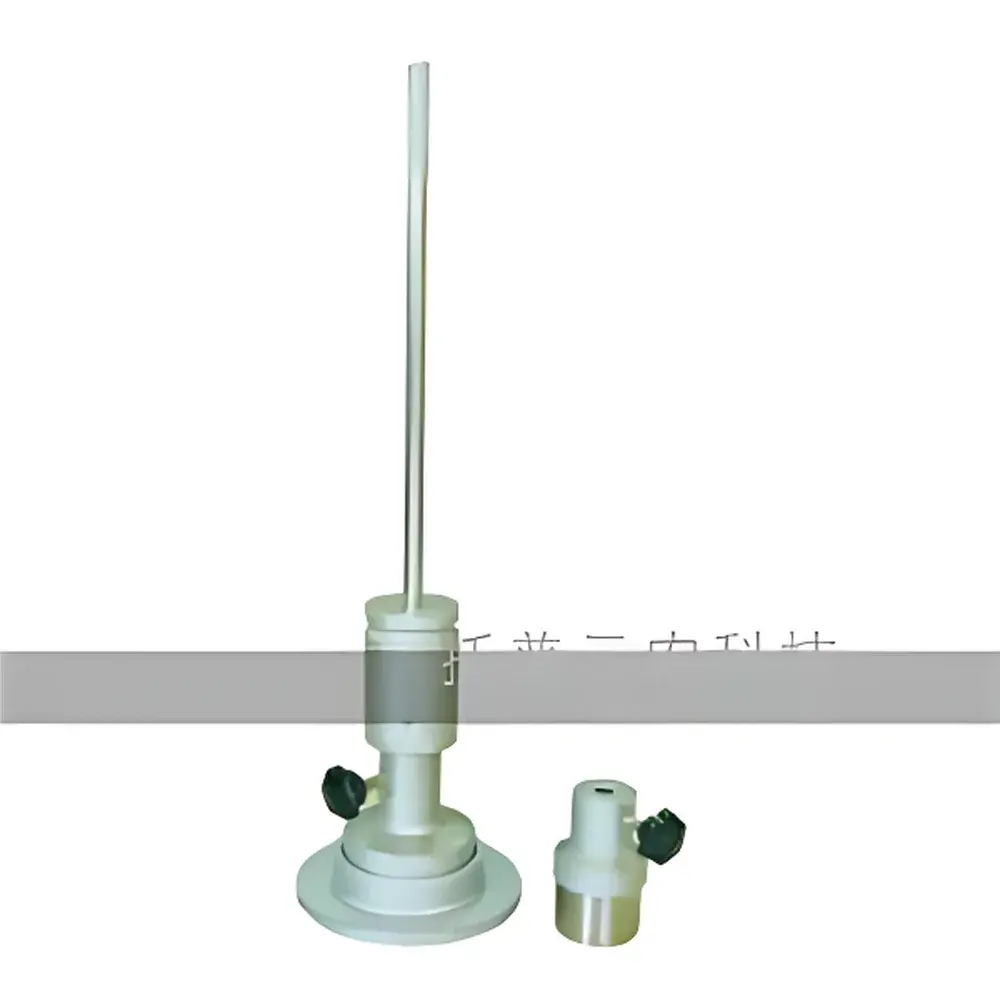
Top Cloud-agri YDRZ-4L Soil Bulk Density Tester
| Brand | Top Cloud-agri |
|---|---|
| Origin | Zhejiang, China |
| Manufacturer Type | Direct Manufacturer |
| Country of Origin | China |
| Model | YDRZ-4L |
| Pricing | Available Upon Request |
| Method | Ring Knife (Core Sampling) |
| Sample Volume | 4 L |
| Calibration Accuracy | ±5 g (via electronic balance) |
| Construction Material | Stainless Steel |
| Key Components | Base Plate, Sand-Filling Funnel (Height: 135 mm), 4-L Calibrated Sand Container, Control Valve, Guide Rod, Drop Hammer,定向 Cylinder, 2× Ring Knives, 2× Ring Knife Press Blocks, 2× Knobs |
Overview
The Top Cloud-agri YDRZ-4L Soil Bulk Density Tester is a field-deployable, manually operated instrument engineered for the precise determination of soil bulk density using the standardized ring knife (core sampling) method. It operates on the principle of volumetric displacement and gravimetric measurement: a stainless steel ring knife of known internal volume is driven into undisturbed soil using a guided drop hammer system, minimizing structural disturbance to the native soil matrix. The extracted core is then weighed, and bulk density is calculated as the ratio of dry soil mass to the fixed volume of the ring knife. This method complies with the technical requirements specified in GB/T 22101–2008 (“Determination of Soil Bulk Density—Ring Knife Method”) and aligns with internationally recognized practices referenced in ASTM D2937 and ISO 28599 for in-situ density assessment of cohesionless and low-cohesion soils.
Key Features
- Rigid Stainless Steel Construction: All primary structural components—including base plate, sand container, funnel assembly, and valve housing—are fabricated from corrosion-resistant stainless steel, ensuring long-term dimensional stability and resistance to field environmental exposure.
- Calibrated 4-L Sand Container: The sand reservoir is dimensionally optimized for consistent flow dynamics and calibrated against traceable electronic balances to within ±5 g, supporting reproducible sand replacement during field calibration steps where required.
- Controlled Ring Knife Insertion System: Incorporates a precision guide rod, directional cylinder, and drop hammer mechanism that delivers uniform vertical force without lateral shear, preserving soil fabric integrity during sampling—critical for accurate porosity and compaction analysis.
- Modular Field Configuration: Includes two calibrated ring knives (standard size per GB/T 22101), matching press blocks, a dedicated directional sleeve, and two adjustable knobs for secure component alignment—enabling rapid setup and repeatable operation across heterogeneous field sites.
- Ergonomic Design for Field Use: Compact footprint, integrated carrying handles, and tool-free assembly minimize operator fatigue during extended survey campaigns in agricultural, ecological, and geotechnical applications.
Sample Compatibility & Compliance
The YDRZ-4L is validated for use with coarse-grained, non-cohesive, and moderately cohesive soils—including sandy loams, gravelly soils, and cultivated topsoil layers—where particle size distribution permits clean ring knife penetration without excessive fracture or crumbling. It is not intended for highly plastic clays, organic peats, or saturated high-moisture-content strata where structural collapse may compromise volumetric fidelity. Instrument compliance includes adherence to GB/T 22101–2008, with supporting documentation available for GLP-aligned field data collection protocols. While not an electronic instrument subject to FDA 21 CFR Part 11, its mechanical design supports audit-trail-capable procedural documentation when integrated into ISO/IEC 17025-accredited soil testing workflows.
Software & Data Management
This is a purely mechanical, non-digital field instrument; no embedded firmware, connectivity, or proprietary software is included. Data acquisition relies on external laboratory-grade electronic balances (e.g., 0.01 g resolution) and manual entry into LIMS or spreadsheet-based reporting systems. Users are advised to follow documented SOPs—including pre- and post-sampling moisture content determination via oven-drying (per GB/T 22101 Annex A)—to ensure full traceability. Calibration records for associated balances, ring knife volume verification logs, and field sampling metadata (location, depth, date, operator ID) constitute the essential elements of compliant data management.
Applications
- Agricultural land evaluation for tillage impact assessment and long-term soil health monitoring
- Ecological restoration projects requiring baseline compaction and porosity characterization
- Construction site pre-excavation surveys for subgrade suitability evaluation
- Soil carbon stock estimation, where bulk density serves as a critical conversion factor from mass concentration (g C/kg soil) to areal storage (Mg C/ha)
- Validation of remote sensing-derived soil physical property models through ground-truthing campaigns
- University and research institute field pedology laboratories conducting comparative soil structure studies
FAQ
What soil types is the YDRZ-4L specifically designed for?
It is optimized for coarse-textured, low-to-medium cohesion soils—such as sands, sandy loams, and gravel-inclusive substrates—where intact core extraction is physically achievable without significant deformation.
Does the instrument require electrical power or digital connectivity?
No. The YDRZ-4L is fully mechanical and operates without batteries, sensors, or data transmission capabilities. All measurements depend on external weighing equipment and manual calculation.
How is calibration verified for field use?
The 4-L sand container is factory-calibrated against NIST-traceable balances; users must independently verify ring knife internal volume (typically 100 cm³ or 200 cm³ variants) using distilled water displacement and confirm balance accuracy prior to each sampling session.
Is this instrument suitable for ISO/IEC 17025-accredited testing laboratories?
Yes—provided that associated weighing devices are calibrated, environmental conditions are recorded, and sampling procedures strictly follow GB/T 22101–2008 or equivalent national standards, with full documentation of uncertainty budgets.
Can the YDRZ-4L be used for ASTM D2937 compliance?
While ASTM D2937 primarily references the sand cone method for in-place density, the YDRZ-4L’s ring knife configuration satisfies the “direct volumetric sampling” alternative outlined in Section 6.2.1 when applied to appropriate soil classes and documented accordingly.





