
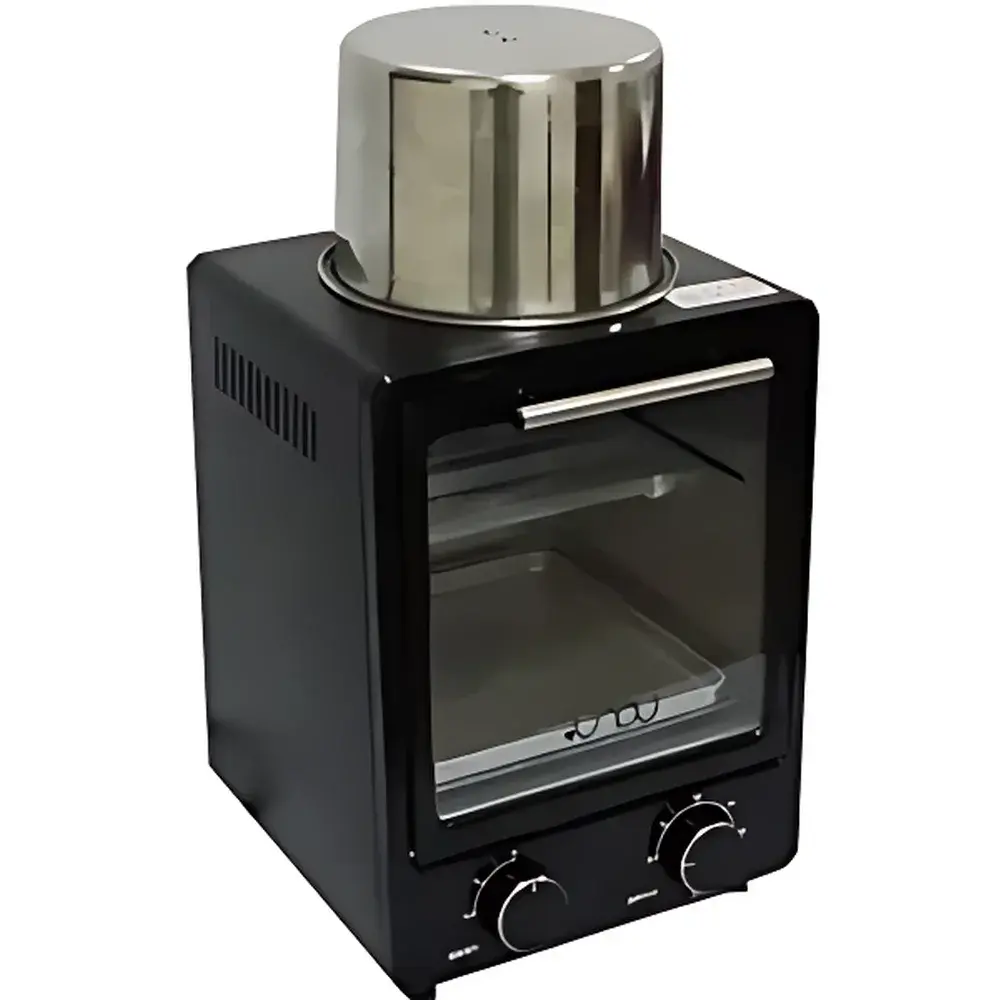
Top Instrument HW-3A Infrared Drying Oven
| Brand | Top Instrument |
|---|---|
| Model | HW-3A |
| Type | Benchtop Infrared Drying Oven |
| Temperature Range | 70–150 °C |
| Temperature Uniformity | ±0.5 °C |
| Internal Chamber Dimensions | 206 mm × 200 mm × 294 mm (L×W×H) |
| External Dimensions | 235 mm × 260 mm × 445 mm (L×W×H) |
| Rated Voltage/Frequency | AC 220 V, 50 Hz |
| Total Rated Power | 600 W (Infrared Heater: 250 W |
| Convection Heater | 350 W) |
| Net Weight | 3.5 kg |
| Gross Weight | 4.0 kg |
| Timer Range | 0–15 min (adjustable in 1-min increments) |
| Heating Modes | Dual-mode (infrared irradiation + resistive convection) |
| Safety Compliance | CE-marked design principles |
| conforms to IEC 61010-1 | 2010 for laboratory electrical equipment |
Overview
The Top Instrument HW-3A Infrared Drying Oven is a compact, benchtop thermal processing system engineered for rapid, controlled moisture removal from small-volume solid samples—particularly hygroscopic analytical standards and spectroscopic substrates such as potassium bromide (KBr) pellets. Unlike conventional convection ovens, the HW-3A integrates dual-mode heating: upper-mounted infrared emitters deliver direct radiant energy to sample surfaces, while a lower resistive heating element ensures uniform ambient temperature distribution within the insulated chamber. This hybrid architecture minimizes thermal lag and accelerates drying kinetics without inducing thermal degradation—critical for maintaining spectral integrity in FTIR sample preparation. Designed for routine use in analytical chemistry labs, quality control environments, and academic research facilities, the HW-3A operates within a precisely regulated 70–150 °C range with ±0.5 °C temperature stability under steady-state conditions, meeting foundational requirements for method reproducibility in ASTM E1421 and ISO 12099-compliant drying protocols.
Key Features
- Dual-heating architecture: Independent infrared (250 W) and convection (350 W) elements enable selective thermal delivery—ideal for surface-sensitive drying of KBr powder prior to pelletization.
- Programmable mechanical timer: 0–15 minute interval setting with audible end-of-cycle alert; supports repeatable exposure durations essential for SOP-driven workflows.
- Front-loading sliding tray mechanism: Integrated drawer-style support automatically extends upon door opening, minimizing operator exposure to elevated surface temperatures and improving ergonomics during sample loading/unloading.
- Two-stage power selection: Toggle switch provides low (infrared-only) and high (combined infrared + convection) output modes—enabling fine-grained thermal control for diverse sample matrices.
- Compact footprint: External dimensions of 235 × 260 × 445 mm allow integration into space-constrained fume hoods or analytical workstations without compromising accessibility.
- Stainless steel interior chamber: Corrosion-resistant 304-grade stainless steel construction ensures long-term dimensional stability and facilitates residue-free cleaning between batches.
Sample Compatibility & Compliance
The HW-3A is validated for drying non-volatile, thermally stable solids including inorganic salts (e.g., KBr, NaCl), metal oxides, and ceramic precursors. It is not intended for volatile organics, polymers, solvents, or flammable materials per IEC 60079-0 hazard classification guidelines. Chamber geometry accommodates standard 30–50 mm diameter mortar-and-pestle assemblies (e.g., agate or玛瑙研钵), enabling direct in-situ drying of ground samples. The unit adheres to fundamental safety provisions outlined in IEC 61010-1:2010 (Safety Requirements for Electrical Equipment for Measurement, Control, and Laboratory Use), including insulation resistance testing, grounding continuity verification, and surface temperature limits (<90 °C at accessible locations during operation). While not certified to GLP/GMP Annex 11 or FDA 21 CFR Part 11, its mechanical timer and fixed-setpoint operation support audit-ready manual log entries when integrated into documented analytical procedures.
Software & Data Management
The HW-3A operates via analog controls only—no embedded firmware, digital interface, or data logging capability. Temperature setpoint and timer duration are adjusted manually using calibrated rotary dials; no software drivers, USB connectivity, or remote monitoring features are included. This design prioritizes operational simplicity, electromagnetic compatibility (EMC) robustness, and long-term reliability in electromagnetically noisy lab environments. All operating parameters—including time, temperature mode, and power level—are recorded manually in laboratory notebooks or electronic lab notebooks (ELNs) as part of standard analytical documentation practices. For users requiring traceable calibration records, optional external temperature validation probes (e.g., NIST-traceable PT100 sensors) may be inserted through the rear vent aperture during periodic performance qualification.
Applications
- FTIR sample preparation: Rapid dehydration of KBr powder to eliminate hydroxyl interference in mid-IR transmittance spectra.
- Reference standard conditioning: Stabilization of hygroscopic calibration materials (e.g., USP Reference Standards) prior to gravimetric analysis.
- Moisture content screening: Preliminary drying step before loss-on-drying (LOD) determination per USP <731> and Ph. Eur. 2.2.32.
- Electrode material pre-treatment: Low-temperature annealing of battery cathode precursors prior to sintering.
- Educational laboratories: Demonstrating thermal kinetics, radiant vs. convective heat transfer, and moisture equilibrium concepts in undergraduate physical chemistry courses.
FAQ
What is the maximum recommended continuous operating time?
The HW-3A is rated for intermittent duty cycles; continuous operation beyond 8 hours is not advised. Allow ≥30 minutes of cooldown between successive 15-minute cycles to maintain thermal stability and component longevity.
Can the oven be used for sterilization or microbial decontamination?
No. The HW-3A lacks validated bioburden reduction capability and does not meet ISO 14644 or EN 554 sterilization process requirements. It is strictly intended for desiccation—not microbial inactivation.
Is the internal chamber volume sufficient for standard KBr pellet dies?
Yes. The 206 × 200 × 294 mm cavity accommodates common 13 mm and 25 mm diameter die sets with clearance for safe handling using insulated tongs.
Does the unit include overtemperature protection?
Yes. A redundant bimetallic thermal cutout (non-resettable at 180 °C) is integrated into the heating circuit to prevent uncontrolled thermal excursion in case of primary thermostat failure.
What maintenance is required for long-term accuracy?
Annual verification of temperature uniformity using a calibrated reference thermometer at three chamber locations (center, top corner, bottom corner) is recommended. No user-serviceable calibration adjustments are provided; deviations >±1.0 °C warrant factory recalibration.



