
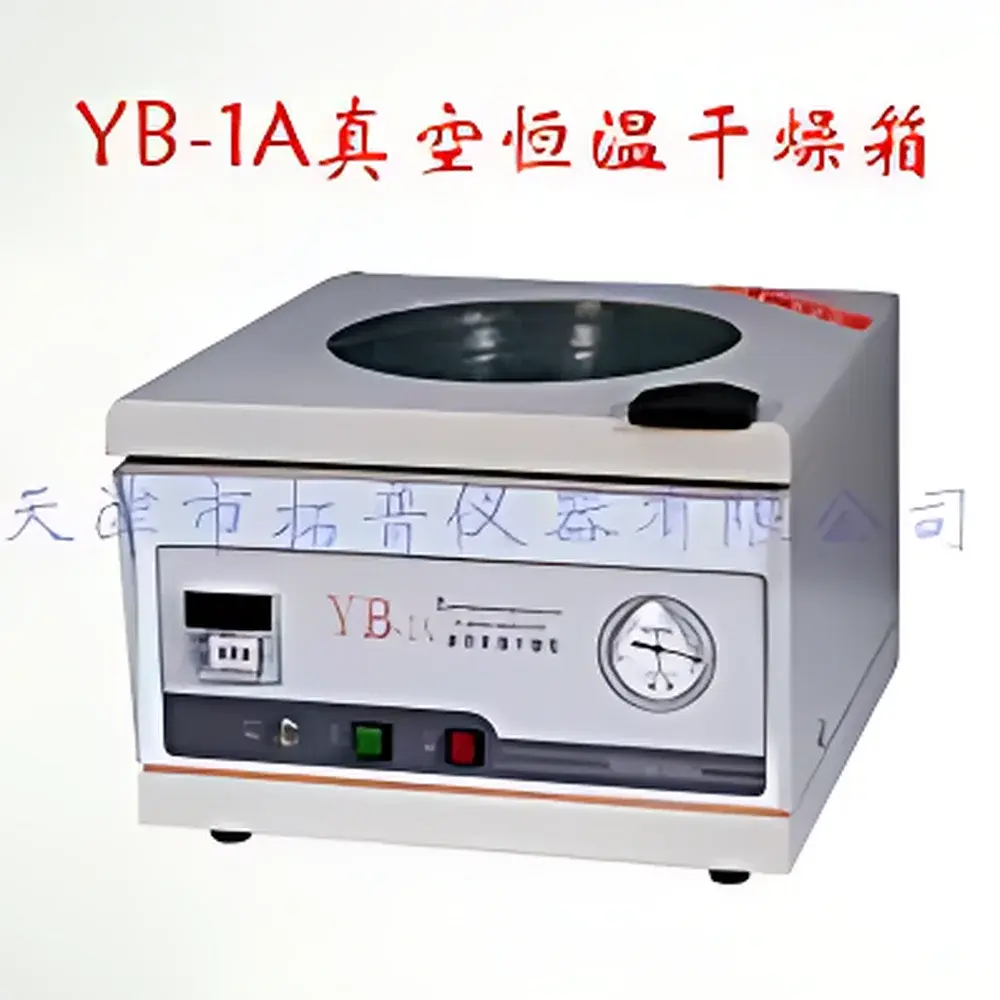
Top Instrument YB-1A Vacuum Drying Oven
| Vacuum Range | 0–0.1 MPa |
|---|---|
| Temperature Range | 30–150 °C (adjustable in 1 °C increments) |
| Temperature Uniformity | ±2 °C across working chamber |
| Input Voltage | AC 220 V ±10%, 50 Hz |
| Power Consumption | 300 W |
| Integrated Vacuum Pump Socket Rating | ≤220 V, 5 A |
| External Dimensions | 350 × 350 × 240 mm (L×W×H) |
| Manufacturer | Top Instrument (Tianjin, China) |
| Origin | China |
| Type | Benchtop Vacuum Drying Oven |
Overview
The Top Instrument YB-1A Vacuum Drying Oven is a benchtop laboratory drying system engineered for precise moisture removal under reduced pressure and controlled thermal conditions. It operates on the principle of vacuum-assisted thermal desorption: by lowering the ambient pressure inside the chamber, the boiling point of volatile components—including water, solvents, and residual moisture—is significantly reduced, enabling gentle, low-temperature drying of thermally sensitive samples without oxidative degradation or structural alteration. This physical mechanism ensures high reproducibility in gravimetric analyses such as Loss on Drying (LOD), a critical parameter defined in pharmacopoeial standards including the Chinese Pharmacopoeia (ChP) 2020 Edition and USP <731>. Designed for routine use in quality control laboratories, R&D facilities, and academic research settings, the YB-1A delivers stable thermal performance within a compact footprint—making it suitable for environments with limited bench space and stringent operational requirements.
Key Features
- Benchtop form factor with integrated vacuum port and rear-mounted power socket rated for standard 220 V, 5 A vacuum pumps—eliminating need for external power distribution units.
- Digital PID temperature controller with 1 °C resolution and ±2 °C accuracy across the full 30–150 °C operating range, ensuring compliance with ISO 17025 calibration traceability protocols when paired with external reference thermometers.
- Stainless steel inner chamber (304 grade) with reinforced silicone door gasket, providing reliable vacuum integrity down to 0.1 MPa (absolute) and resistance to chemical vapors commonly encountered during solvent-based drying procedures.
- Thermal insulation layer composed of high-density ceramic fiber board, minimizing heat loss and improving energy efficiency while maintaining surface temperatures below safety thresholds per IEC 61010-1.
- Front-panel LED display with intuitive key navigation for setpoint entry, real-time chamber temperature readout, and elapsed time tracking—supporting unattended operation for extended drying cycles.
Sample Compatibility & Compliance
The YB-1A accommodates a broad spectrum of sample types, including pharmaceutical active ingredients (APIs), excipients, hygroscopic powders, polymer films, biological tissue sections, and analytical reference standards. Its vacuum and temperature profile aligns with regulatory methodologies specified in ChP General Chapter 0832 (“Loss on Drying”), USP <731>, and EP 2.2.32. When used in GMP-compliant environments, the unit supports documented validation activities—including Installation Qualification (IQ), Operational Qualification (OQ), and Performance Qualification (PQ)—through standardized test protocols for vacuum decay rate, temperature uniformity mapping, and recovery time verification. The absence of forced convection eliminates particle disturbance, preserving sample morphology and preventing cross-contamination between sequential runs.
Software & Data Management
The YB-1A operates as a standalone instrument without proprietary software dependency. All operational parameters are configured and monitored via its embedded microcontroller interface. For laboratories requiring electronic record retention under FDA 21 CFR Part 11 or EU Annex 11, optional RS-485 serial output (available upon request) enables integration with validated data acquisition systems or LIMS platforms. Time-stamped temperature logs can be exported externally using third-party SCADA-compatible hardware, supporting audit-ready documentation for GLP/GMP audits. No internal memory or cloud connectivity is included—ensuring data sovereignty and simplifying cybersecurity validation.
Applications
- Pharmaceutical QC: Determination of residual solvents and moisture content in APIs and finished dosage forms per ICH Q5C guidelines.
- Materials Science: Pre-treatment of electrode materials prior to electrochemical characterization; degassing of ceramic precursors before sintering.
- Food Analysis: Moisture determination in dairy powders, spices, and freeze-dried products following AOAC 950.46 methodology.
- Academic Research: Solvent removal from organometallic complexes, stabilization of air-sensitive catalysts, and preparation of anhydrous reagents for synthetic chemistry.
- Environmental Testing: Conditioning of soil and sediment samples prior to heavy metal extraction per EPA Method 3050B.
FAQ
What vacuum level does the YB-1A achieve, and how is it measured?
The chamber achieves a minimum absolute pressure of 0.1 MPa (equivalent to ~100 mbar), verified using calibrated mechanical vacuum gauges traceable to national metrology institutes.
Can the YB-1A be used for drying samples containing flammable solvents?
Yes—operation under vacuum significantly lowers vapor pressure and flash point; however, users must ensure compatible pump oil selection (e.g., dry scroll or diaphragm pumps) and observe local hazardous area classification requirements.
Is temperature uniformity validated across the chamber volume?
Per ISO 15504-2, uniformity is characterized at three points (center, top corner, bottom corner) during OQ; typical deviation remains within ±1.5 °C at 60 °C and ±2.0 °C at 120 °C.
Does the unit include over-temperature protection?
Yes—a redundant bimetallic safety cutoff activates at 165 °C, independent of the main PID controller, halting heating and triggering audible alarm.
What maintenance is required for long-term reliability?
Routine inspection of door gasket integrity, periodic cleaning of chamber interior with ethanol, and annual verification of temperature sensor drift using NIST-traceable reference thermometers.



