
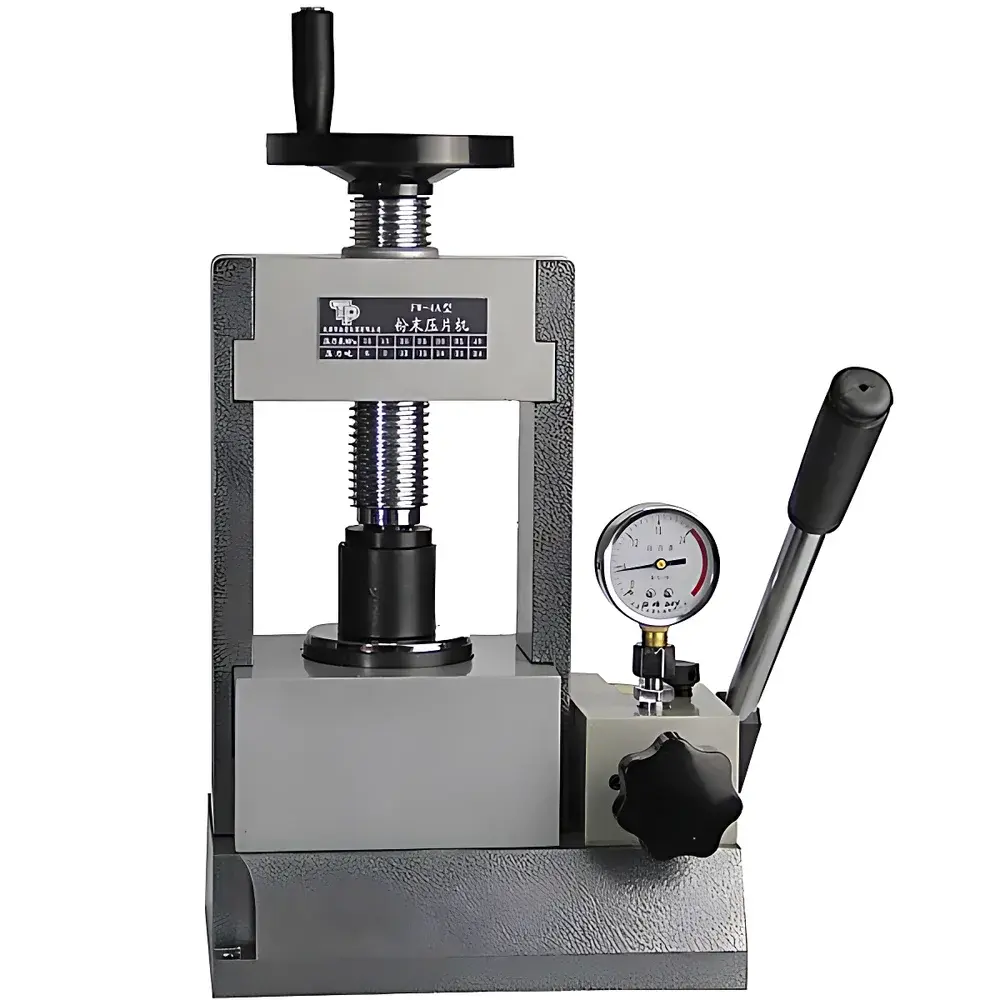
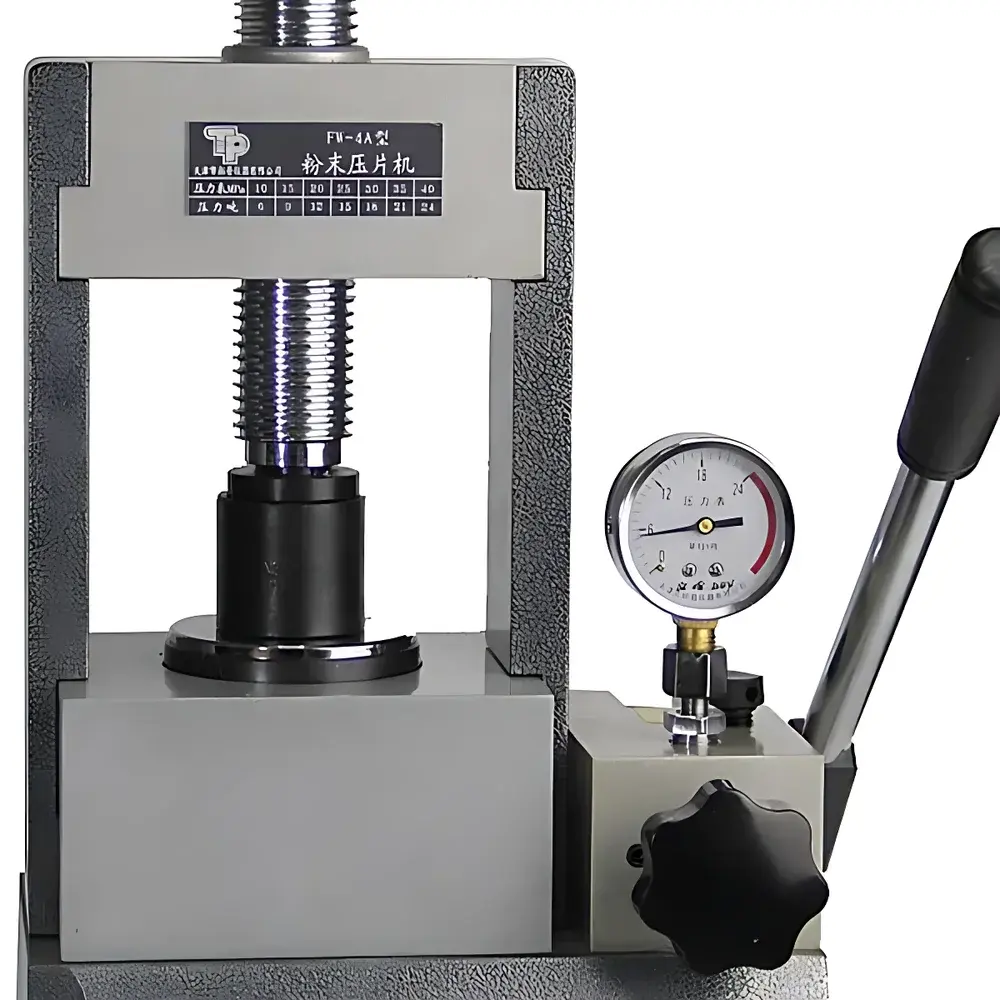
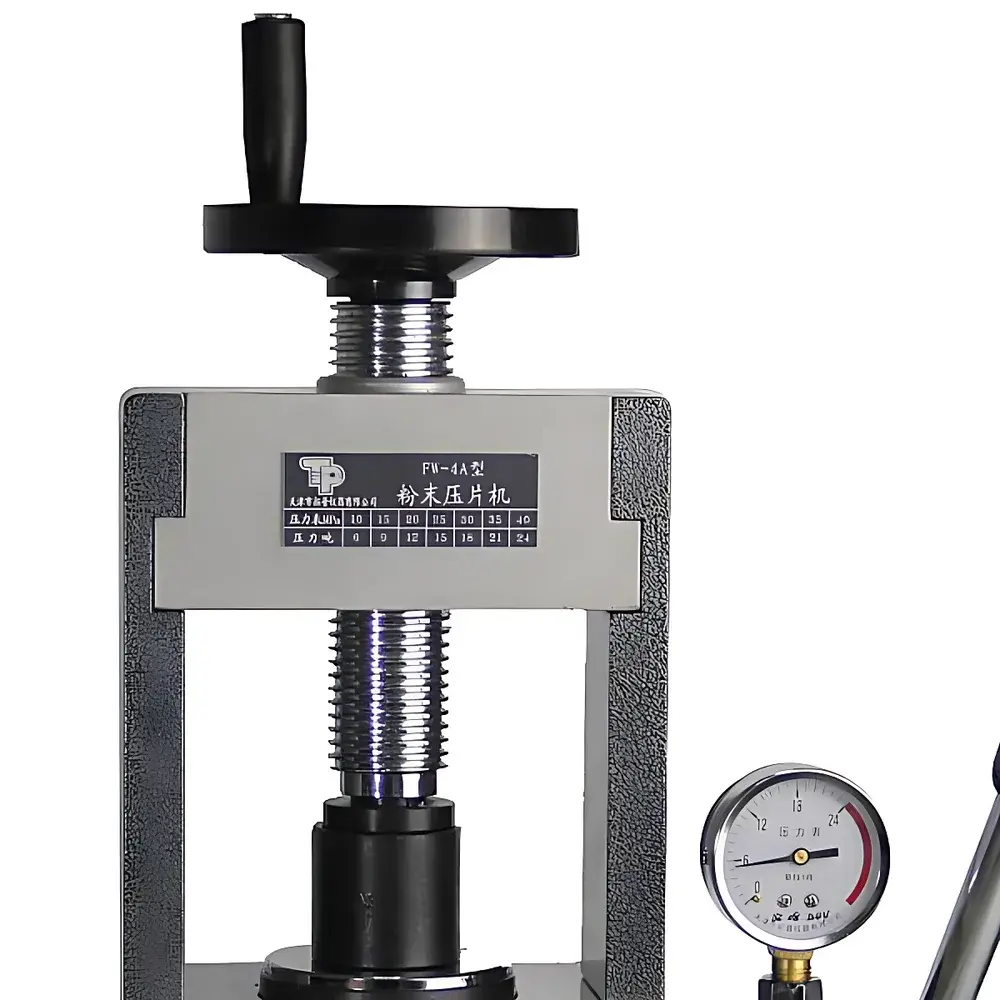
Top Instruments FW-4A Manual Hydraulic Pellet Press
| Brand | Top Instruments (TP) |
|---|---|
| Origin | Tianjin, China |
| Manufacturer Type | Direct Manufacturer |
| Country of Origin | China |
| Model | FW-4A |
| Instrument Type | Manual Hydraulic Pellet Press |
| Pressure Range | 0–24 tons (0–392 MPa equivalent) |
| Piston Cross-sectional Area | 0.6 dm² (60 cm²) |
| Stroke | 20 mm |
| Working Chamber Dimensions | 110 mm × 120 mm |
| Oil Reservoir Capacity | 400 mL |
| Overall Dimensions | 470 mm × 380 mm × 200 mm |
| Net Weight | 49 kg |
Overview
The Top Instruments FW-4A Manual Hydraulic Pellet Press is a precision-engineered laboratory press designed for the reproducible preparation of uniform, binder-free pellets from fine particulate samples—primarily for Fourier Transform Infrared (FTIR) spectroscopy, but also applicable to X-ray fluorescence (XRF), Raman spectroscopy, and other analytical techniques requiring homogeneous solid-state sample presentation. Operating on fundamental hydraulic principles, the FW-4A utilizes a manually actuated two-stage hand pump system to generate controlled, stable pressure via an oil-filled closed-loop cylinder. Its maximum rated force of 24 metric tons (equivalent to ~392 MPa at the piston interface) enables full densification of diverse inorganic salts, pharmaceutical excipients, polymer blends, and geological powders into optically transparent or semi-transparent discs with minimal scattering artifacts. Unlike pneumatic or motorized systems, this manual architecture eliminates electrical dependencies and ensures intrinsic pressure stability during dwell—critical for minimizing inter-pellet variability in quantitative spectral analysis.
Key Features
- Patented side-wall structural reinforcement design minimizes frame flexure under load, enhancing long-term dimensional stability and reducing risk of permanent deformation during repeated high-pressure cycling.
- Integrated automatic piston return mechanism ensures consistent zero-position retraction after each compression cycle—eliminating manual reset steps and improving throughput in routine QC workflows.
- Visual overpressure warning line engraved directly onto the main cylinder housing provides immediate, unambiguous indication when piston travel approaches its mechanical limit (20 mm stroke), preventing accidental component damage.
- Sealed hydraulic circuit with dual O-ring piston seals and calibrated relief valve maintains pressure integrity for ≥5 minutes at rated load—demonstrating negligible pressure decay (<0.5% per minute), essential for time-sensitive pellet consolidation.
- Corrosion-resistant steel construction and nickel-plated hydraulic components ensure compatibility with common solvent-cleaned dies and resistance to ambient lab humidity and incidental chemical exposure.
Sample Compatibility & Compliance
The FW-4A accommodates standard die sets including HF-2 and HF-2B (13 mm and 25 mm diameter, respectively), enabling preparation of pellets compliant with ASTM E1252-98 (Standard Practice for General Techniques for Infrared Spectroscopy) and ISO 18381:2015 (Plastics — Determination of carbonyl index by FTIR). It supports dry powder compaction without binders—ideal for KBr, CsI, and polyethylene matrix applications—and is routinely validated in GLP-regulated environments for raw material identification and polymorph screening. While not intrinsically certified to FDA 21 CFR Part 11, its mechanical simplicity and absence of electronic data logging render it suitable for use within Part 11-compliant workflows when paired with auditable manual logbooks and SOP-controlled operation.
Software & Data Management
As a fully manual, non-electronic instrument, the FW-4A does not incorporate embedded software, firmware, or digital interfaces. All operational parameters—including applied pressure (indirectly inferred via pump stroke count and calibrated gauge correlation), dwell time, and die configuration—are recorded manually per laboratory SOPs. This analog architecture eliminates cybersecurity vulnerabilities, firmware obsolescence risks, and validation overhead associated with regulated digital instrumentation—making it particularly suited for legacy lab infrastructure and audit-ready environments where traceability is maintained through paper-based or LIMS-integrated procedural documentation.
Applications
- Preparation of transmission-mode FTIR pellets for qualitative and semi-quantitative analysis of organic functional groups, crystallinity assessment, and contaminant detection in APIs and excipients.
- Routine QC pellet formation for XRF calibration standards in metallurgical and environmental laboratories.
- Consolidation of ceramic oxide powders for subsequent sintering studies and density measurement (Archimedes principle).
- Compression testing of brittle pharmaceutical granules under controlled static load to assess compactibility profiles.
- Supporting research in materials science for cold isostatic pressing (CIP) pre-forming prior to hot pressing or spark plasma sintering (SPS).
FAQ
What hydraulic oil is recommended for the FW-4A?
ISO VG 46 anti-wear hydraulic oil (e.g., Shell Tellus S2 MX 46 or equivalent) is specified. Oil must be particle-free, water-free, and compatible with nitrile rubber seals.
How often should the small piston linkage be lubricated?
Apply one drop of light machine oil (e.g., ISO VG 10) to the small piston rod and guide bushing every 50 operating cycles or biweekly—whichever occurs first.
Is the FW-4A compatible with dies from other manufacturers?
Yes—provided the die outer diameter and height conform to standard T-slot dimensions (e.g., 110 mm × 120 mm chamber clearance); however, Top Instruments recommends HF-2/HF-2B dies for optimal alignment and pressure uniformity.
What is the maximum safe operating pressure?
Do not exceed 24 tons (392 MPa at piston interface). The engraved red line on the cylinder indicates the absolute stroke limit; exceeding it may cause irreversible seal extrusion or cylinder wall yielding.
How should the unit be anchored for routine use?
Mount using four M10 bolts through the pre-drilled base holes onto a rigid, vibration-damped surface with minimum compressive strength of 25 MPa (e.g., reinforced concrete or 50 mm thick steel benchtop).



