
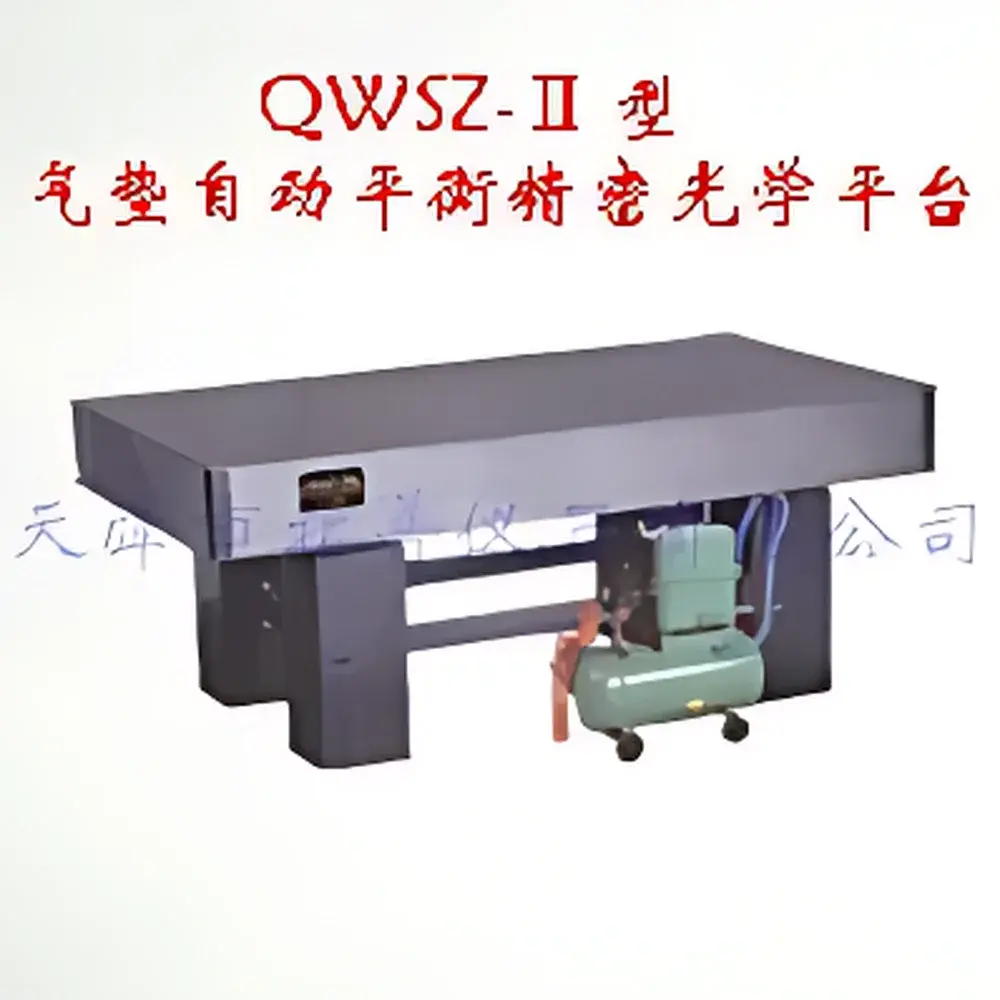
Top Optical QWSZ-II Pneumatic Auto-Leveling Precision Optical Table
| Brand | Top Optical |
|---|---|
| Model | QWSZ-II |
| Origin | Tianjin, China |
| Manufacturer Type | Direct Manufacturer |
| Country of Origin | China |
| Platform Dimensions (L×W×H) | 1200×800×800 mm, 1500×1000×800 mm, 1800×1000×800 mm, 1800×1200×800 mm, 2000×1200×800 mm, 2400×1200×800 mm |
| Surface Roughness | ≤0.8 µm |
| Flatness | ≤0.02 mm/m² |
| Natural Frequency | ≤3 Hz |
| Maximum Vibration Amplitude | ≤3 µm |
| Top Plate Material | High-permeability stainless steel |
| Mounting Grid | M6 threaded inserts at 50×50 mm or 25×25 mm pitch |
| Core Structure | Honeycomb polymer damping layer |
| Side Walls | Medium-carbon structural steel |
| Leveling Mechanism | High-wear-resistance precision adjustable supports |
Overview
The Top Optical QWSZ-II Pneumatic Auto-Leveling Precision Optical Table is an engineered passive vibration isolation platform designed for high-stability optical alignment, interferometry, laser cavity construction, and nanoscale metrology applications. It operates on the principle of pneumatic levitation combined with mechanical auto-leveling feedback—using integrated pressure-regulated air cushions beneath a rigid top plate to decouple the working surface from floor-borne vibrations across a broad low-frequency spectrum (0.5–10 Hz). Unlike static optical tables relying solely on mass and damping, the QWSZ-II dynamically maintains horizontal equilibrium through real-time pneumatic compensation, enabling sub-microradian angular stability over extended operational periods. Its structural architecture integrates a high-permeability stainless steel top plate bonded to a lightweight yet stiff honeycomb polymer core, enclosed by medium-carbon steel side walls—a configuration optimized for high modal stiffness, minimal thermal drift, and long-term geometric integrity under sustained load.
Key Features
- Pneumatic auto-leveling system with pressure-sensing feedback loop ensures continuous horizontal stabilization within ±1 arcsecond, independent of asymmetric payload distribution or ambient temperature gradients.
- Top plate fabricated from high-permeability austenitic stainless steel (AISI 304 equivalent), offering exceptional dimensional stability, non-magnetic properties for sensitive magnetic field experiments, and surface roughness ≤0.8 µm (Ra) after precision lapping.
- Flatness specification of ≤0.02 mm per square meter meets ISO 10360-2 Class 1 tolerances for coordinate measuring machine (CMM) reference surfaces and supports alignment-critical setups such as Michelson interferometers and ultrafast amplifier chains.
- Honeycomb polymer core provides broadband passive damping with natural frequency ≤3 Hz—effectively attenuating ground-borne vibrations from HVAC systems, footfall, and building resonance in typical laboratory environments.
- M6 threaded inserts arranged in dual-grid configurations (50×50 mm and 25×25 mm pitch) enable flexible component mounting while maintaining mechanical continuity across the entire surface; all inserts are torque-secured and epoxy-anchored to prevent loosening under dynamic loading.
- Adjustable leveling feet with hardened steel contact surfaces and fine-pitch micrometer threads deliver ±5 mm vertical travel range and repeatability better than ±2 µm per full rotation—critical for multi-stage optical train integration requiring Z-axis synchronization.
Sample Compatibility & Compliance
The QWSZ-II accommodates standard optical components including kinematic mounts, translation stages, lens holders, beam splitters, and fiber launch systems. Its non-magnetic top plate ensures compatibility with magneto-optical traps (MOTs), atomic interferometers, and electron microscopy sample stages requiring zero magnetic interference. The platform conforms to general requirements outlined in ISO 7243 (ergonomic design of laboratory equipment), ISO 140-6 (vibration isolation testing methods), and ASTM E177 (standard practice for use of the terms precision and bias in ASTM test methods). While not certified to specific FDA or GLP standards (as it is a mechanical support device, not a diagnostic or analytical instrument), its construction materials and dimensional traceability support audit-ready documentation in GxP-compliant laboratories when integrated into validated optical measurement workflows.
Software & Data Management
The QWSZ-II is a fully passive mechanical platform and does not incorporate embedded electronics, firmware, or software interfaces. No drivers, calibration files, or proprietary data formats are required. All leveling adjustments are manual via calibrated knurled knobs; no external power supply or network connectivity is needed. This architecture eliminates electromagnetic interference (EMI) risks and ensures long-term reliability without obsolescence concerns associated with firmware-dependent hardware. For labs implementing digital lab infrastructure (e.g., LabVantage, Thermo Fisher SampleManager), the QWSZ-II may be registered as a static asset with assigned serial number, installation date, and periodic flatness verification records—supporting ISO/IEC 17025 clause 6.4.10 on equipment management and maintenance history tracking.
Applications
- Laser-based metrology systems requiring sub-micron positional stability over >8-hour acquisition windows.
- Quantum optics experiments involving entangled photon sources, single-photon detectors, and polarization-sensitive interferometers.
- High-resolution spectroscopy benches where grating alignment drift directly impacts spectral resolution and wavelength accuracy.
- Optical coherence tomography (OCT) development platforms demanding consistent path-length matching between reference and sample arms.
- Calibration laboratories performing ISO 10110-compliant surface form measurements using phase-shifting interferometers (PSI).
- Educational advanced physics labs supporting undergraduate and graduate coursework in wave optics, holography, and adaptive optics.
FAQ
Does the QWSZ-II require compressed air or external power to operate?
No—it uses self-contained, sealed pneumatic chambers with pre-charged nitrogen gas; no external air supply or electrical connection is needed.
What is the maximum recommended static load capacity per square meter?
The platform supports up to 250 kg/m² uniformly distributed load without compromising flatness or natural frequency performance.
Can the leveling system compensate for floor slope exceeding 2 degrees?
Yes—the integrated auto-leveling range accommodates inclination angles up to ±3.5°, verified via integrated bubble level indicators and digital inclinometer validation points.
Is surface recalibration required after relocation?
Flatness verification using a grade-0 granite straightedge and optical autocollimator is recommended after transport; however, the honeycomb core’s creep resistance ensures <0.005 mm/m² drift over 5 years under stable environmental conditions.
Are custom grid patterns or non-standard dimensions available?
Yes—Top Optical offers OEM engineering services for bespoke length/width combinations, alternative mounting thread specifications (e.g., M4 or 1/4″-20), and optional integrated cable management channels upon request.






