
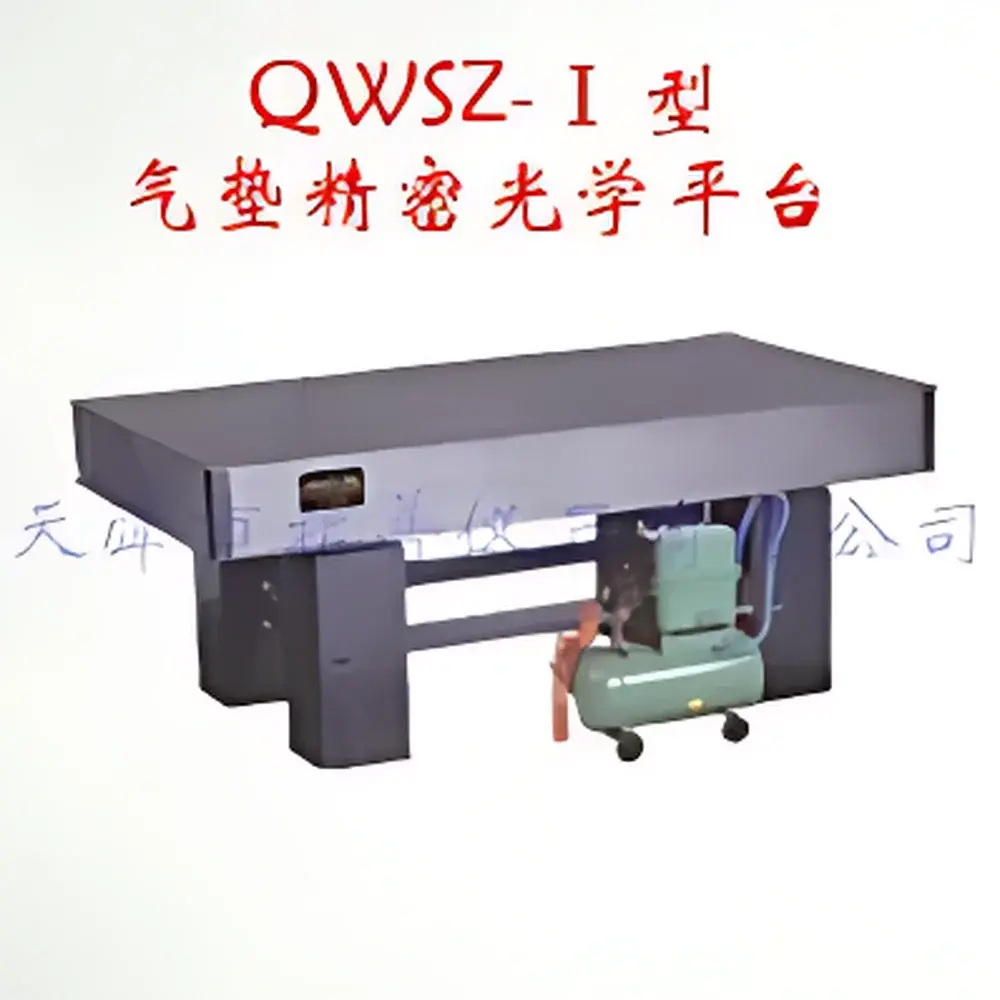
Top Optical QWSZ-I Precision Air-Bearing Optical Table
| Brand | Top Optical |
|---|---|
| Model | QWSZ-I |
| Origin | Tianjin, China |
| Manufacturer | Top Optical Co., Ltd. |
| Construction Type | Domestic Production |
| Dimensions (L×W×H) | 1200×800×800 mm, 1500×1000×800 mm, 1800×1000×800 mm, 1800×1200×800 mm, 2000×1200×800 mm, 2400×1200×800 mm |
| Surface Roughness | ≤ 0.8 µm |
| Flatness | ≤ 0.02 mm/m² |
| Natural Frequency | ≤ 3 Hz |
| Maximum Vibration Amplitude | ≤ 3 µm |
| Top Plate Material | High-permeability stainless steel |
| Mounting Pattern | M6 threaded inserts, spaced at 50×50 mm or 25×25 mm grid |
| Core Structure | Honeycomb polymer damping layer |
| Side Walls | Medium-carbon structural steel |
| Adjustable Supports | Wear-resistant precision leveling feet |
Overview
The Top Optical QWSZ-I Precision Air-Bearing Optical Table is an engineered vibration isolation platform designed for high-stability optical experiments requiring sub-micron positional stability and low-frequency mechanical decoupling. It operates on the principle of pneumatic levitation—using a regulated, laminar airflow film between the table’s base and its support frame to eliminate solid–solid contact transmission paths. This air-bearing interface achieves dynamic stiffness reduction while maintaining static load capacity, enabling effective attenuation of ground-borne vibrations below 5 Hz—critical for interferometry, holography, laser cavity alignment, and quantum optics setups where thermal drift and mechanical resonance compromise measurement fidelity.
Key Features
- Air-bearing isolation system: Delivers broadband passive vibration suppression with natural frequency ≤ 3 Hz, verified per ISO 20483-2:2021 methodology for laboratory floor vibration mitigation.
- High-flatness stainless steel top plate: Electropolished 430F magnetic stainless steel surface with ≤ 0.02 mm/m² flatness and ≤ 0.8 µm Ra roughness—optimized for direct mounting of kinematic mounts, translation stages, and fiber collimators without additional shimming.
- Modular M6 insert grid: Standardized 50×50 mm or optional 25×25 mm pitch threaded inserts ensure compatibility with Thorlabs, Newport, and Standa accessories; inserts are cold-welded into the plate to prevent torque-induced loosening.
- Honeycomb polymer core: Closed-cell polyurethane-based damping layer with isotropic viscoelastic response provides consistent loss factor (tan δ ≥ 0.15) across temperature range −10 °C to +40 °C, minimizing resonant amplification in vertical and lateral modes.
- Structural side walls: Hot-rolled medium-carbon steel (AISI 1045 equivalent) frames provide torsional rigidity > 2.1 × 10⁶ N·m/rad, validated via modal FEA up to 200 Hz.
- Precision leveling system: Four-point adjustable supports with hardened steel thrust washers and micrometer-scale vernier scales enable repeatable height adjustment within ±1 µm per full turn, supporting GLP-compliant setup documentation.
Sample Compatibility & Compliance
The QWSZ-I accommodates optical components ranging from compact diode lasers (< 0.5 kg) to multi-axis optomechanical assemblies exceeding 150 kg (distributed loading). Its surface geometry complies with ISO 10360-2 requirements for coordinate measuring machine (CMM) reference tables used in metrology labs. The stainless steel top meets ASTM A240/A240M specifications for corrosion resistance in controlled-humidity environments. All structural welds conform to AWS D1.1 standards; pneumatic supply interface follows ISO 8573-1 Class 4 purity requirements (oil-free, ≤ 5 µm particulates). No hazardous substances are used in core materials—RoHS 2011/65/EU and REACH SVHC declarations available upon request.
Software & Data Management
While the QWSZ-I is a passive mechanical platform and does not incorporate embedded electronics or firmware, it integrates seamlessly into digitally documented workflows. Its dimensional repeatability supports traceable calibration protocols aligned with ISO/IEC 17025:2017 Annex A.3. Each unit ships with a certified flatness map (generated via laser tracker measurement, Leica AT960-MR), archived in ASCII .xyz format for import into Zemax OpticStudio or MATLAB for spatial error modeling. Optional add-ons include USB-powered MEMS accelerometers (e.g., PCB Piezotronics model 393B04) for real-time vibration spectral logging—data exportable as CSV compliant with ASTM E1776-22 guidelines for environmental noise characterization.
Applications
- Laser interferometric gravitational-wave observatory (LIGO)-style beam path stabilization
- Atomic force microscopy (AFM) and scanning tunneling microscopy (STM) base isolation
- Optical coherence tomography (OCT) source and detector alignment rigs
- Ultrafast pump–probe spectroscopy platforms requiring < 10 fs timing jitter control
- Quantum key distribution (QKD) free-space optical terminals
- Calibration laboratories performing ISO 10110-7 surface form verification
FAQ
What compressed air specifications are required for stable air-bearing operation?
Minimum supply pressure: 0.45 MPa (65 psi); flow rate: 12 L/min at 0.5 MPa; dew point ≤ 10 °C; filtration to ISO 8573-1 Class 4.
Can the table be anchored to a concrete floor without compromising isolation performance?
Yes—integrated seismic anchors (optional) maintain decoupling integrity when installed per IBC 2021 Section 1613.2; anchor stiffness must remain < 5 kN/mm to preserve ≤ 3 Hz natural frequency.
Is flatness certification included with delivery?
Yes—a NIST-traceable flatness report (per ISO 10360-2 Annex B) is provided digitally and as a hardcopy with each unit.
What is the maximum allowable payload for the 2400×1200×800 mm configuration?
Uniformly distributed load limit: 320 kg; point load limit (center-mounted): 85 kg with deflection < 1.2 µm (calculated per Euler–Bernoulli beam theory with honeycomb core modulus = 140 MPa).
Does the platform meet FDA 21 CFR Part 11 requirements for electronic records?
The QWSZ-I itself is not a computerized system; however, its calibration data files and usage logs generated via third-party sensors may be configured for Part 11 compliance using validated LIMS software (e.g., LabWare LIMS v11.4).






