
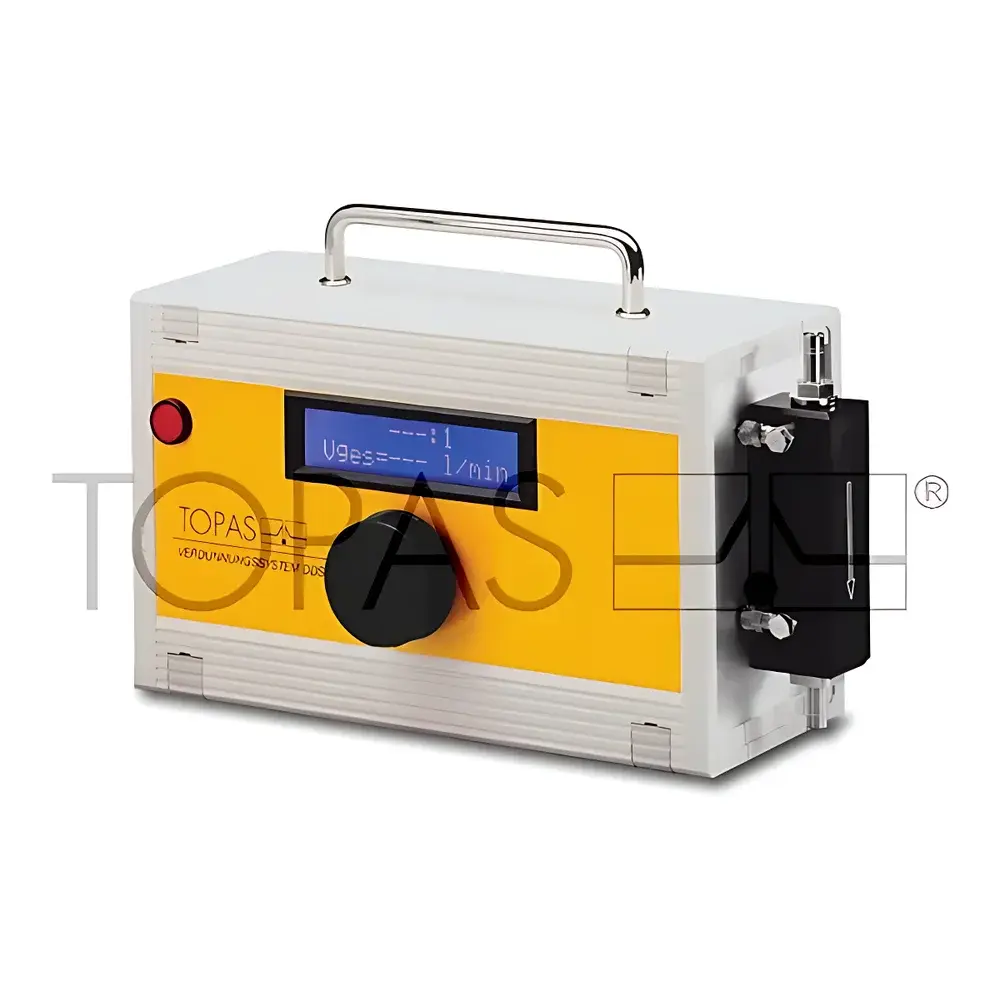
TOPAS DDS-560 Dynamic Aerosol Dilution System
| Brand | TOPAS |
|---|---|
| Origin | Germany |
| Model | DDS-560 |
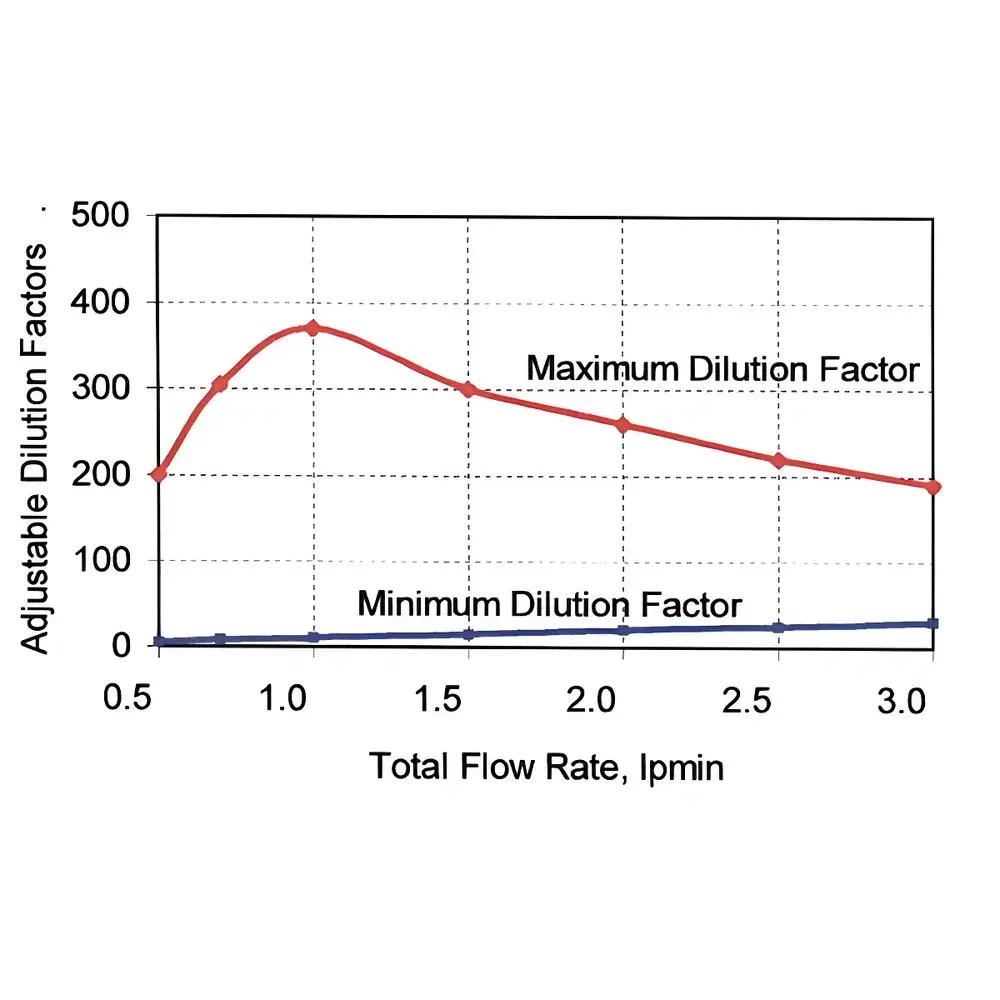
| Dilution Factor Range | 5–370 (flow-dependent) |
| Adjustable Sample Flow Rate | 0.5–3.0 L/min |
| Dilution Principle | Capillary Bypass with HEPA-Filtered Bypass Stream |
| Display | Real-time Flow & Dilution Ratio |
| Power Supply | 12 V DC, 300 mA |
| Dimensions (W×H×D) | 300 × 200 × 140 mm |
| Weight | 2.9 kg |
| Max Backpressure | ±35 kPa |
| Capillary Material | Brass |
| Inlet/Outlet Fitting | Ø8 mm |
| Compliance | VDI 3491-15, VDI 2083 |
Overview
The TOPAS DDS-560 Dynamic Aerosol Dilution System is an engineered precision instrument designed for controlled, real-time dilution of polydisperse aerosols without altering particle size distribution or gas-phase properties. It operates on a well-established capillary bypass principle compliant with VDI 3491-15, wherein the total aerosol flow is split into two parallel streams: a major bypass stream routed through a certified HEPA filter (removing all particles), and a minor capillary stream that remains undiluted. These streams recombine downstream, yielding a homogeneous diluted aerosol whose concentration is inversely proportional to the ratio of capillary flow to total flow. This physical dilution method ensures metrological traceability, eliminates electrostatic or diffusion-related artifacts common in jet-based or sonic dilutors, and preserves humidity, temperature, and volatile composition—critical for calibration integrity in cleanroom validation (VDI 2083), filter testing, and aerosol instrument intercomparison studies.
Key Features
- Continuous, stepless dilution factor adjustment from 5 to 370—calibrated and verified across the full operational flow range (0.5–3.0 L/min)
- Simultaneous digital display of actual sample volumetric flow rate and applied dilution ratio, enabling immediate verification of system performance
- Self-contained closed-loop architecture: no external air intake or exhaust required; eliminates contamination risk and ambient interference
- Stable preservation of aerosol thermodynamic state—relative humidity, temperature, and vapor-phase constituents remain unaltered post-dilution
- Robust mechanical design featuring brass capillaries for long-term dimensional stability and resistance to particle deposition
- Low-pressure-drop configuration with maximum allowable backpressure of ±35 kPa, compatible with upstream aerosol generators and downstream analyzers including optical particle counters (OPCs), condensation particle counters (CPCs), and aerosol spectrometers (e.g., LAP-322)
Sample Compatibility & Compliance
The DDS-560 is validated for use with solid and liquid aerosols generated by standardized sources—including palas®, TSI, and RBG-type generators—as well as combustion-derived and bioaerosol test materials. Its dilution fidelity has been confirmed for particles ranging from sub-20 nm to >10 µm, with no measurable shift in measured size distribution (verified via differential mobility analysis and time-of-flight measurement). The system meets the technical requirements of VDI 2083 Part 10 (cleanroom monitoring), VDI 3491-15 (aerosol dilution methodology), and ISO 14644-3 Annex B (filter testing protocols). It supports GLP-compliant workflows when integrated with audit-trail-capable data acquisition software and is suitable for ISO/IEC 17025-accredited laboratories performing filter efficiency validation per EN 1822 or IEST-RP-CC001.
Software & Data Management
While the DDS-560 operates as a stand-alone analog device with local LCD readout, it is fully interoperable with third-party data acquisition systems via analog voltage outputs (0–10 V) corresponding to flow and dilution setpoints. When paired with TOPAS’s optional DAQ interface module or industry-standard SCADA platforms (e.g., LabVIEW, MATLAB, or Python-based control scripts), users can log timestamped flow/dilution records, synchronize with particle counter triggers, and generate automated calibration reports compliant with FDA 21 CFR Part 11 requirements—including electronic signatures, user access controls, and immutable audit trails. All firmware updates and calibration certificates are distributed exclusively through authorized TOPAS service channels and include NIST-traceable documentation.
Applications
- Calibration and dynamic range extension of optical particle counters (OPCs) and laser aerosol spectrometers during high-concentration measurements (e.g., upstream of HEPA/ULPA filters)
- Validation of aerosol generation stability and output consistency for palas® MFP, TSI 3475, or RBG 1000 generators under ISO 21501-4 and ISO 14644-3 conditions
- Filter penetration testing per EN 1822-3 and ISO 16890, where precise upstream challenge concentrations must be maintained across multiple test cycles
- Real-time monitoring of cleanroom supply air ducts and laminar flow hoods per VDI 2083-10, supporting both acceptance testing and routine surveillance
- Reference-grade dilution in inter-laboratory comparison exercises organized under EU Joint Research Centre (JRC) or PT schemes accredited to ISO/IEC 17043
FAQ
Does the DDS-560 alter particle size distribution during dilution?
No. The capillary bypass method physically separates particle-free and particle-laden flows without turbulent mixing or inertial impaction, preserving the original size distribution with <±1% deviation across the 5–370 dilution range.
Can the DDS-560 be used with corrosive or hygroscopic aerosols?
Yes—provided the aerosol is compatible with brass wetted parts and does not exceed the specified backpressure limit. For aggressive chemical aerosols (e.g., HCl, NH₃), optional stainless-steel capillary kits are available upon request.
Is external power conditioning required?
No. The unit accepts stable 12 V DC input via included switching adapter (CE/UKCA marked); no uninterruptible power supply is necessary for standard operation.
How often does the HEPA bypass filter require replacement?
Under typical cleanroom validation use (≤8 hrs/day, ISO Class 5 environments), the certified HEPA filter maintains >99.995% retention at 0.3 µm for ≥12 months; replacement intervals are logged automatically when integrated with TOPAS ServiceLink software.
Is the DDS-560 suitable for field-deployable applications?
Yes—the compact footprint (300 × 200 × 140 mm), low mass (2.9 kg), and DC power requirement make it ideal for mobile labs and on-site cleanroom commissioning, provided ambient temperature remains within 15–30 °C and relative humidity ≤80% non-condensing.
Related Products







