

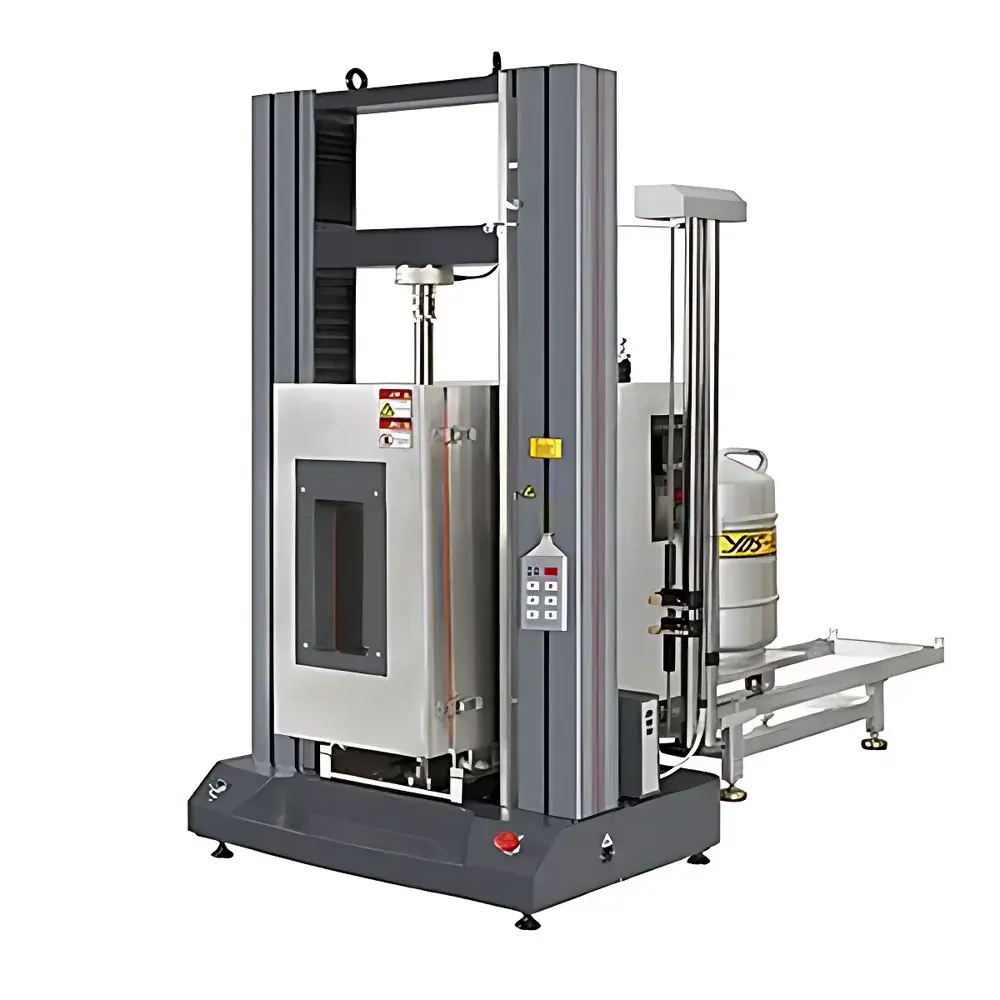
Topfeng TFW-319 Intelligent High-Low Temperature Universal Testing Machine
| Brand | Topfeng |
|---|---|
| Origin | Shanghai, China |
| Manufacturer Type | Direct Manufacturer |
| Model | TFW-319 |
| Price Range | USD 1,400 – 28,500 |
| Instrument Type | Electromechanical Universal Testing Machine |
| Load Capacity | 0.02 N to 300 kN |
| Load Accuracy | ±0.5% FS |
| Force Measurement Range | 0.4–100% of Full Scale |
| Force Resolution | 1/500,000 of Maximum Load |
| Deformation Measurement Range | 0.2–100% FS |
| Deformation Accuracy | ±0.5% of Reading |
| Displacement Accuracy | ±0.5% of Reading |
| Column Spacing | 840 mm |
| Test Space (Vertical) | Up to 1000 mm |
| Host Dimensions | 1250 × 560 × 2400 mm |
| Power Supply | AC 220 V / 50 Hz ±10%, 750 W |
| Weight | ~380 kg |
| Environmental Operating Range | +5 °C to +35 °C |
| Temperature Chamber Range | −40 °C to +100 °C |
| Chamber Internal Dimensions | 360 × 300 × 500 mm (W×D×H) |
| Heating Power | 1.5 kW |
| Cooling Method | Compressor-based refrigeration |
| Temperature Uniformity | ±2 °C over 100 mm axial zone |
| Ramp Rate | ≤30 min to reach +100 °C from ambient |
| Thermal Equilibration Time | ≤5 min (both above and below 0 °C) |
| Chamber Construction | 304 Stainless Steel Exterior / 316 Mirror-Finish Stainless Steel Interior |
| Insulation | Alumina-silica fiber |
| Temperature Sensor | PT100 Platinum Resistance Thermometer |
| Viewing Window | Double-sealed thermal glass |
| Safety Systems | Leakage current protection, overcurrent circuit breaker |
Overview
The Topfeng TFW-319 Intelligent High-Low Temperature Universal Testing Machine is an electromechanical materials testing system engineered for precision mechanical characterization across extreme thermal environments. It integrates a high-stiffness dual-column load frame with a programmable environmental chamber capable of stable operation from −40 °C to +100 °C, enabling standardized uniaxial tensile, compression, flexural, peel, tear, and shear testing under controlled thermal conditions. The system operates on the principle of closed-loop servo-controlled displacement and force actuation, with real-time feedback from high-resolution load cells and extensometers. Its architecture conforms to the fundamental metrological requirements of ISO 7500-1 (Class 0.5 accuracy), ASTM E4, ASTM E8/E8M, ISO 6892-1, and GB/T 228.1—ensuring traceable, repeatable, and inter-laboratory comparable results in both R&D and QA/QC settings.
Key Features
- High-accuracy load measurement system with ±0.5% full-scale error tolerance and 1/500,000 internal resolution, maintaining consistent sensitivity across the entire 0.02 N–300 kN range without range switching.
- Integrated programmable temperature chamber featuring compressor-assisted cooling and NiCr alloy heating elements, delivering rapid thermal ramping (≤30 min to +100 °C) and tight axial uniformity (±2 °C over 100 mm).
- Rigid dual-column frame with 840 mm clear width and 1000 mm vertical test space—optimized for compatibility with standard high- and low-temperature fixtures and environmental chamber configurations.
- Real-time digital control via Windows-based software with full audit trail capability, supporting 21 CFR Part 11-compliant user authentication, electronic signatures, and data integrity logging.
- Modular extensometry support including clip-on, non-contact video, and laser-based options—enabling compliant strain measurement per ISO 527-1, ASTM D638, and ISO 178.
- Comprehensive safety subsystems: leakage current protection, thermal overload cutoff, emergency stop with hardware interlock, and chamber door position monitoring.
Sample Compatibility & Compliance
The TFW-319 accommodates a broad spectrum of specimen geometries and material classes—including metallic alloys, thermoplastics, elastomers, composites, ceramics, adhesives, thin films, and textile laminates—within standardized grips, wedge-action clamps, and custom fixture interfaces. Specimen mounting is facilitated by dual-port access (50 mm diameter openings top and bottom) with retractable thermal shielding to minimize heat transfer during elevated-temperature tests. All operational parameters—including force, displacement, temperature, and time—are recorded with timestamped metadata, satisfying GLP and GMP documentation requirements. The system supports method validation protocols aligned with ISO/IEC 17025 and is routinely deployed in laboratories undergoing FDA pre-submission audits, CNAS accreditation, and EU Notified Body assessments.
Software & Data Management
The embedded control and analysis suite runs natively on Windows OS and provides automated calculation of mechanical properties—including ultimate tensile strength, yield point (offset or proportional), modulus of elasticity, elongation at break, compressive yield stress, flexural modulus, peel resistance, and tear propagation energy. Raw data streams are saved in vendor-neutral CSV and XML formats, while report generation complies with ISO 14289-1 (PDF/A-2u) archival standards. Multi-user role management allows configurable access levels (operator, supervisor, administrator), with all critical actions logged in an immutable audit trail. Optional integration with LIMS platforms is supported via OPC UA and RESTful API endpoints, enabling seamless data ingestion into enterprise quality management systems (QMS).
Applications
- Thermal-mechanical evaluation of aerospace aluminum-lithium alloys at cryogenic service temperatures (−40 °C).
- Creep and stress-relaxation profiling of polyetheretherketone (PEEK) components under sustained 100 °C exposure.
- Adhesion strength quantification of pressure-sensitive tapes per ASTM D3330 across −20 °C to +60 °C.
- Compression testing of ceramic matrix composites (CMCs) in simulated turbine inlet conditions.
- Quality conformance verification of medical-grade silicone tubing per ISO 527-3 and USP <1031>.
- Failure mode analysis of battery separator membranes under thermal abuse scenarios.
FAQ
What international standards does the TFW-319 comply with for force calibration?
The system meets ISO 7500-1 Class 0.5 requirements and is supplied with factory calibration certificates traceable to NIM (China National Institute of Metrology) or optional UKAS-accredited calibration.
Can the temperature chamber be operated independently of mechanical testing?
Yes—the environmental chamber functions as a standalone thermal conditioning unit with programmable soak profiles, ramp rates, and dwell cycles.
Is third-party software integration supported?
Yes—via open communication protocols including Modbus TCP, Ethernet/IP, and HTTP-based APIs for integration with MES, SCADA, and laboratory information systems.
What is the maximum specimen thickness compatible with the chamber’s dual-port configuration?
Specimens up to 45 mm thick can be accommodated using standard high-temperature grips while maintaining full thermal isolation and optical access through the viewing window.
Does the system support multi-step cyclic testing under variable temperature conditions?
Yes—custom test sequences can embed synchronized thermal ramps, dwell periods, and mechanical loading profiles within a single method file, with full parameter logging at ≥100 Hz sampling rate.



