
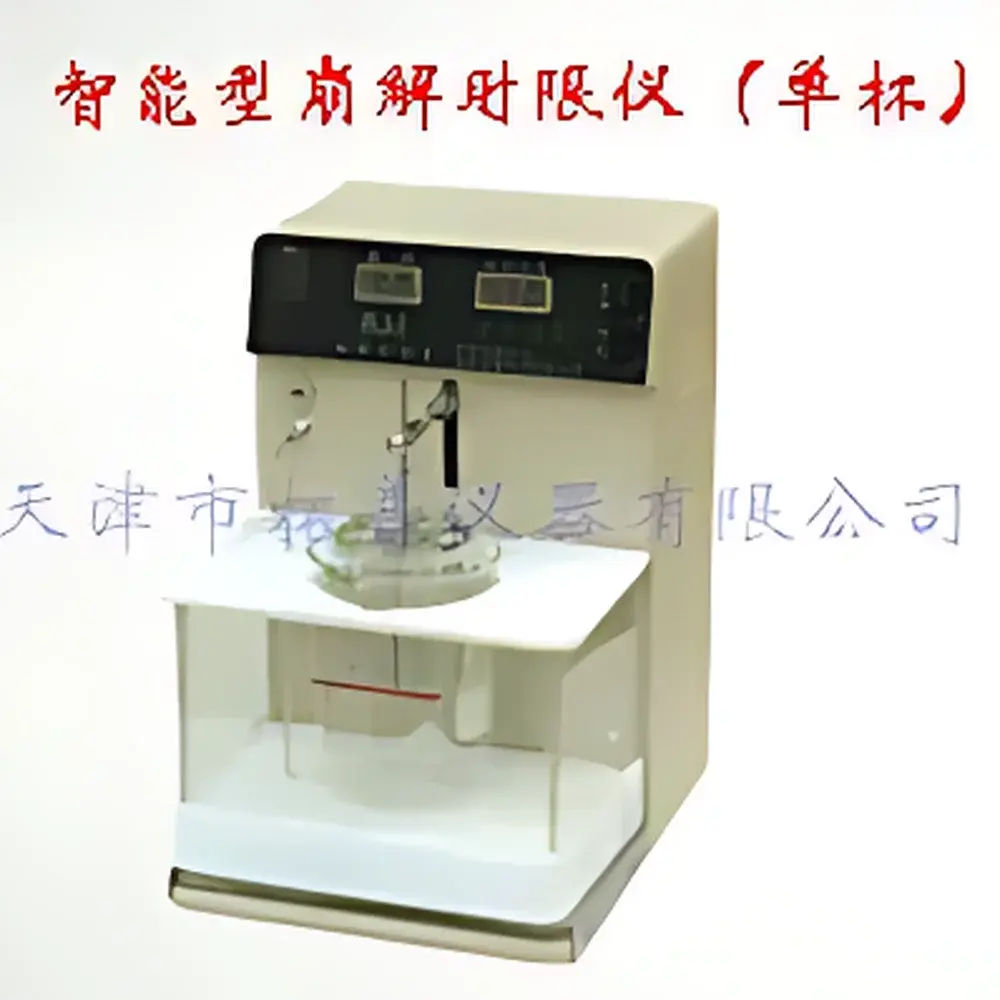
Topo BJ-1 Intelligent Single-Basket Disintegration Tester
| Brand | Topo |
|---|---|
| Model | BJ-1 |
| Origin | Tianjin, China |
| Manufacturer Type | Direct Manufacturer |
| Country of Origin | China |
| Power Supply | 220 V / 50 Hz / 500 W |
| Bath Temperature Control | 37 °C ± 1 °C |
| Basket Stroke Frequency | 32 cycles/min |
| Heating Method | Bottom-mounted water bath |
| Display | LED digital display |
| Control System | Microcontroller-based intelligent control with real-time clock and audible/visual alarm |
| Cabinet Design | Compact, integrated housing with ergonomic front panel (PC membrane keypad) |
Overview
The Topo BJ-1 Intelligent Single-Basket Disintegration Tester is a precision-engineered pharmaceutical testing instrument designed in strict accordance with the mechanical and operational requirements specified in the Chinese Pharmacopoeia (2000 Edition) for disintegration testing of solid oral dosage forms—including tablets, capsules, and suppositories. It operates on the principle of controlled immersion and cyclic vertical motion of a standardized basket assembly within a thermostatically regulated water bath at 37 °C ± 1 °C—mimicking physiological gastric conditions. The device employs a bottom-heated water bath configuration to ensure uniform thermal distribution and minimal temperature gradient across the test zone. Its single-basket architecture provides dedicated, isolated testing capacity ideal for routine QC labs, R&D validation studies, or small-batch release testing where throughput demands do not require parallel multi-sample operation.
Key Features
- Microcontroller-based intelligent control system with real-time clock functionality and programmable countdown timer for precise disintegration endpoint detection.
- Integrated audio-visual alarm system activated automatically upon test completion or deviation from set parameters (e.g., temperature excursion or cycle interruption).
- Bottom-mounted heating element ensures stable, homogeneous bath temperature with rapid thermal recovery after basket insertion—critical for maintaining pharmacopoeial compliance over repeated runs.
- Ergonomic front panel featuring a durable PC membrane keypad and high-contrast LED digital display for intuitive parameter input and status monitoring.
- Built-in LED illumination positioned above the observation window enables clear visual assessment of sample disintegration without external lighting interference.
- Structurally reinforced cabinet with compact footprint (W × D × H ≈ 300 × 350 × 450 mm) optimized for benchtop integration in GLP-compliant laboratories.
Sample Compatibility & Compliance
The BJ-1 accommodates standard USP/ChP-compliant disintegration baskets (22.2 mm internal diameter, 16.5 mm height) and includes a fixed baffle plate conforming to the dimensional and material specifications outlined in the Chinese Pharmacopoeia (2000 Edition). It supports all conventional solid dosage forms requiring disintegration evaluation under monograph-defined conditions—such as uncoated tablets (≤15 min), film-coated tablets (≤30 min), hard gelatin capsules (≤30 min), and effervescent tablets (≤5 min). While primarily aligned with ChP requirements, its mechanical performance (stroke frequency: 32 ± 2 cycles/min; amplitude: 55 ± 1 mm) falls within the tolerance ranges referenced in USP and EP 2.9.1 for disintegration apparatus type I (basket-rack assembly). The unit is suitable for use in environments governed by GMP Annex 11, FDA 21 CFR Part 11 (when paired with validated electronic record workflows), and ISO/IEC 17025-accredited testing laboratories.
Software & Data Management
The BJ-1 operates as a standalone hardware platform without embedded data logging or network connectivity. All operational parameters—including start time, target duration, and final pass/fail status—are manually recorded by the operator in laboratory notebooks or LIMS-integrated spreadsheets. For auditability, users are advised to maintain contemporaneous records documenting calibration date (temperature sensor and stroke counter), preventive maintenance logs, and daily verification checks per internal SOPs. Optional external USB data loggers (e.g., calibrated thermistors with timestamped output) may be deployed to generate traceable thermal profiles during qualification protocols (IQ/OQ/PQ). The instrument’s deterministic mechanical behavior and absence of firmware-upgradable logic simplify regulatory validation compared to fully automated systems.
Applications
- Routine quality control release testing of tablet and capsule batches in pharmaceutical manufacturing facilities.
- Formulation development support—evaluating excipient effects (e.g., disintegrant type/concentration, binder viscosity) on dissolution onset kinetics.
- Stability program monitoring—tracking disintegration time shifts across accelerated and long-term storage conditions per ICH Q1 guidelines.
- Comparative bioequivalence bridging studies where disintegration behavior correlates with in vivo performance.
- Educational use in university pharmacy and pharmaceutics laboratories for hands-on pharmacopoeial method training.
FAQ
Does the BJ-1 comply with current USP or EP standards?
While engineered to meet ChP (2000 Ed.) specifications, its mechanical parameters align with the nominal operating ranges defined in USP and Ph. Eur. 2.9.1 for apparatus type I—though formal USP/EP certification requires third-party verification against latest editions.
Can the unit be calibrated in-house?
Yes—temperature calibration using a NIST-traceable thermometer and stroke frequency verification via digital tachometer are feasible with standard metrology tools per manufacturer-recommended intervals.
Is the water bath volume sufficient for full immersion of all basket types?
The bath holds ≥1.5 L of distilled water, ensuring complete submersion of standard baskets and baffle plates at maximum stroke extension, as required by pharmacopoeial methodology.
What maintenance is required to sustain accuracy?
Monthly cleaning of the heating element and basket rack, quarterly verification of thermostat response time, and annual inspection of motor coupling integrity constitute the recommended maintenance schedule.
Can it be used for non-pharmaceutical applications?
Its design is purpose-built for pharmacopoeial disintegration testing; use outside this scope (e.g., food or cosmetic matrices) lacks documented validation and is not supported by the manufacturer.







