
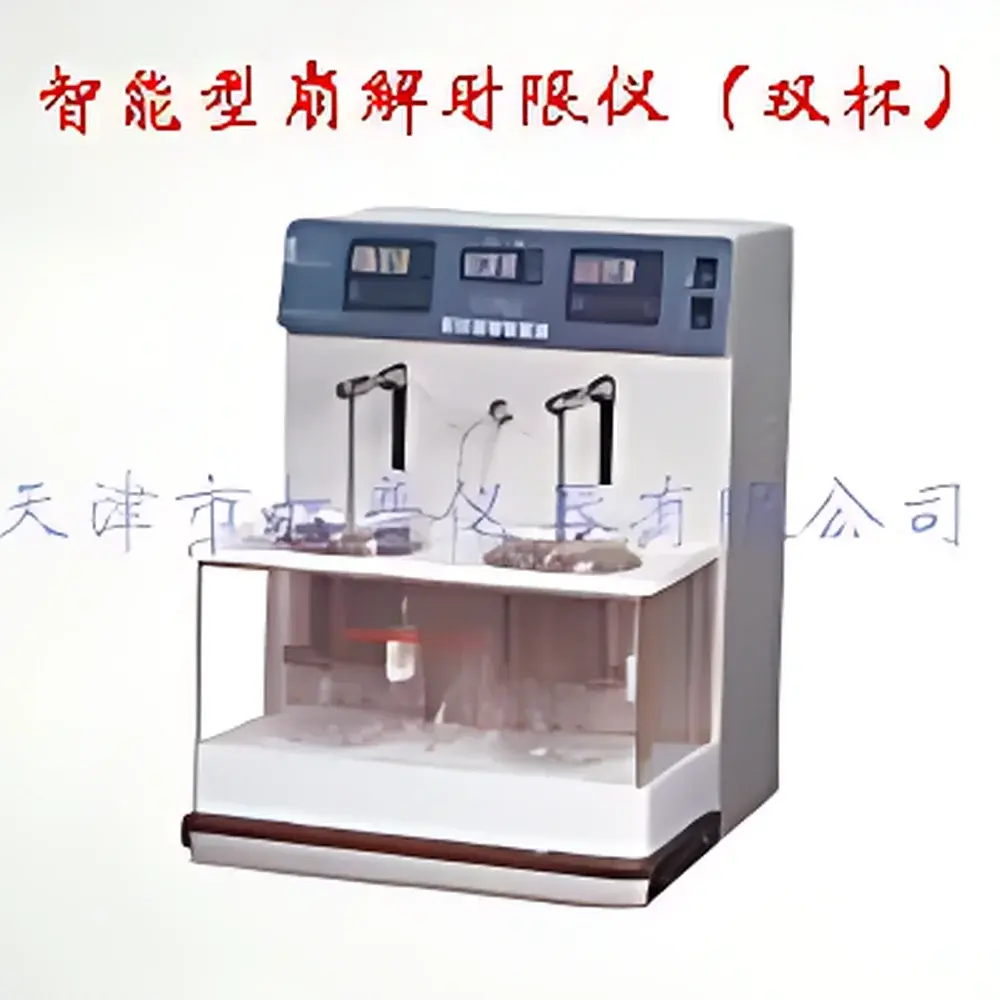
Topo BJ-2 Dual-Cup Intelligent Disintegration Tester
| Brand | Topo |
|---|---|
| Model | BJ-2 |
| Origin | Tianjin, China |
| Manufacturer Type | Direct Manufacturer |
| Product Origin | Domestic (China) |
| Power Supply | 220 V / 50 Hz / 500 W |
| Bath Temperature Control | 37 °C ± 1 °C |
| Basket Stroke Frequency | 32 cycles/min |
| Compliance | Chinese Pharmacopoeia 2000 Edition |
| Display | LED digital display |
| Interface | PC membrane touch keypad |
| Heating Method | Bottom-mounted water bath |
| Basket Drive | Dual independent motors |
| Built-in illumination | Yes |
| Cabinet Design | Compact, integrated, and ergonomic |
Overview
The Topo BJ-2 Dual-Cup Intelligent Disintegration Tester is a precision-engineered pharmaceutical testing instrument designed to determine the disintegration time of solid oral dosage forms—including tablets, capsules, and suppositories—under standardized conditions specified in the Chinese Pharmacopoeia (ChP) 2000 Edition. It operates on the principle of mechanical immersion cycling: test units are suspended in a temperature-controlled aqueous medium (typically purified water or simulated gastric/intestinal fluid), and subjected to vertical reciprocating motion via stainless-steel baskets. The system monitors the time required for complete disintegration—defined as the point at which no palpable residue remains on the basket mesh—within a thermostatically stabilized environment. Engineered for reproducibility and regulatory alignment, the BJ-2 meets core functional requirements outlined in ChP Section 0921 and provides a robust platform compatible with GLP-compliant laboratory workflows.
Key Features
- Dual independent motor-driven basket assemblies enable simultaneous, non-interfering testing of two samples—enhancing throughput without compromising measurement integrity.
- Precision temperature control maintains the water bath at 37 °C ± 1 °C, achieved via bottom-mounted heating elements and integrated PID feedback regulation—ensuring thermal stability across extended test durations.
- Programmable stroke frequency of 32 cycles per minute conforms strictly to pharmacopoeial specifications; motion amplitude and dwell time are mechanically fixed to eliminate operator-induced variability.
- LED digital display with real-time countdown timer and elapsed time tracking supports unambiguous endpoint determination; clock functionality enables timestamped test logging.
- PC membrane touch keypad offers tactile responsiveness and chemical resistance—critical for cleanroom and QC lab environments where frequent disinfection is routine.
- Integrated illumination module illuminates the observation zone directly beneath each basket, facilitating visual confirmation of disintegration endpoints without external lighting interference.
- Compact cabinet architecture minimizes benchtop footprint while maintaining structural rigidity and acoustic dampening—reducing vibration transmission to adjacent instrumentation.
Sample Compatibility & Compliance
The BJ-2 accommodates standard pharmacopoeial baskets (22 mm inner diameter, 78 mm height) and conforms to dimensional and material requirements defined in ChP 2000 Edition Annex 0921. It supports all solid dosage forms referenced in official monographs—including uncoated and film-coated tablets, hard and soft gelatin capsules, enteric-coated products (when tested in appropriate media), and vaginal/rectal suppositories. While primarily aligned with ChP, its operational parameters (37 °C ± 1 °C, 32 cpm, 15 mm stroke) are functionally equivalent to those stipulated in USP , EP 2.9.1, and JP 17 General Test 2.06—enabling cross-referenced method validation. The unit does not include automated pass/fail decision logic but delivers objective, observer-independent timing data suitable for inclusion in audit-ready batch records.
Software & Data Management
The BJ-2 operates as a standalone hardware platform with no embedded microprocessor-based data storage or network connectivity. All timing and control functions are managed by an industrial-grade 8-bit microcontroller with hardened firmware. Results are recorded manually or transcribed into LIMS or ELN systems via standardized templates. For laboratories requiring electronic record integrity under FDA 21 CFR Part 11 or EU Annex 11, external timestamped documentation—such as video capture synchronized with wall-clock time or dedicated data loggers—is recommended. The device’s deterministic behavior, absence of configurable software parameters, and fixed operating setpoints simplify IQ/OQ qualification and support straightforward revalidation following maintenance.
Applications
- Quality control release testing of tablet and capsule batches in pharmaceutical manufacturing facilities.
- Stability-indicating method development for modified-release formulations during preformulation studies.
- Comparative disintegration profiling of generic versus innovator products in bioequivalence support studies.
- In-process testing during tablet compression or capsule filling operations to verify excipient compatibility and binder efficacy.
- Educational use in university pharmacy and pharmaceutics laboratories for teaching pharmacopoeial compliance principles.
FAQ
Does the BJ-2 comply with USP or EP 2.9.1?
Yes—the mechanical and thermal operating parameters meet the nominal requirements of both standards; however, formal compliance requires site-specific verification per your laboratory’s SOPs and regulatory jurisdiction.
Can the unit be used with alternative test media such as simulated gastric fluid (SGF) or simulated intestinal fluid (SIF)?
Yes—provided the media is non-corrosive to stainless-steel components and maintained at 37 °C ± 1 °C; users must validate temperature uniformity and basket immersion depth for each medium.
Is calibration traceable to national standards?
Temperature calibration may be performed using NIST-traceable thermometers; stroke frequency verification requires a calibrated tachometer or high-speed camera—procedures are documented in the user manual.
What maintenance is required to ensure long-term accuracy?
Monthly inspection of basket mesh integrity, quarterly cleaning of heater surfaces and water bath seals, and annual verification of motor timing consistency are recommended.
Is the device suitable for GMP production environments?
Yes—it is routinely deployed in QC labs operating under GMP guidelines; its fixed-function design, lack of user-modifiable software, and mechanical repeatability support consistent audit outcomes.






