
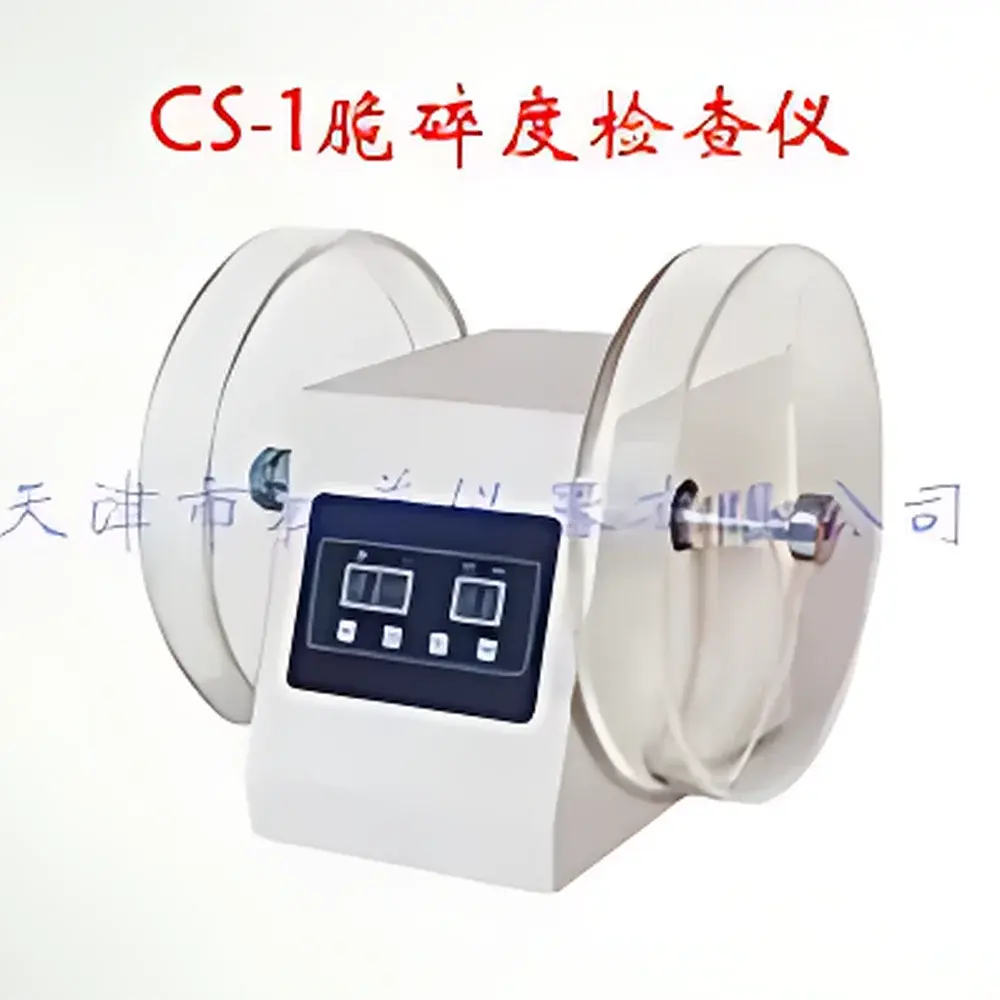
Topo CS-1 Friability Tester
| Brand | Topo (TP) |
|---|---|
| Origin | Tianjin, China |
| Manufacturer Type | Direct Manufacturer |
| Country of Origin | China |
| Model | CS-1 |
| Power Supply | 220 V, 50 Hz, 50 W |
| Drum Internal Dimensions | Ø286 mm × Depth 39 mm |
| Drop Height | 156 mm |
| Rotational Speed Range | 20–90 rpm |
| Speed Accuracy | ±1 rpm |
| Rotation Count Range | 10–240 revolutions |
| Compliance | Meets or exceeds national metrological verification requirements for pharmaceutical friability testing instruments |
Overview
The Topo CS-1 Friability Tester is a precision-engineered instrument designed in strict accordance with the physical testing requirements specified in pharmacopoeial standards—including the Chinese Pharmacopoeia (ChP), United States Pharmacopeia (USP <1216>), and European Pharmacopoeia (Ph. Eur. 2.9.7). It operates on the principle of controlled mechanical attrition: tablets are subjected to repeated tumbling and free-fall within a rotating cylindrical drum, simulating mechanical stresses encountered during packaging, transportation, and handling. The resulting mass loss—expressed as percentage weight loss—is quantified to assess tablet integrity, surface cohesion, and resistance to edge chipping or surface abrasion. This test serves as a critical quality control checkpoint in solid oral dosage form development and routine manufacturing release.
Key Features
- Microcontroller-based digital control system ensures precise regulation of rotational speed (20–90 rpm, ±1 rpm accuracy) and programmable rotation count (10–240 revolutions), enabling repeatable test execution across batches and laboratories.
- Dual-parameter programmability allows independent setting of speed and revolution count—essential for method development aligned with USP/ChP protocols or internal SOPs requiring non-standard test durations.
- Drum geometry conforms to pharmacopoeial specifications: internal diameter of 286 mm and depth of 39 mm, with a calibrated drop height of 156 mm—ensuring consistent kinetic energy transfer per tumble cycle.
- Front-panel interface features tactile membrane keys and high-contrast LED numeric display, optimized for glove-compatible operation in cleanroom and QC laboratory environments.
- Robust mechanical architecture utilizes high-grade domestic and imported components—including corrosion-resistant drum lining, low-inertia drive motor, and sealed bearing assembly—to ensure long-term dimensional stability and operational reliability under daily use.
Sample Compatibility & Compliance
The CS-1 accommodates standard uncoated and film-coated tablets up to 20 mm in diameter and 10 mm in thickness. It supports batch testing of up to 20 g of sample (typically 20 tablets, pre-weighed to ±0.1 mg), in compliance with USP <1216> sample mass requirements. Instrument validation documentation includes traceable calibration records for rotational speed and revolution counting. While not certified to ISO/IEC 17025 by default, the device is fully compatible with GLP- and GMP-aligned laboratory workflows—including integration into equipment qualification protocols (IQ/OQ/PQ) and audit-ready maintenance logs. Its design facilitates routine verification using certified reference weights and optical tachometer cross-checks.
Software & Data Management
The CS-1 operates as a standalone hardware platform without embedded data logging or PC connectivity. All test parameters and outcomes are recorded manually by operators in laboratory notebooks or electronic batch records (EBRs). To support 21 CFR Part 11 compliance, users may integrate the instrument into validated LIMS or ELN systems via manual entry with dual-signature review workflows. Optional external USB digital timers or RPM loggers can be deployed for enhanced traceability—though such peripherals are not supplied by Topo and require separate validation per site-specific requirements.
Applications
- Release testing of immediate-release and modified-release tablets prior to packaging and distribution.
- Stability study support: friability assessment at multiple timepoints under ICH Q1 conditions (e.g., 40 °C/75% RH).
- Formulation development screening: comparative evaluation of binder type, granulation method, or compression force impact on tablet robustness.
- Supplier qualification: incoming inspection of contract-manufactured tablets against agreed-upon friability acceptance criteria (e.g., ≤1.0% weight loss).
- Educational use in pharmacy and pharmaceutics laboratories for hands-on demonstration of mechanical property–structure relationships in solid dosage forms.
FAQ
Does the CS-1 meet USP <1216> requirements?
Yes—the drum dimensions, drop height, rotational speed range, and repeatability performance align with the physical specifications defined in USP <1216>. Final compliance depends on site-specific operational qualification and documented calibration practices.
Can the CS-1 test coated tablets?
Yes, it is routinely used for film-coated tablets; however, interpretation must consider coating-specific failure modes (e.g., cracking vs. powdering) and may require supplementary assays such as dissolution or visual inspection.
Is speed calibration traceable to national standards?
The unit incorporates factory-set speed calibration verified with NIST-traceable tachometric reference devices. End users are responsible for periodic in-house verification using an accredited handheld tachometer.
What maintenance is required?
Routine cleaning of the drum interior with lint-free isopropyl alcohol wipes; biannual inspection of drive belt tension and bearing smoothness; annual verification of timer accuracy and rotational consistency across the full speed range.
Related Products





