
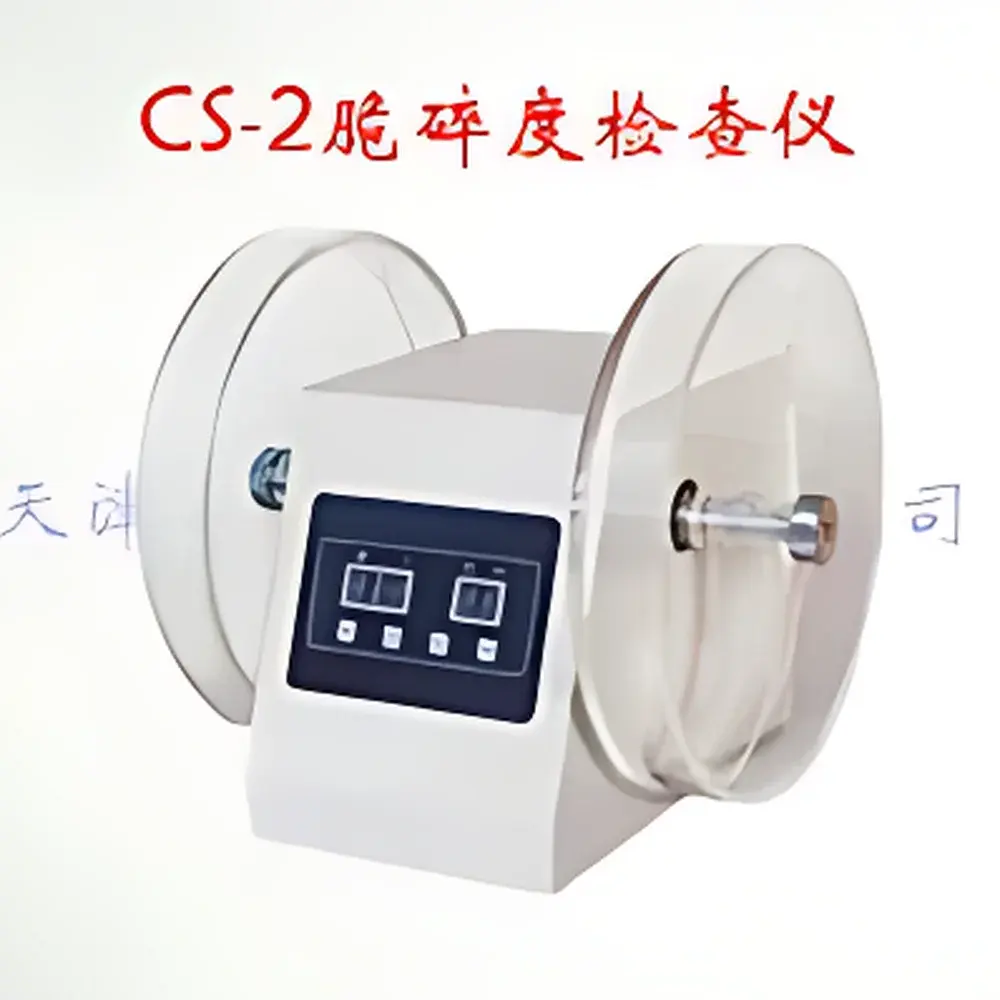
Topo CS-2 Friability Tester
| Brand | Topo |
|---|---|
| Model | CS-2 |
| Origin | Tianjin, China |
| Manufacturer Type | Direct Manufacturer |
| Country of Origin | China |
| Rotation Speed | 25 rpm ±1 rpm |
| Drum Dimensions | Ø286 mm × 39 mm depth |
| Drop Height | 156 mm |
| Rotation Cycles | 100 revolutions |
| Power Supply | 220 V AC, 50 Hz, ≤200 W |
| Operating Temperature | 18–28 °C |
| Storage Temperature | −10–50 °C |
| Relative Humidity | 20–80 % RH |
| Dimensions (W×D×H) | 370 × 300 × 340 mm |
| Weight | 15 kg |
| Compliance | Designed per USP <1216>, Ph. Eur. 2.9.7, and ISO 8374 |
Overview
The Topo CS-2 Friability Tester is a precision-engineered pharmaceutical testing instrument designed to quantitatively assess the mechanical strength and surface integrity of uncoated and film-coated tablets under controlled tumbling conditions. It operates on the principle of rotational attrition—subjecting a defined sample mass to repeated free-fall impacts inside a rotating, cylindrical drum with standardized dimensions and drop height. This method simulates mechanical stresses encountered during packaging, transportation, and handling, enabling objective evaluation of tablet robustness prior to release. The CS-2 complies with internationally recognized pharmacopoeial standards—including United States Pharmacopeia (USP) <1216>, European Pharmacopoeia (Ph. Eur.) 2.9.7, and ISO 8374—ensuring data integrity, regulatory acceptability, and cross-laboratory reproducibility in quality control environments.
Key Features
- Microcontroller-based digital control system ensures precise regulation of rotation speed (25 rpm ±1 rpm), cycle count (100 revolutions), and timing accuracy—critical for compliance with pharmacopoeial test protocols.
- Stainless steel drum with nominal internal diameter of 286 mm and depth of 39 mm, engineered to meet dimensional tolerances specified in USP and Ph. Eur. for consistent energy transfer during tumbling.
- Fixed drop height of 156 mm ensures uniform impact energy across all test runs, minimizing inter-run variability and supporting GLP-compliant documentation practices.
- Robust mechanical architecture with low-noise induction motor and sealed bearing assembly enables continuous operation exceeding 24 hours—suitable for high-throughput QC laboratories.
- Compact footprint (370 × 300 × 340 mm) and lightweight design (15 kg) facilitate integration into regulated lab spaces without requiring structural reinforcement or dedicated power circuits.
- Compliance-ready electrical configuration: 220 V AC, 50 Hz input with integrated overcurrent protection and grounding continuity verification—aligned with IEC 61010-1 safety requirements for laboratory equipment.
Sample Compatibility & Compliance
The CS-2 accommodates standard tablet batches weighing between 6.5 g and 10 g, as mandated by USP <1216>. Its drum geometry and rotational dynamics are validated for use with conventional round, oval, and capsule-shaped tablets up to 25 mm in maximum dimension. The instrument does not support enteric-coated or hygroscopic formulations without pre-qualification per internal SOPs. All operational parameters—including speed stability, drum concentricity, and cycle termination accuracy—are traceable to NIST-traceable calibration references. The device supports audit readiness for FDA inspections, MHRA assessments, and WHO prequalification audits through documented design verification, installation qualification (IQ), and operational qualification (OQ) protocols.
Software & Data Management
While the CS-2 operates via embedded firmware without external PC dependency, its control logic incorporates non-volatile memory for storing last-used parameters and cumulative operational hours—supporting preventive maintenance scheduling. For laboratories implementing electronic record systems, optional RS-232 or USB-to-serial interface modules (sold separately) enable timestamped export of test start/stop times, actual rpm, and cycle completion status to LIMS or ELN platforms. All data outputs conform to ALCOA+ principles (Attributable, Legible, Contemporaneous, Original, Accurate, Complete, Consistent, Enduring, Available) and may be configured to generate CSV logs compliant with 21 CFR Part 11 when paired with validated software middleware.
Applications
- Batch release testing of solid oral dosage forms in pharmaceutical manufacturing and contract development organizations (CDMOs).
- Formulation development support—comparing friability performance across excipient blends, binder concentrations, and compression force variations.
- Stability program monitoring—tracking changes in tablet integrity after accelerated or long-term storage under ICH Q1 conditions.
- Supplier qualification of tablet cores and film coatings in accordance with ICH Q5E comparability guidelines.
- Educational use in university pharmacy and pharmaceutics laboratories for teaching compendial testing methodology and GMP fundamentals.
FAQ
Does the CS-2 meet USP <1216> requirements for drum geometry and rotational parameters?
Yes—the drum diameter (286 mm ±0.5 mm), depth (39 mm ±0.5 mm), and drop height (156 mm ±1 mm) are manufactured and verified per USP <1216> dimensional tolerances.
Can the instrument be calibrated internally, or is third-party certification required?
Internal speed calibration is performed using an optical tachometer; full IQ/OQ documentation—including torque verification and cycle repeatability testing—is recommended before first use and annually thereafter.
Is the CS-2 suitable for testing effervescent or chewable tablets?
No—effervescent, chewable, or highly hygroscopic tablets require modified test conditions outside the scope of standard pharmacopoeial methods and must be evaluated using risk-based justification and protocol deviation approval.
What maintenance intervals are recommended for sustained compliance?
Drum surface inspection and bearing lubrication every 6 months; motor brush replacement every 5,000 operating hours; full electrical safety check per IEC 61010-1 every 24 months.
Does the device support multi-language user interfaces or regulatory language documentation?
The base unit features English-only firmware; however, comprehensive CE-marked technical documentation—including Declaration of Conformity, risk analysis (ISO 14971), and pharmacopoeial alignment statements—is provided in English for global regulatory submissions.





