
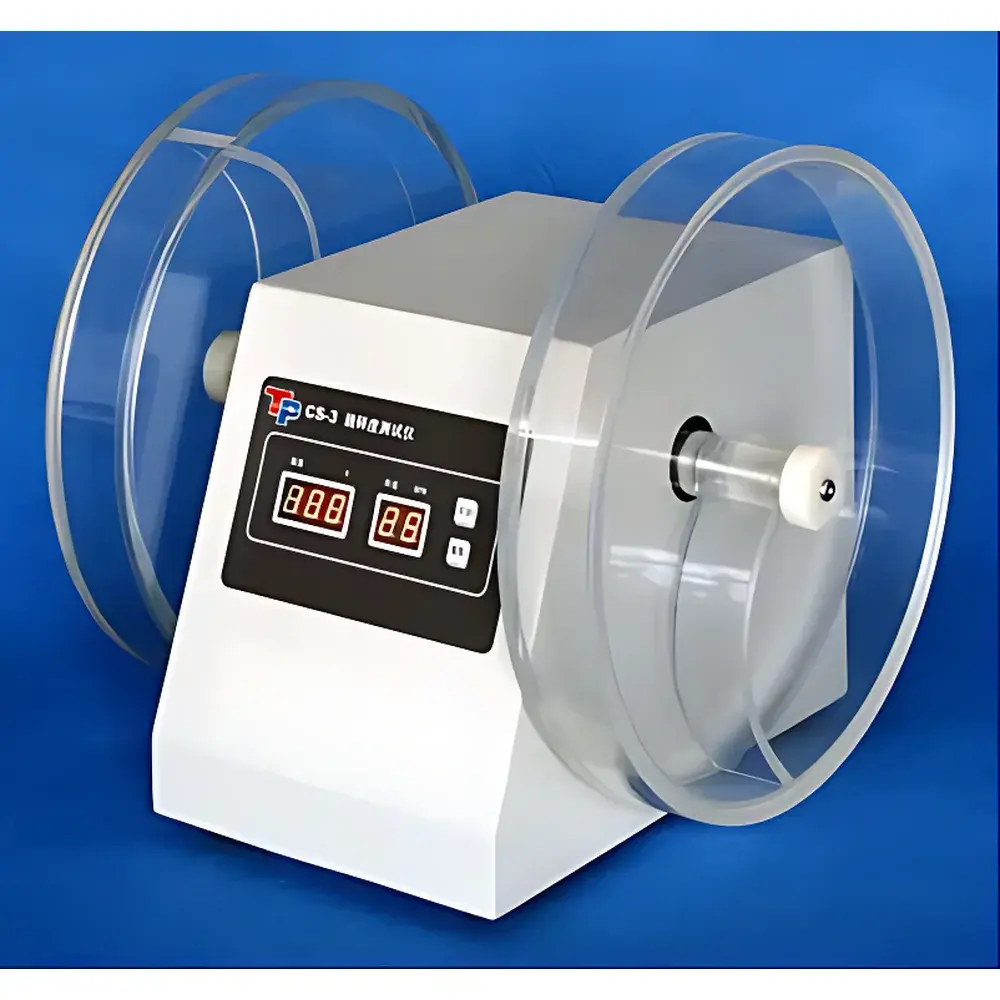
Topo CS-3 Friability Tester
| Brand | Topo |
|---|---|
| Model | CS-3 |
| Rotation Speed | 25 rpm ±1 rpm |
| Timer Range | 0–9 h 59 min 59 s (forward/reverse) |
| Counter Range | 0–99,999 cycles (forward/reverse) |
| Drum Dimensions | Internal Diameter ≈ 286 mm, Depth 39 mm |
| Power Supply | 220 V ±10%, 50 Hz |
| Operating Temperature | 5–35 °C |
| Relative Humidity | <80% RH |
| Power Consumption | 18 W |
Overview
The Topo CS-3 Friability Tester is a precision-engineered pharmaceutical testing instrument designed to quantitatively assess the mechanical strength and surface integrity of uncoated tablets under controlled tumbling conditions. It operates on the principle of rotational drum attrition—mimicking the physical stresses encountered during packaging, transportation, and handling—per ASTM D1473 and aligned with USP <1216>, EP 2.9.7, and JP 6.07 standards for friability testing. The device subjects tablets to repeated free-fall impacts against the inner wall of a rotating cylindrical drum, enabling reproducible evaluation of mass loss (%) as a critical quality attribute in tablet formulation development, stability studies, and routine QC release testing.
Key Features
- Two operational modes: precise time-based testing (0–9 h 59 min 59 s) and cycle-based testing (0–99,999 rotations), both configurable in forward or reverse direction to accommodate method-specific protocols.
- Dual-mode digital LCD interface providing real-time visibility of elapsed time, remaining time, current rotation count, or target count—ensuring full experimental transparency and operator control.
- Integrated pause function enabling mid-test interruption without resetting parameters, essential for sample inspection, drum cleaning, or process verification during extended assays.
- Repeat test capability allows consecutive execution of identical test sequences without manual reconfiguration—reducing operator variability and supporting GLP-compliant batch testing workflows.
- Robust drum assembly constructed from high-grade stainless steel with precisely machined internal geometry (ID ≈ 286 mm, depth 39 mm), ensuring consistent tablet trajectory and impact energy distribution across all runs.
- Low-power, thermally stable drive system (18 W nominal consumption) optimized for continuous operation in regulated laboratory environments with ambient temperature control (5–35 °C) and humidity <80% RH.
Sample Compatibility & Compliance
The CS-3 accommodates standard tablet sizes up to 25 mm in diameter and weights ranging from 100 mg to 2 g per unit, making it suitable for immediate-release, sustained-release, and effervescent formulations. Its mechanical design conforms to the dimensional and rotational requirements specified in pharmacopoeial monographs, including USP <1216> (which mandates 25 rpm ±1 rpm and 100 rotations as default), EP 2.9.7, and JP 6.07. All operational parameters—including speed tolerance, drum geometry, and timing resolution—are validated to meet ISO/IEC 17025 traceability requirements when used within an accredited QC laboratory framework. The instrument supports audit-ready documentation practices required under FDA 21 CFR Part 11 when integrated with compliant data capture systems.
Software & Data Management
While the CS-3 operates as a standalone hardware platform with embedded firmware, its parameter-driven architecture enables seamless integration with external LIMS or ELN systems via RS-232 or optional USB-to-serial interfaces (available upon request). Timestamped test logs—including start time, duration, rotation count, and user ID—can be exported for electronic record retention. Firmware supports user-defined method templates stored in non-volatile memory, facilitating rapid recall of validated protocols across shifts and operators. All configuration changes are logged with date/time stamps, contributing to ALCOA+ data integrity principles (Attributable, Legible, Contemporaneous, Original, Accurate) required under GMP and GLP environments.
Applications
- Routine quality control release testing of solid oral dosage forms in pharmaceutical manufacturing facilities.
- Formulation optimization during preclinical and clinical development stages, particularly for evaluating binder efficacy, granulation method impact, and excipient compatibility.
- Stability-indicating assessment under ICH Q1 guidelines, tracking friability drift over accelerated and long-term storage conditions.
- Comparative analysis of coating integrity between batches or suppliers using standardized tumbling exposure followed by weight loss and visual inspection.
- Educational use in university pharmacy and pharmaceutics laboratories for hands-on instruction in solid dosage form characterization principles.
FAQ
What regulatory standards does the CS-3 comply with?
The CS-3 meets the mechanical and procedural specifications outlined in USP <1216>, EP 2.9.7, JP 6.07, and ASTM D1473 for friability determination.
Can the drum speed be adjusted beyond 25 rpm?
No—the CS-3 is fixed at 25 rpm ±1 rpm to ensure strict adherence to pharmacopoeial requirements; variable-speed operation is not supported.
Is calibration certification included with the instrument?
A factory-issued calibration report verifying rotational speed accuracy and timer/counter functionality is provided; annual recalibration is recommended per ISO/IEC 17025 guidelines.
How is data integrity ensured during testing?
All test parameters and outcomes are displayed in real time on the LCD and retained in non-volatile memory until manually cleared; external data logging requires optional interface hardware and compliant software.
Does the CS-3 support multi-language user interfaces?
The standard firmware features English-only display and menu navigation; localized UI variants are not available at this time.






