
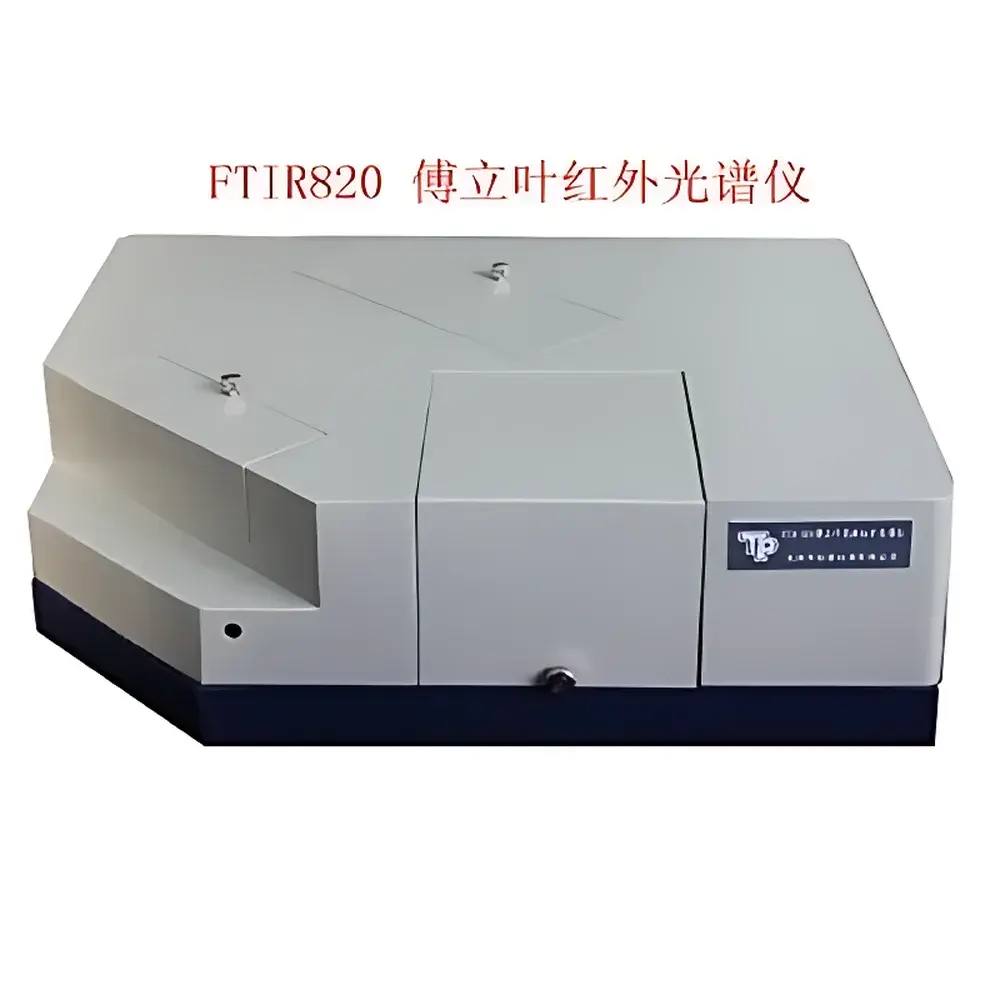
Topo FTIR820 Fourier Transform Infrared Spectrometer
| Brand | Topo |
|---|---|
| Origin | Tianjin, China |
| Manufacturer Type | Direct Manufacturer |
| Instrument Type | Laboratory Benchtop FTIR |
| Spectral Range | 7800–375 cm⁻¹ |
| Resolution | ≤1 cm⁻¹ (0.5 cm⁻¹ optional) |
| Scan Speed | Microprocessor-Controlled, 6 Adjustable Speeds |
| Signal-to-Noise Ratio | 30,000:1 (RMS, 2100 cm⁻¹, 4 cm⁻¹ resolution, DLATGS detector, 1-min acquisition) |
| Beam Diameter | 30 mm |
| Sample Aperture | 5 mm Ø |
| Interferometer | Self-Compensating Michelson with Active Alignment |
| Detector | Imported Low-Noise DLATGS |
| Source | Imported Long-Life Air-Cooled Ceramic IR Source |
| Beamsplitter | Multi-Layer KBr |
| Wavenumber Accuracy | ±0.01 cm⁻¹ |
| Linearity | ≤0.1% T |
| Data Interface | USB 2.0 |
| Dimensions (W×D×H) | 555 × 445 × 118 mm |
| Weight | 22 kg |
| Power | AC 90–230 V, 40 W |
| Operating Environment | 15–28 °C, <65% RH |
| Software Platform | Windows 98/2000/XP/Vista (32-bit) |
Overview
The Topo FTIR820 Fourier Transform Infrared Spectrometer is a laboratory-grade, benchtop FTIR system engineered for high spectral fidelity, operational robustness, and long-term measurement reproducibility. Based on the Michelson interferometer architecture with an integrated self-compensating optical design, the FTIR820 eliminates common alignment drift and phase error issues inherent in conventional passive interferometers. Its core measurement principle relies on interferometric modulation of broadband infrared radiation—generated by a stabilized ceramic source—followed by Fourier transformation of the resulting interferogram to yield high-resolution absorbance/transmittance spectra across the mid-infrared region (7800–375 cm⁻¹). The instrument incorporates a He–Ne laser for real-time path-length calibration and dynamic zero-path-difference tracking, ensuring wavenumber accuracy within ±0.01 cm⁻¹ and linearity better than 0.1% T. Designed for routine analytical workflows in regulated and research environments, the FTIR820 delivers a signal-to-noise ratio of 30,000:1 (RMS, 2100 cm⁻¹, 4 cm⁻¹ resolution, 60-second scan), supporting both qualitative identification and semi-quantitative analysis of organic and inorganic functional groups.
Key Features
- Self-compensating Michelson interferometer with active laser-based alignment and automatic zero-path-difference correction
- Imported low-noise deuterated triglycine sulfate (DLATGS) detector optimized for thermal stability and dynamic range
- High-intensity, air-cooled ceramic infrared source with extended operational lifetime (>10,000 hours)
- Multi-layer potassium bromide (KBr) beamsplitter for broad spectral throughput and humidity resistance
- Six-step microprocessor-controlled scan speed selection to balance acquisition time, resolution, and SNR requirements
- Optimized optical path: 30 mm beam diameter, 5 mm sample aperture, and 116 × 118 × 112 mm sample compartment for flexible accessory integration
- USB 2.0 interface compliant with standard Windows driver models; no proprietary hardware dongles or legacy serial adapters required
Sample Compatibility & Compliance
The FTIR820 accommodates a wide range of solid, liquid, and gaseous samples via standardized mounting interfaces compatible with industry-recognized accessories—including single-bounce ATR (ZnSe or diamond crystal), specular reflectance, diffuse reflectance (DRIFTS), transmission cells (gas/liquid), and photoacoustic modules. Its mechanical and thermal design meets IEC 61010-1 safety standards for laboratory electrical equipment. While not pre-certified for FDA 21 CFR Part 11, the instrument’s software architecture supports audit-trail-enabling configurations when deployed with validated third-party spectroscopy platforms compliant with GLP and GMP documentation requirements. Routine performance verification follows ASTM E1421 and ISO 18389 protocols using NIST-traceable polystyrene film and water vapor reference standards.
Software & Data Management
The FTIR820 ships with native Windows-compatible acquisition and processing software supporting full spectral preprocessing (zero-filling, apodization, phase correction), baseline correction, peak search, library searching (built-in >2,500 compound database), and custom quantitative calibration (e.g., Beer–Lambert modeling). Raw interferograms and processed spectra are stored in open-format .SPA and .CSV files for interoperability with MATLAB, Python (SciPy), and commercial chemometrics packages. All data operations—including parameter changes, spectrum annotation, and report generation—are timestamped and logged. Optional software upgrades enable automated sequence control, multi-sample batch processing, and export to LIMS-compliant XML structures.
Applications
- Pharmaceutical QC: Identification of polymorphs, excipient compatibility, residual solvent quantification (per USP & EP monographs)
- Materials science: Characterization of polymer crystallinity, oxidation state in composites, carbon/oxygen content in silicon wafers
- Environmental monitoring: Quantification of free silica (α-quartz) in airborne dust per OSHA Method ID-142
- Forensics & gemology: Differentiation of natural vs. synthetic gemstones, detection of polymer coatings on jewelry
- Coatings & adhesives: Analysis of curing kinetics, crosslink density, and additive migration in acrylics, epoxies, and polyurethanes
- Cosmetics & personal care: Verification of raw material authenticity, preservative degradation profiling, emulsion stability assessment
FAQ
What is the minimum achievable resolution, and how is it verified?
The FTIR820 achieves 0.5 cm⁻¹ nominal resolution under optimal conditions (longer scan time, narrow aperture, high SNR averaging); verification is performed using the 0.5 cm⁻¹ splitting of the CO₂ doublet near 2350 cm⁻¹ per ASTM E1421 Annex A2.
Is the instrument compatible with modern Windows operating systems?
The shipped software supports Windows 98 through Vista (32-bit); for Windows 10/11 compatibility, users must install the vendor-provided universal driver package (v3.2+), which maintains full spectral acquisition and processing functionality without emulation layers.
Can the FTIR820 be used for quantitative analysis in regulated labs?
Yes—when operated with validated methods, documented instrument qualification (IQ/OQ/PQ), and traceable reference standards, the FTIR820 satisfies data integrity requirements for QC release testing under ISO/IEC 17025 and pharmaceutical cGMP guidelines.
What maintenance is required to sustain optical performance?
Routine desiccant replacement (silica gel indicator included), periodic mirror cleaning with spectroscopic-grade methanol, and annual verification of laser alignment and wavenumber calibration using certified polystyrene film are recommended.
Does the system support external triggering or synchronization with other instruments?
Yes—the rear-panel TTL-compatible trigger input allows precise synchronization with external events such as reaction initiation, temperature ramping, or chromatographic elution, enabling time-resolved or hyphenated FTIR applications.




