
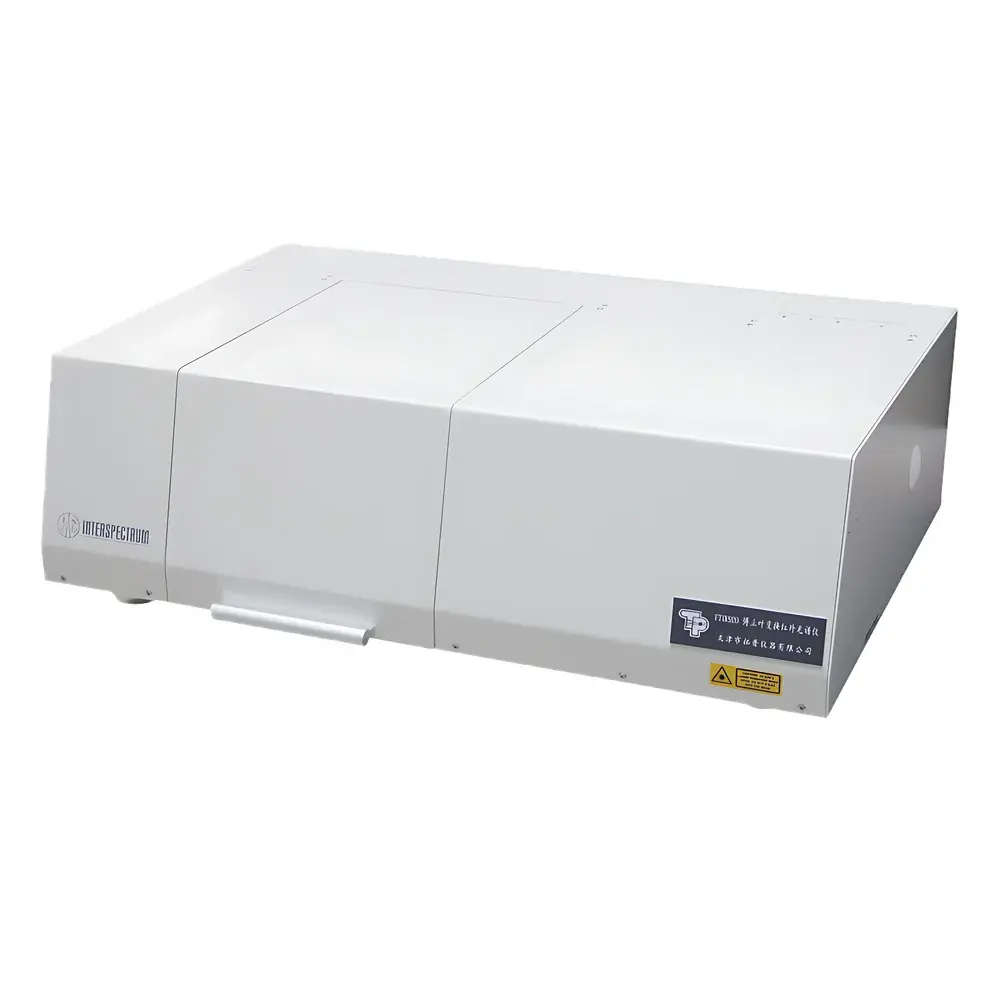
Topo FTIR920N Fourier Transform Near-Infrared Spectrometer
| Brand | Topo |
|---|---|
| Model | FTIR920N |
| Origin | Tianjin, China |
| Manufacturer Type | Original Equipment Manufacturer (OEM) |
| Regional Classification | Domestic (PRC) |
| Pricing | Available Upon Request |
Overview
The Topo FTIR920N is a benchtop Fourier Transform Near-Infrared (FT-NIR) spectrometer engineered for routine qualitative and quantitative analysis in quality control, raw material verification, and process monitoring environments. Operating in the 10,000–4,000 cm⁻¹ spectral range (1,000–2,500 nm), the instrument employs a Michelson interferometer with a solid-state laser reference and a thermoelectrically cooled InGaAs detector to deliver high signal-to-noise ratio (SNR) spectra with excellent photometric stability. Its optical design minimizes stray light and ensures long-term wavelength accuracy traceable to NIST-traceable standards. Unlike dispersive NIR systems, the FTIR920N benefits from Fellgett’s (multiplex) and Jacquinot’s (throughput) advantages—enabling rapid acquisition of high-resolution interferograms without mechanical grating movement or slit-based intensity loss. The system is optimized for reflectance (diffuse and specular) and transmittance measurements on solids, powders, pastes, and liquids using standardized sampling accessories compatible with ASTM E1655 and ISO 12099.
Key Features
- Robust Michelson interferometer with sealed, alignment-free optical path and dynamic alignment compensation
- High-stability He–Ne laser reference for real-time wavenumber calibration (±0.02 cm⁻¹ typical reproducibility)
- TE-cooled InGaAs photodiode detector offering extended dynamic range and low dark current drift
- Modular sampling interface supporting fiber-optic probes (SMA 905), integrating spheres (30 mm & 50 mm), transmission cells (0.1–10 mm pathlength), and ATR accessories (ZnSe, Ge, or diamond crystals)
- Embedded ARM-based controller with onboard data preprocessing (zero-filling, apodization, phase correction, and Fourier transformation)
- Compliance-ready architecture supporting audit trails, electronic signatures, and user access levels per FDA 21 CFR Part 11 requirements when paired with validated software modules
Sample Compatibility & Compliance
The FTIR920N accommodates diverse sample forms without destructive preparation: intact tablets, granules, agricultural grains, polymer pellets, edible oils, dairy powders, and aqueous solutions. It supports both contact (ATR, transmission) and non-contact (fiber-coupled reflectance) modalities, minimizing operator-induced variability. All optical components meet RoHS directives, and mechanical housing conforms to IP20 industrial enclosure standards. The system facilitates compliance with pharmacopeial monographs (USP , EP 2.2.24), feed analysis protocols (AOAC 971.13), and food authenticity screening (ISO 21543). Full traceability is maintained through embedded metadata logging—including instrument ID, environmental sensor readings (temperature/humidity), operator ID, and acquisition timestamp—for GLP/GMP-aligned laboratories.
Software & Data Management
The instrument ships with TopoSpectra™ v3.x—a Windows-based application supporting method development, multivariate calibration (PLS, PCR, PCA), spectral library management, and automated pass/fail reporting. Raw interferogram (.ifg) and processed spectrum (.spc, .jdx) files adhere to ASTM E131 and JCAMP-DX v5.0 formats. Data integrity safeguards include encrypted project archives, version-controlled calibration models, and configurable retention policies. Optional integration with LIMS (e.g., LabVantage, Thermo SampleManager) via ASTM E1578-compliant API enables bidirectional workflow synchronization. Software validation documentation (IQ/OQ/PQ protocols) and 21 CFR Part 11 configuration packages are available upon request for regulated environments.
Applications
- Pharmaceutical: Active pharmaceutical ingredient (API) identification, blend uniformity assessment, moisture content quantification in lyophilized products
- Agriculture & Food: Protein/fat/carbohydrate prediction in cereals and legumes; adulteration detection in honey, olive oil, and milk powder
- Polymers: Resin grade verification, additive concentration profiling, degradation monitoring via carbonyl index tracking
- Chemicals: Solvent purity screening, reaction endpoint determination in batch synthesis, catalyst activity evaluation
- Environmental: Soil organic carbon estimation, sludge composition analysis, biofuel feedstock characterization
FAQ
What spectral resolution options are supported by the FTIR920N?
The instrument operates at fixed nominal resolutions of 4 cm⁻¹ and 8 cm⁻¹, selectable via software; higher resolution settings (2 cm⁻¹) are available as a factory-configured option.
Is the system compatible with third-party chemometric software such as Unscrambler® or MATLAB?
Yes—raw interferograms and absorbance/transmittance spectra can be exported in ASCII, CSV, or JCAMP-DX format for external modeling.
Does the FTIR920N require external vibration isolation or climate-controlled rooms?
No. Its monolithic optical baseplate and passive thermal management enable stable operation in standard laboratory environments (15–30 °C, ≤70% RH, non-condensing).
Can the instrument be integrated into automated production lines?
Yes—via Ethernet (TCP/IP) and digital I/O ports (TTL-compatible), supporting trigger-based acquisition and PLC handshake protocols (Modbus TCP optional).
What is the typical warm-up time before achieving spectral stability?
Less than 15 minutes after power-on, with full photometric stability achieved within 30 minutes under ambient conditions.




