
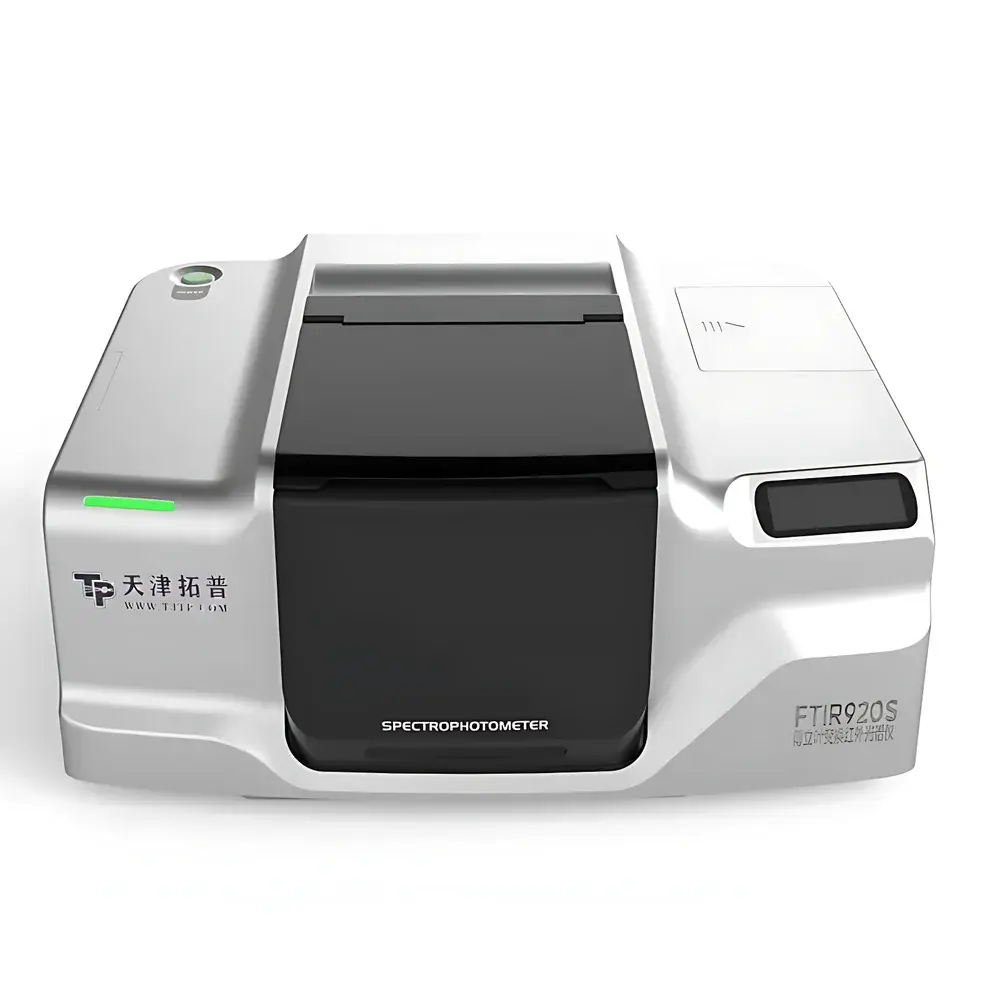
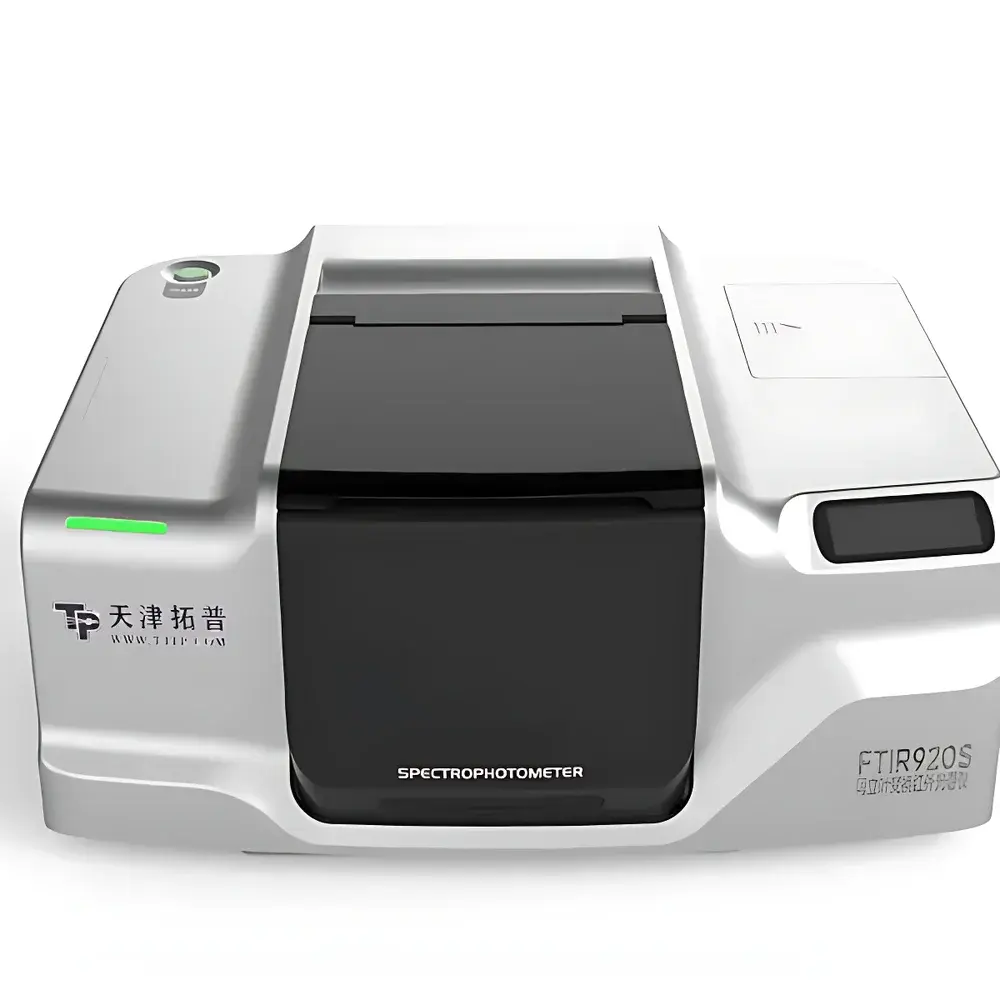
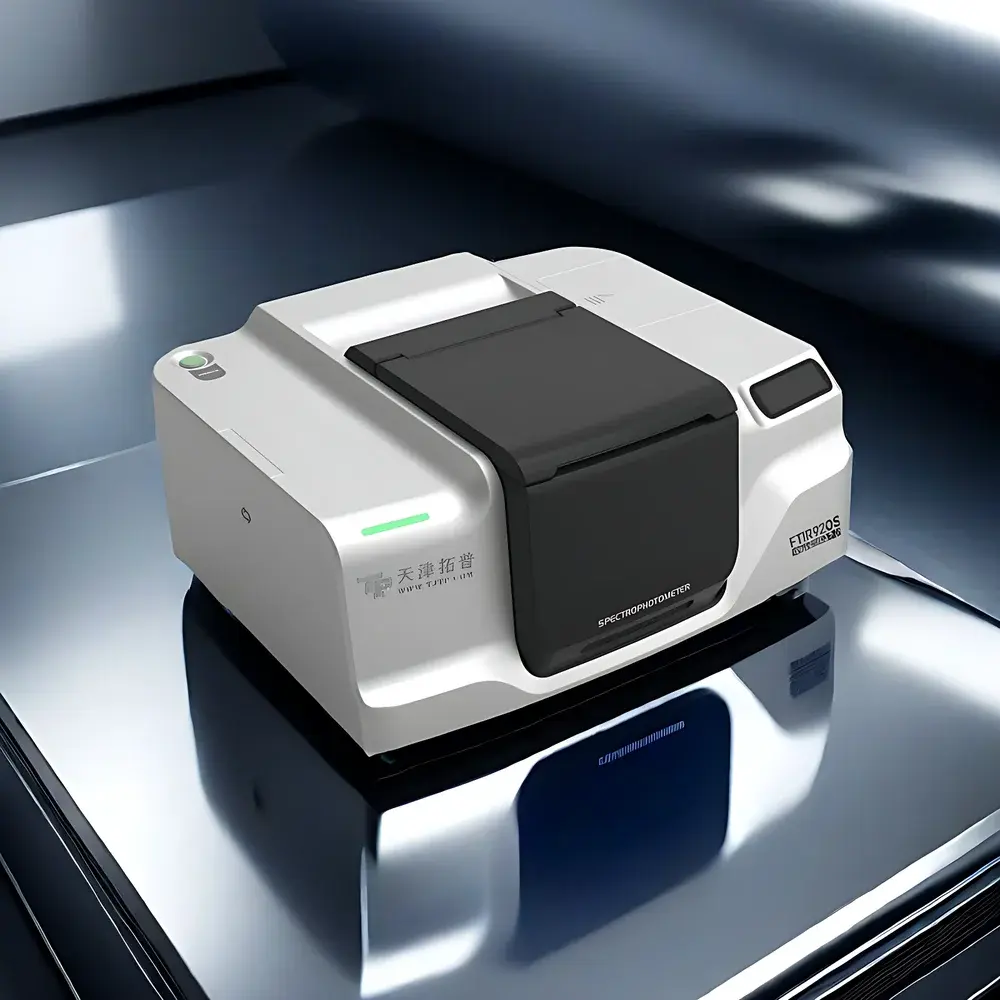
Topo FTIR920S Fourier Transform Infrared Spectrometer
| Brand | Topo (TP) |
|---|---|
| Origin | Tianjin, China |
| Manufacturer Type | OEM Manufacturer |
| Instrument Type | Laboratory FTIR |
| Wavenumber Range | 7800–350 cm⁻¹ |
| Resolution | <1.0 cm⁻¹ |
| Scan Speed | Up to 1 scan per 2 seconds (microprocessor-controlled) |
| Signal-to-Noise Ratio | 30,000:1 (at 4 cm⁻¹, 1 min scan, MCT detector not included) |
| Wavenumber Accuracy | ±0.01 cm⁻¹ |
Overview
The Topo FTIR920S is a laboratory-grade Fourier Transform Infrared (FTIR) spectrometer engineered for precision, stability, and operational flexibility in academic teaching, fundamental research, and routine industrial quality control. Based on the Michelson interferometer architecture with active alignment compensation, the system delivers high optical throughput and exceptional spectral fidelity across the mid-infrared region (7800–350 cm⁻¹). Its robust optical design—featuring a sealed, monolithic optical bench and thermally stabilized interferometer core—ensures long-term baseline stability and minimal drift under variable ambient conditions. The instrument operates on the principle of interferometric modulation of broadband infrared radiation, followed by Fourier transformation of the resulting interferogram to yield high-resolution absorption/transmission spectra. This enables quantitative and qualitative molecular identification via vibrational mode analysis, supporting compliance-driven workflows in regulated environments.
Key Features
- High-Stability IR Source: Equipped with a high-intensity, low-noise ceramic globar source powered by digitally regulated DC supply, ensuring consistent radiant output and extended operational lifetime (>10,000 hours typical).
- Low-Noise Detection: Standard configuration includes a deuterated triglycine sulfate (DLATGS) detector with integrated thermoelectric cooling, optimized for high sensitivity in routine transmission and ATR measurements.
- Optimized Interferometer: Self-compensating Michelson design with dynamic alignment correction minimizes phase errors and maximizes optical energy throughput without manual realignment.
- Sealed Optical Architecture: Fully enclosed, vibration-damped optical baseplate isolates critical components from dust, moisture, and thermal gradients—critical for reproducible results in non-climate-controlled labs.
- Large Sample Compartment: 200 × 175 × 153 mm (W × D × H) sample chamber accommodates standard accessories including single-bounce ATR, liquid cells, KBr pellet holders, specular reflectance stages, and variable-angle reflection modules.
- Environmental Monitoring & Protection: Integrated LCD display (80 × 20 mm) shows real-time internal temperature and relative humidity; desiccant window with colorimetric indicator enables visual moisture status assessment; multi-point sealing supports integration with external dry-air or purge systems.
- Service-Friendly Design: External interferometer energy adjustment port allows rapid optimization post-maintenance without optical re-alignment or disassembly.
Sample Compatibility & Compliance
The FTIR920S supports diverse sampling modalities without hardware modification: transmission (KBr pellets, thin films), attenuated total reflectance (ATR), diffuse reflectance (DRIFTS), and specular reflection. Its modular accessory interface conforms to ISO 17025-aligned installation practices. The system meets calibration traceability requirements per GB/T 21186–2007 (Chinese national standard for FTIR performance verification) and JJF 1319–2011 (metrological verification regulation). Full GMP/GLP compliance is enabled through configurable electronic signatures, role-based user permissions, and audit-trail logging meeting FDA 21 CFR Part 11 criteria. Optional IQ/OQ/PQ documentation packages are available for regulated pharmaceutical and materials manufacturing facilities.
Software & Data Management
Bundled TopoSpectra™ software provides dual-language (English/Chinese) operation on Windows 11 (64-bit) and later. It supports full spectral acquisition, processing, and reporting—including peak picking, spectral subtraction, Savitzky-Golay smoothing, baseline correction, and absorbance/transmittance conversion. Advanced modules include QC pass/fail comparison against reference libraries, 2D correlation spectroscopy (2D-COS), and automated hydroxyl quantification in fused silica per ASTM C1039. Data export options include CSV, TXT, JCAMP-DX, and native .spc formats; wavenumber (cm⁻¹) and wavelength (µm) scales are interconvertible within the interface. The software integrates with third-party platforms (e.g., Thermo OMNIC-compatible spectral search engines) via standardized API hooks and supports cloud-based data synchronization when equipped with optional Wi-Fi module.
Applications
The FTIR920S serves cross-disciplinary analytical needs: polymer identity verification and degradation monitoring (ASTM D3677); pharmaceutical excipient characterization and counterfeit detection; asphalt binder compositional profiling (AASHTO T302); building glass thermal emissivity modeling (ISO 10292); and quantitative OH-content analysis in quartz optics (IEC 61290-1-3). Its high signal-to-noise ratio and sub-0.01 cm⁻¹ wavenumber accuracy make it suitable for subtle conformational studies in protein secondary structure analysis and low-concentration contaminant screening in semiconductor-grade solvents.
FAQ
What interferometer design does the FTIR920S use?
It employs a self-compensating Michelson interferometer with active alignment stabilization, eliminating the need for periodic manual recalibration.
Is the system compatible with GLP/GMP-regulated laboratories?
Yes—TopoSpectra™ software includes electronic signature capability, audit trail generation, and user access controls aligned with FDA 21 CFR Part 11 and ISO/IEC 17025 requirements.
Can I upgrade the detector after purchase?
The optical bench supports field-replaceable detectors; DLATGS may be substituted with an optional liquid-nitrogen-cooled MCT detector for enhanced sensitivity in research applications.
Does the instrument support automated calibration verification?
Yes—built-in polystyrene film validation routines comply with GB/T 21186–2007 and enable daily performance checks with documented traceability.
What data formats can be exported for LIMS integration?
CSV, TXT, JCAMP-DX, and XML-based reports are supported; spectral metadata (date, operator ID, instrument serial, calibration status) is embedded in all exports.



