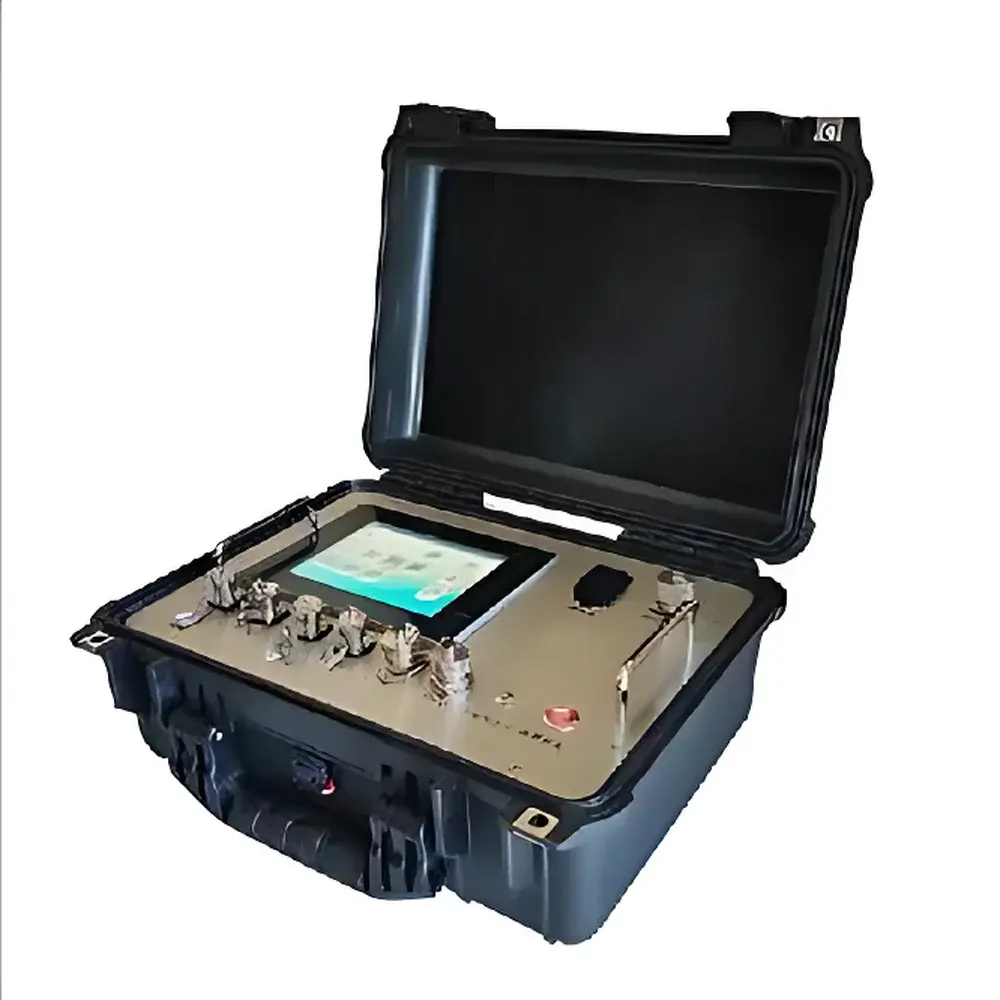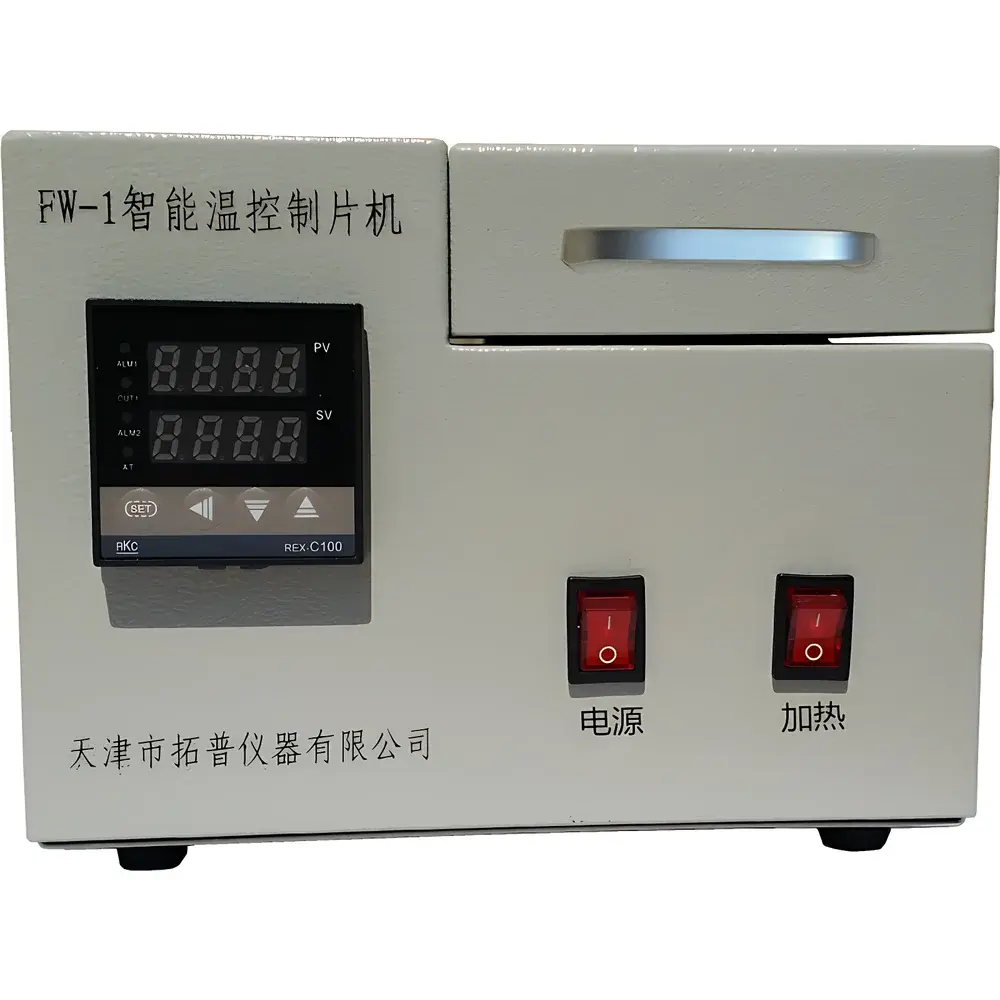
Topo FW-1 Intelligent Temperature-Controlled Pellet Press
| Brand | Topo |
|---|---|
| Model | FW-1 |
| Type | Benchtop Heated Hydraulic Pellet Press |
| Origin | Tianjin, China |
| Power Supply | AC 220 V, 50 Hz |
| Temperature Range | Ambient to 300 °C |
| Temperature Control Accuracy | ±3% of setpoint |
| Setpoint Resolution | ±5% |
| Heating Linearity | ±4% |
| Standard Die Set | Internal Diameter Ø15 mm |
| Thickness Options | 0.1 mm, 0.05 mm, 0.025 mm |
| Dimensions (W×D×H) | 183 mm × 115 mm × 114 mm |
| Weight | <5 kg |
| Compliance | Designed for ISO/IEC 17025-compliant sample preparation workflows |
Overview
The Topo FW-1 Intelligent Temperature-Controlled Pellet Press is a compact, manually operated benchtop hydraulic press engineered for reproducible, thermally stabilized solid-sample preparation—specifically optimized for spectroscopic analysis. It operates on the principle of simultaneous uniaxial compression and conductive heating, enabling users to consolidate powdered or granular specimens into uniform, free-standing thin films or pellets under controlled thermal conditions. Unlike ambient-only presses, the FW-1 integrates dual-channel PID temperature regulation to maintain stable thermal profiles during pressing—critical for minimizing thermal degradation, ensuring consistent crystallinity, and improving spectral baseline fidelity in downstream FTIR, Raman, or XRF measurements. Its design targets laboratories requiring traceable, repeatable sample conditioning without reliance on external ovens or vacuum systems.
Key Features
- LED digital display with real-time temperature readout and manual continuous adjustment—enabling precise setpoint tuning without software dependency
- Dual-channel temperature controller: one channel monitors heater block temperature; the second provides redundant feedback for enhanced stability during prolonged dwell cycles
- Integrated heating plate with uniform thermal distribution across the die cavity (±2 °C spatial variation at 250 °C)
- Compact footprint (183 × 115 × 114 mm) and low mass (<5 kg) facilitate placement inside fume hoods, gloveboxes, or shared instrument benches
- Interchangeable stainless-steel die sets with standardized Ø15 mm internal diameter and three nominal thicknesses: 0.100 mm, 0.050 mm, and 0.025 mm—each certified for parallelism ≤5 µm
- Hydraulic pressure transmission system rated for maximum compressive force ≥10 tonnes (equivalent to ~56 MPa at Ø15 mm), with mechanical pressure retention during cooling
Sample Compatibility & Compliance
The FW-1 accommodates a broad range of inorganic, polymeric, and composite powders—including KBr, NaCl, CsI, PTFE, LiCoO₂, perovskite precursors, and metal-organic frameworks—provided particle size distributions fall within D₉₀ < 45 µm. All standard dies comply with ASTM E1977–22 (Standard Practice for Preparation of Solid Samples for Infrared Spectroscopy) and are compatible with ISO 1833–2:2021 (Textiles — Quantitative chemical analysis — Part 2: Binary mixtures of certain fibres). The unit’s thermal and mechanical calibration protocol supports GLP documentation requirements; optional NIST-traceable temperature verification kits (Pt100 probe + calibrator) are available upon request. No vacuum or inert gas purging is built-in, but the die assembly permits retrofitting with O-ring sealed top plungers for controlled-atmosphere pressing.
Software & Data Management
The FW-1 is hardware-controlled with no embedded microprocessor or digital interface—ensuring electromagnetic compatibility in spectrometer-dense environments and eliminating firmware update dependencies. Temperature setpoints and dwell times are recorded manually in lab notebooks or LIMS-compatible spreadsheets. For labs requiring audit trails, Topo provides a companion PDF-based Standard Operating Procedure (SOP) template aligned with FDA 21 CFR Part 11 Annex 11 expectations—detailing equipment qualification (IQ/OQ), operator training logs, and periodic temperature uniformity mapping procedures. Raw thermal performance data (e.g., ramp rate validation curves, steady-state deviation histograms) can be exported from optional external data loggers (e.g., Omega OM-DAQPRO-5300) interfaced via analog 4–20 mA output.
Applications
- FTIR sample preparation: fabrication of KBr pellets for quantitative organic functional group analysis (per USP and EP 2.2.24)
- Battery electrode characterization: cold/hot pressing of cathode slurries (NMC, LFP) onto current collectors for cross-sectional SEM-EDS correlation
- Building material QA: consolidation of cementitious or geopolymer powders into discs for XRF elemental mapping and hydration phase identification
- Superconductor research: oxygen-sensitive pellet formation of YBCO or MgB₂ under nitrogen-purged dies (user-modified)
- Pharmaceutical solid-state screening: thermal-assisted compaction of API-excipient blends to assess polymorphic stability prior to DSC or PXRD
FAQ
What is the maximum recommended operating temperature for continuous use?
The FW-1 is rated for sustained operation up to 280 °C; 300 °C is an absolute upper limit for short-duration (≤10 min) calibration or process validation.
Can the FW-1 be used with corrosive halide salts like KBr without compromising heater longevity?
Yes—standard dies feature passivated 316L stainless steel construction; however, post-use cleaning with anhydrous ethanol and immediate drying are mandatory to prevent chloride-induced pitting.
Is die alignment adjustable to correct for minor parallelism drift over time?
No—die flatness is factory-lapped and non-adjustable; users should perform quarterly visual inspection under monochromatic light to detect interference fringes indicating warpage.
Does Topo offer GMP-compliant documentation packages for regulated labs?
Yes—upon order confirmation, Topo supplies a Device Master Record (DMR) including material certifications (EN 10204 3.1), pressure calibration certificates, and thermal mapping reports conducted per ASTM E74-23.
Are custom die geometries (e.g., Ø25 mm or stepped thickness profiles) available?
Yes—custom tooling is manufactured to ISO 2768-mK tolerances; lead time is 6–8 weeks, and NRE charges apply based on complexity and metrology validation scope.