
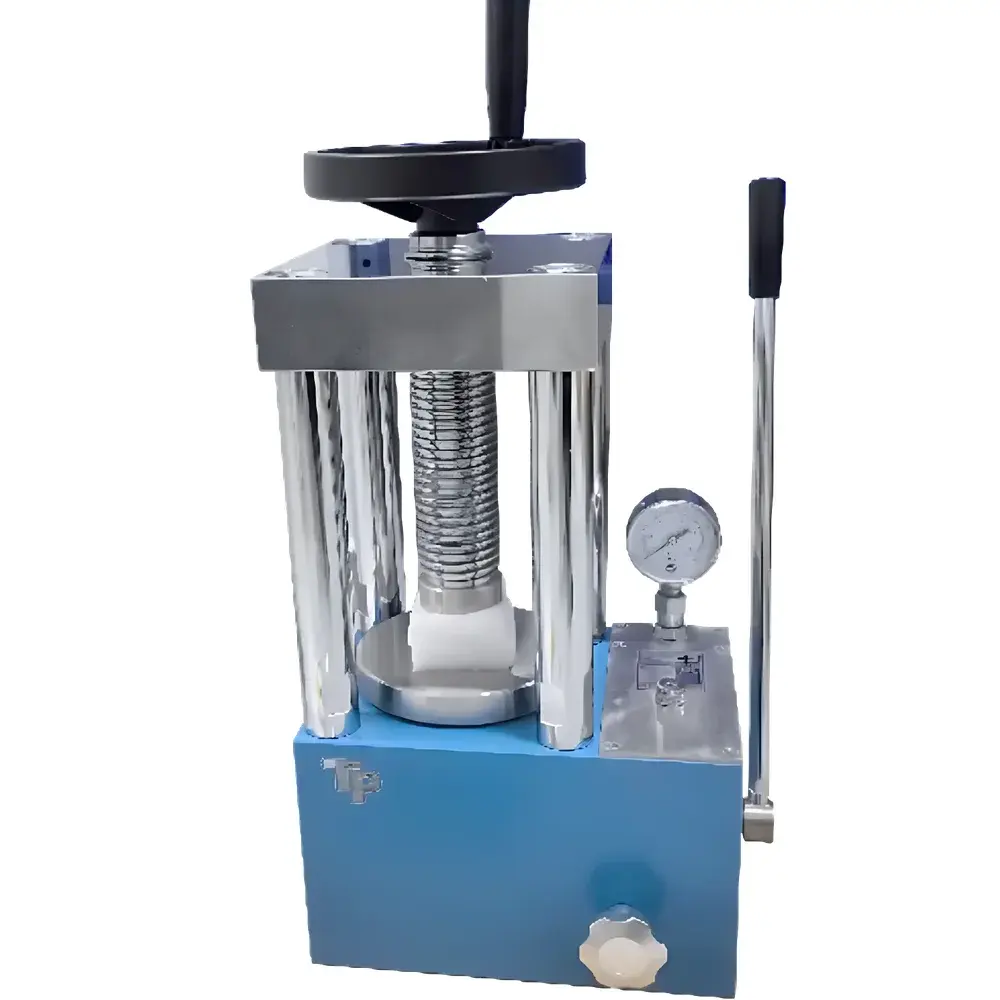
Topo FW-30 / FW-40 / FW-60 Hydraulic Powder Press
| Brand | Topo (TP) |
|---|---|
| Origin | Tianjin, China |
| Manufacturer Type | Direct Manufacturer |
| Model Series | FW-30, FW-40, FW-60 |
| Max Pressure | 30 ton / 40 ton / 60 ton |
| Piston Diameter | Φ100 mm / Φ130 mm / Φ150 mm |
| Piston Stroke | 40 mm / 50 mm / 50 mm |
| Column Count | 4 |
| Column Spacing | 92×160 mm / 106×185 mm / 185×250 mm |
| Dimensions (W×D×H) | 275×195×420 mm / 295×215×500 mm / 405×240×565 mm |
| Weight | 56 kg / 80 kg / 150 kg |
Overview
The Topo FW-30, FW-40, and FW-60 series are manually operated, four-column hydraulic powder compaction presses engineered for reproducible, high-force sample preparation in analytical, materials science, and quality control laboratories. These instruments apply uniaxial compressive force via a precision-machined hydraulic cylinder to consolidate powdered specimens—including ceramics, metal oxides, pharmaceutical actives, catalysts, and geological samples—into dense, geometrically stable pellets suitable for X-ray fluorescence (XRF), Fourier-transform infrared (FTIR), X-ray diffraction (XRD), and elemental analysis. Each model operates on the principle of Pascal’s law, utilizing mineral-oil-based hydraulic transmission to convert hand-pump pressure into calibrated, static compressive load. The rigid C-frame architecture with four hardened steel columns ensures minimal frame deflection (<0.02 mm under maximum load), critical for maintaining parallelism between upper and lower platens and achieving uniform density distribution across pellet cross-sections.
Key Features
- Four-column structural design with high-tensile steel columns and precision-ground guide surfaces—ensures axial alignment stability and minimizes eccentric loading during compression.
- Manually actuated hydraulic system with integrated pressure gauge (dual-scale: MPa and ton-force) enabling real-time load monitoring with ±1.5% full-scale accuracy per ISO 7500-1 Class 2 compliance.
- Interchangeable platen sets (standard: 13 mm, 25 mm, 32 mm, and 50 mm diameter) with flatness tolerance ≤2 µm; optional hardened stainless-steel or tungsten-carbide coated platens available for abrasive or reactive powders.
- Adjustable stop mechanism for repeatable piston stroke control—critical for standardizing pellet thickness in regulated environments (e.g., ASTM E1361 for XRF pellet preparation).
- Self-contained oil reservoir with air-bleed valve and sealed piston seal assembly—reduces maintenance frequency and prevents hydraulic fluid contamination over extended service life.
- CE-compliant mechanical safety guard and dual-hand operation interlock (optional upgrade) meet EN 692 requirements for manual press equipment.
Sample Compatibility & Compliance
These presses accommodate free-flowing, cohesive, and nanostructured powders with particle sizes ranging from 500 µm. They support binder-free cold pressing as well as slurry-based wet compaction when used with die sets featuring vented cavities. All models comply with ISO 14644-1 Class 8 cleanroom compatibility for controlled environment deployment. Documentation packages include Factory Acceptance Test (FAT) reports, traceable calibration certificates (NIST-traceable pressure transducer verification), and conformity declarations aligned with EU Machinery Directive 2006/42/EC. For regulated pharmaceutical labs, optional IQ/OQ documentation kits are available to support FDA 21 CFR Part 11–aligned validation protocols.
Software & Data Management
While the FW-series is primarily analog/manual, digital integration options are available via optional USB-connected load-monitoring modules (Topo LoadLink™). This add-on provides real-time force-time curve logging, automatic peak-load capture, and CSV export compatible with LIMS platforms such as LabVantage and Thermo Fisher SampleManager. Audit trails record operator ID, timestamp, target pressure, actual achieved load, and dwell duration—supporting GLP/GMP data integrity requirements. Firmware updates and configuration backups are managed through Topo’s secure cloud portal, accessible only via authenticated institutional credentials.
Applications
- Preparation of homogeneous pressed pellets for quantitative XRF analysis of ores, alloys, and environmental soils (per ASTM D5630 and ISO 29581-2).
- Compaction of LiCoO₂, NMC, and solid-electrolyte powders for battery electrode R&D—enabling controlled porosity studies via mercury intrusion porosimetry post-pressing.
- Manufacture of KBr or polyethylene matrix pellets for FTIR transmission spectroscopy, ensuring minimal spectral interference and consistent pathlength.
- High-pressure densification of refractory ceramic precursors (e.g., Al₂O₃, ZrO₂) prior to sintering trials—facilitating green-body strength evaluation per ISO 14702.
- Standardized tablet formation for dissolution testing method development in pharmaceutical QA/QC workflows (aligned with USP <1092>).
FAQ
What is the recommended maintenance interval for the hydraulic system?
Topo recommends biannual inspection of hydraulic oil level and clarity, annual replacement of seals and filter elements, and recalibration every 12 months or after 5,000 operational cycles—whichever occurs first.
Can I use custom dies with non-standard diameters?
Yes. The platen mounting interface follows ISO 8015 standardized threading (M24×1.5), allowing third-party or in-house machined dies up to 75 mm in outer diameter and 40 mm cavity depth.
Is technical support available outside mainland China?
Yes. Topo maintains certified service partners in Germany, USA, and Singapore; remote diagnostics and English-language engineering support are provided within 4 business hours during CET working days.
Do these presses meet ISO/IEC 17025 requirements for accredited testing labs?
When paired with accredited calibration services and documented SOPs for load application and dwell time control, the FW-series meets metrological traceability requirements outlined in ISO/IEC 17025:2017 clause 6.4.6 for mechanical testing equipment.




