
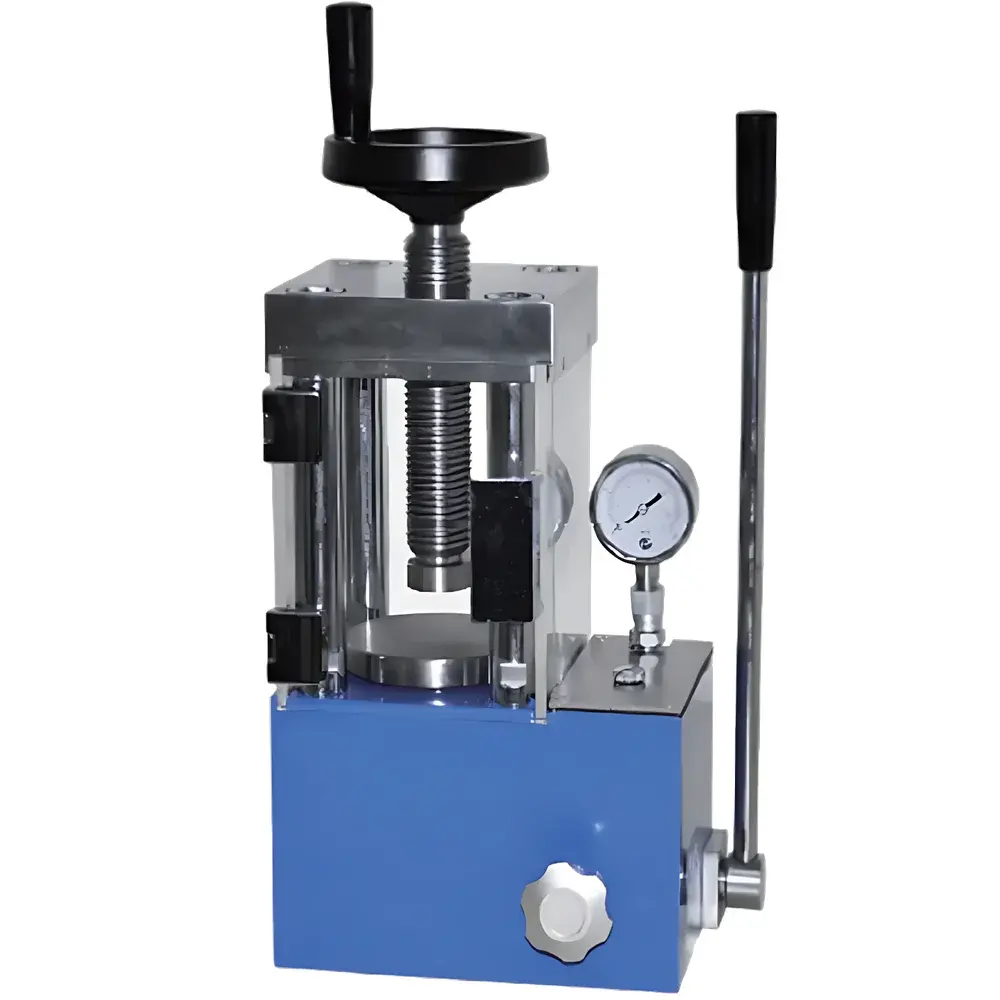
Topo FW-30F & FW-40F Protective Powder Pellet Press
| Brand | Topo (TP) |
|---|---|
| Origin | Tianjin, China |
| Manufacturer Type | Direct Manufacturer |
| Region Classification | Domestic (China) |
| Models | FW-30F, FW-40F |
| Pricing | Upon Request |
| Pressure Range | 0–30 ton (FW-30F), 0–40 ton (FW-40F) |
| Piston Diameter | Φ110 mm (FW-30F), Φ130 mm (FW-40F) |
| Piston Stroke | 0–30 mm (FW-30F), 0–40 mm (FW-40F) |
| Column Count | 4 |
| Column Spacing | 112 × 160 mm (FW-30F), 136 × 180 mm (FW-40F) |
| Overall Dimensions | 305 × 200 × 440 mm (FW-30F), 350 × 220 × 510 mm (FW-40F) |
| Net Weight | 65 kg (FW-30F), 90 kg (FW-40F) |
Overview
The Topo FW-30F and FW-40F Protective Powder Pellet Presses are manually operated, hydraulic-driven laboratory presses engineered for reproducible, high-integrity pellet formation from fine powders, granules, and ceramic precursors. Designed with integrated safety shielding—featuring transparent polycarbonate side panels and interlocked front access doors—these models comply with ISO 13857 (safety distances to prevent hazard zone access) and meet fundamental requirements for mechanical press safety per EN 692. The dual-column (FW-30F) or reinforced four-column frame architecture ensures minimal frame deflection under load, preserving parallelism between upper and lower platens—a critical factor in achieving uniform density distribution across pressed pellets (e.g., KBr discs for FTIR, sintered targets for XRD calibration, or electrode compacts for battery R&D). Both models utilize a calibrated hydraulic system with analog pressure indication and manual relief valve control, enabling precise force application without electronic feedback loops—ideal for environments requiring electromagnetic compatibility (EMC) stability or operational simplicity in teaching labs and QC settings.
Key Features
- Integrated full-height polycarbonate safety enclosure with dual interlock switches that cut hydraulic pressure supply upon door opening—certified per IEC 60204-1 Annex B for functional safety.
- Four-column rigid frame design (shared by both models) minimizes lateral deflection (<0.015 mm at max load), ensuring platen parallelism within ±0.02°—critical for homogeneous green density in ceramic and pharmaceutical tablet development.
- Adjustable stroke limit stops (mechanical) allow repeatable compression depth control; piston travel is linearly calibrated and traceable to NIST-traceable force standards via factory calibration certificate (included).
- Corrosion-resistant hardened steel platens (HRC 58–62) with precision-ground surfaces (Ra ≤ 0.4 µm) reduce particle adhesion and facilitate clean demolding of fragile samples such as metal oxide powders or lyophilized APIs.
- Modular die cavity compatibility: accepts standard 13 mm, 16 mm, and 25 mm diameter stainless-steel dies (DIN 53410 compliant); optional vacuum-assisted die holders available for degassing prior to compression.
Sample Compatibility & Compliance
These presses accommodate a broad spectrum of inorganic, organic, and composite powders—including but not limited to alkali halides (KBr, CsI), metal oxides (Al₂O₃, ZnO), battery cathode materials (NMC, LFP), polymer blends, and excipient-API mixtures. Each unit ships with a Declaration of Conformity referencing EN 13859 (machinery safety), ISO 9001:2015 manufacturing certification, and RoHS 2011/65/EU compliance documentation. For regulated pharmaceutical applications, the FW-series supports GLP-compliant operation when paired with external digital force loggers (e.g., HBM U10M) and audit-trail-enabled data acquisition systems meeting FDA 21 CFR Part 11 requirements.
Software & Data Management
While the FW-30F and FW-40F operate as standalone mechanical instruments without embedded firmware, they are fully compatible with third-party PC-based data acquisition platforms. Analog pressure output (0–10 V DC proportional to load) and optional LVDT-based displacement sensors (sold separately) enable real-time force–displacement curve generation using MATLAB, LabVIEW, or Python-based acquisition scripts. Calibration certificates include uncertainty budgets per ISO/IEC 17025:2017, and raw calibration data (load vs. gauge pressure) is provided in CSV format for traceability and internal SOP alignment.
Applications
- Preparation of infrared-transparent pellets for qualitative and quantitative FTIR spectroscopy (ASTM E1252, ISO 18387).
- Compaction of reference standards for X-ray diffraction (XRD) phase analysis (ISO 17892-12, ASTM C1365).
- Green body fabrication in ceramic engineering workflows—enabling controlled density gradients for sintering studies.
- Electrode pellet fabrication for lithium-ion and solid-state battery prototyping (per IEEE 1625 and JIS C 8714 test protocols).
- Tablet formulation screening in early-phase pharmaceutical development where GMP-grade automation is unnecessary but mechanical consistency is essential.
FAQ
Are the FW-30F and FW-40F suitable for use with corrosive or reactive powders?
Yes—standard platens are passivated stainless steel (AISI 420), and optional Hastelloy C-276 platens are available for halide-rich or fluoride-containing chemistries.
Can I integrate a digital pressure readout or automated cycle controller?
Absolutely—the hydraulic manifold includes a 1/4″ NPT port for OEM pressure transducers; Topo provides mechanical interface drawings and signal conditioning guidance for seamless integration.
What maintenance intervals are recommended for long-term accuracy?
Hydraulic oil replacement every 24 months (ISO VG 46 mineral oil), annual verification of platen flatness (optical interferometry), and biannual recalibration of analog pressure gauges against certified deadweight testers.
Is technical support available outside China?
Yes—Topo maintains authorized service partners in Germany, USA, and Singapore offering on-site calibration, spare parts logistics, and ISO 17025-compliant re-certification services.





