
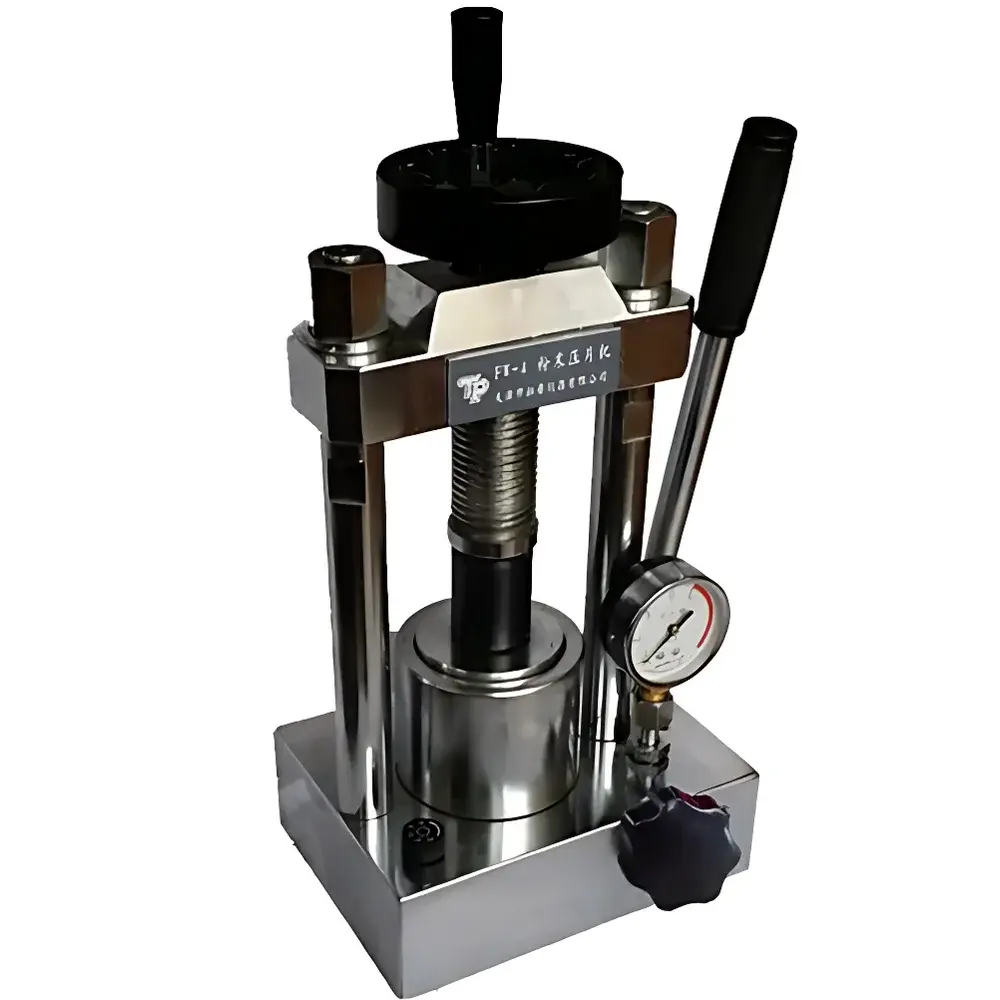
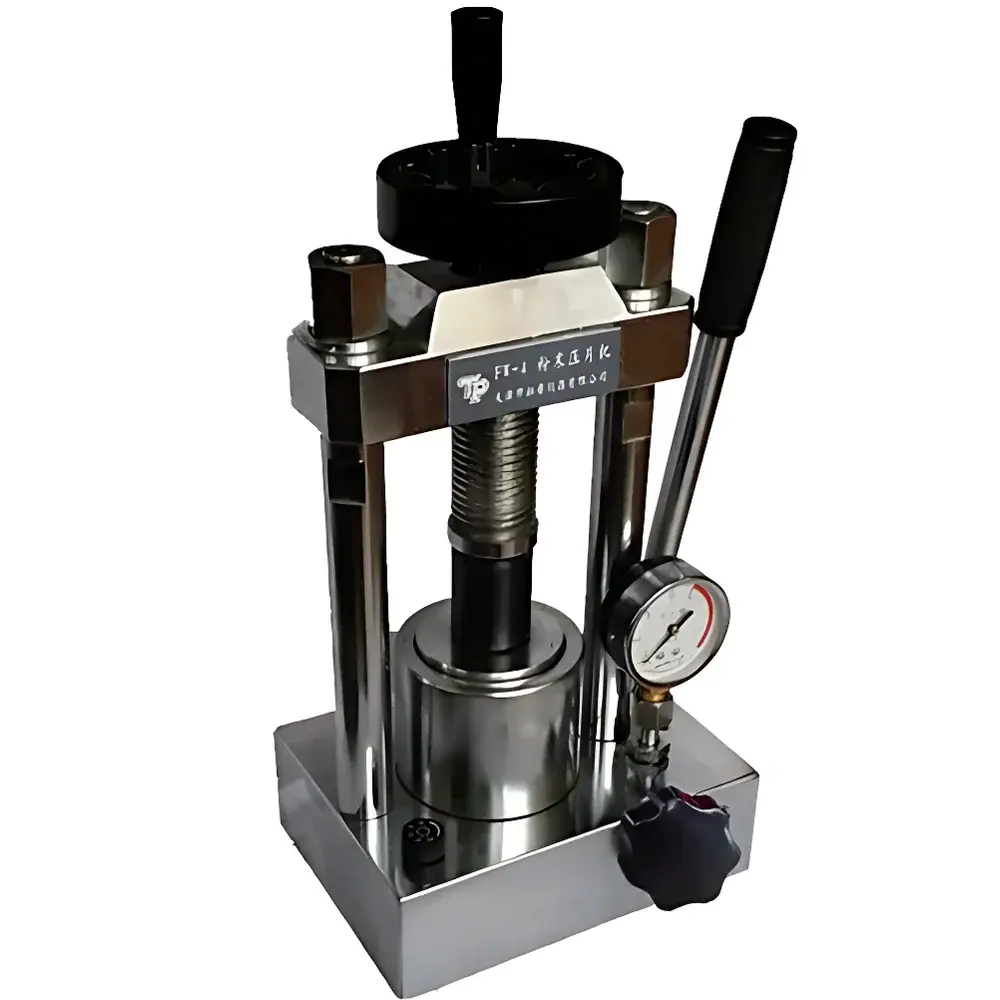
Topo FW-4 Manual Hydraulic Pellet Press
| Brand | Topo |
|---|---|
| Origin | Tianjin, China |
| Manufacturer Type | Direct Manufacturer |
| Country of Origin | China |
| Model | FW-4 |
| Instrument Type | Manual Hydraulic Pellet Press |
| Maximum Pressure | 24 tons (235.4 kN) |
| Piston Diameter | Ø90 mm |
| Stroke Length | 20 mm |
| Net Weight | 24.5 kg |
| Working Chamber Dimensions | 120 × 120 mm |
| Overall Dimensions | 200 × 150 × 420 mm |
| Packaging | Wooden Crate |
| Warranty | 12 months standard warranty, lifetime technical support and repair service |
Overview
The Topo FW-4 Manual Hydraulic Pellet Press is a precision-engineered laboratory instrument designed for reproducible preparation of uniform solid pellets from powdered samples. It operates on a manually actuated hydraulic principle, where force is transmitted via an incompressible fluid medium to generate controlled, stable pressure across the sample die cavity. This mechanical architecture eliminates dependency on external power sources or complex control systems, making it ideal for routine sample preparation in analytical laboratories performing X-ray fluorescence (XRF), Fourier-transform infrared spectroscopy (FTIR), X-ray diffraction (XRD), and elemental analysis workflows. The press delivers a maximum nominal force of 24 tons (235.4 kN), sufficient to compact a wide range of inorganic oxides, geological standards, pharmaceutical excipients, catalysts, and ceramic precursors into dense, low-porosity discs with minimal binder requirement—critical for minimizing spectral interference and ensuring quantitative accuracy.
Key Features
- Robust cast-iron frame with precision-machined hydraulic cylinder housing, engineered for long-term dimensional stability and load retention.
- Manually operated dual-stage hydraulic pump system enabling fine pressure control and smooth, vibration-free loading—essential for minimizing particle rearrangement during compaction.
- Large working chamber (120 × 120 mm) accommodating standard die sets (e.g., 13 mm, 25 mm, 32 mm, and 40 mm diameter) as well as custom tooling for specialized applications.
- 20 mm piston stroke ensures full engagement of high-height dies and accommodates multi-layer pellet stacking or spacer-based thickness calibration protocols.
- Compact footprint (200 × 150 × 420 mm) and lightweight design (24.5 kg) facilitate benchtop integration in space-constrained QA/QC labs or mobile analytical units.
- Corrosion-resistant surface finish and sealed hydraulic circuit minimize maintenance requirements and extend service life under routine laboratory conditions.
Sample Compatibility & Compliance
The FW-4 supports diverse powder matrices including but not limited to metal oxides (Al₂O₃, SiO₂, Fe₂O₃), mineral standards (USGS, NIST SRMs), soil digests, fly ash, polymer blends, and pharmaceutical APIs. Its manual operation and absence of electronic controllers ensure intrinsic compliance with environments requiring electromagnetic compatibility (EMC)-free instrumentation. While the unit itself does not carry CE or UL certification, its mechanical design aligns with ISO 17025-recommended practices for sample preparation traceability when used in conjunction with calibrated pressure gauges and documented SOPs. For regulated industries (e.g., pharmacopeial testing per USP or ASTM E1317), users may integrate optional analog pressure transducers with data loggers to satisfy GLP/GMP audit requirements for process documentation.
Software & Data Management
As a purely mechanical device, the FW-4 requires no embedded firmware, drivers, or proprietary software. Pressure application is monitored visually via an integrated analog pressure gauge (optional accessory), and all operational parameters—including applied force, dwell time, and die geometry—are recorded manually or within existing LIMS or ELN platforms. This architecture avoids regulatory complications associated with computerized systems (e.g., FDA 21 CFR Part 11 validation burdens), while supporting full auditability through standardized lab notebooks, digital image capture of pellet surfaces, and metadata tagging in compliant document management systems.
Applications
- Preparation of homogeneous pellets for wavelength-dispersive XRF (WDXRF) and energy-dispersive XRF (EDXRF) calibration and analysis.
- Formation of IR-transparent KBr or polyethylene matrix pellets for FTIR qualitative and quantitative analysis.
- Compaction of certified reference materials (CRMs) for inter-laboratory proficiency testing programs.
- Routine QC sampling in cement, mining, and metallurgical laboratories adhering to ISO 29581-1 and ASTM C114 protocols.
- Research-scale densification studies in materials science labs investigating green strength, binder migration, and porosity–density relationships.
FAQ
What is the maximum achievable pressure in MPa for a 13 mm diameter die?
Based on the 24-ton (235.4 kN) force and Ø13 mm area (132.7 mm²), the theoretical maximum pressure is approximately 1,775 MPa—though practical compaction pressures are typically maintained between 10–30 MPa depending on material compressibility and desired pellet integrity.
Can the FW-4 be used with vacuum or inert-gas die enclosures?
Yes—the open-top die cavity and modular upper/lower platen configuration allow integration with third-party vacuum die holders or glovebox-compatible pressing fixtures, provided mechanical clearances and alignment tolerances are maintained.
Is calibration of the hydraulic system required?
While the FW-4 does not include a built-in pressure sensor, periodic verification using a NIST-traceable hydraulic pressure calibrator is recommended every 6–12 months for labs operating under ISO/IEC 17025 or GMP frameworks.
Does Topo provide die sets or spare parts?
Yes—Topo offers a full catalog of stainless steel and hardened tool-steel dies (13 mm to 40 mm), spacers, alignment guides, and replacement O-rings, all supplied with dimensional certificates and material test reports upon request.



