
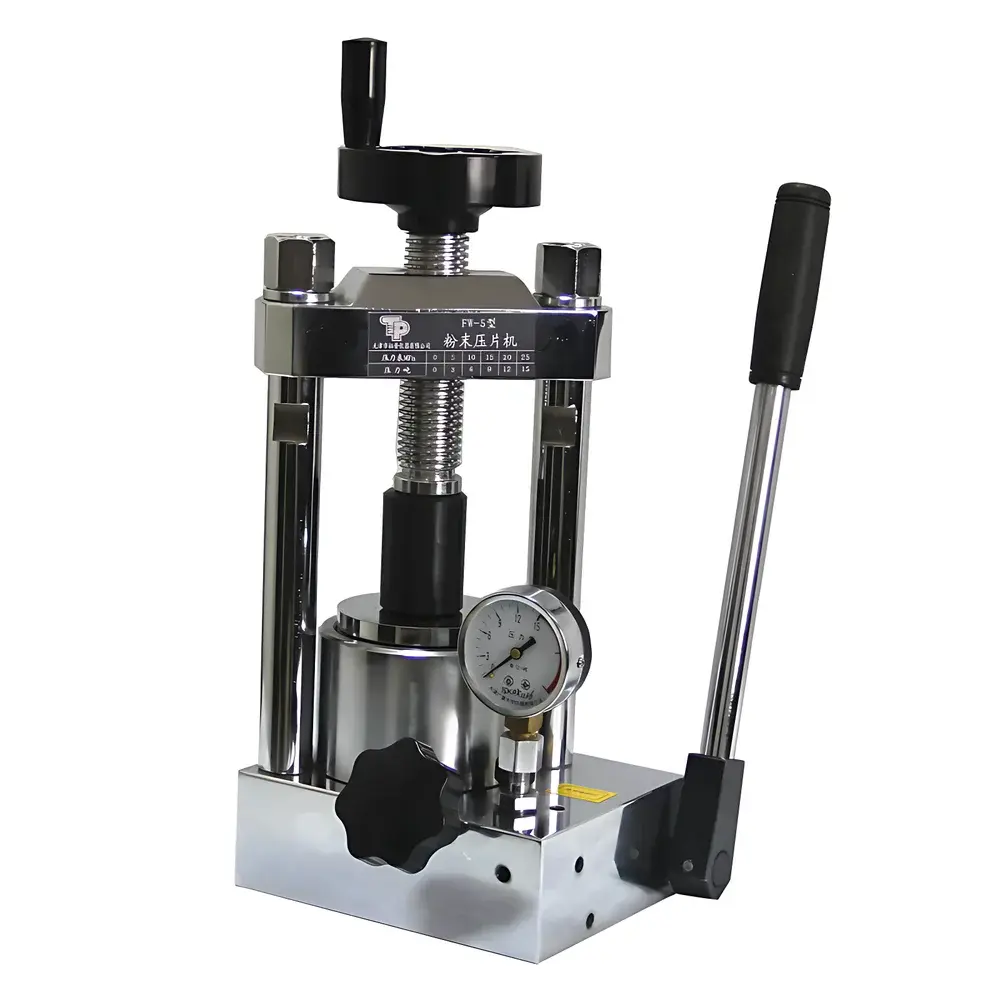
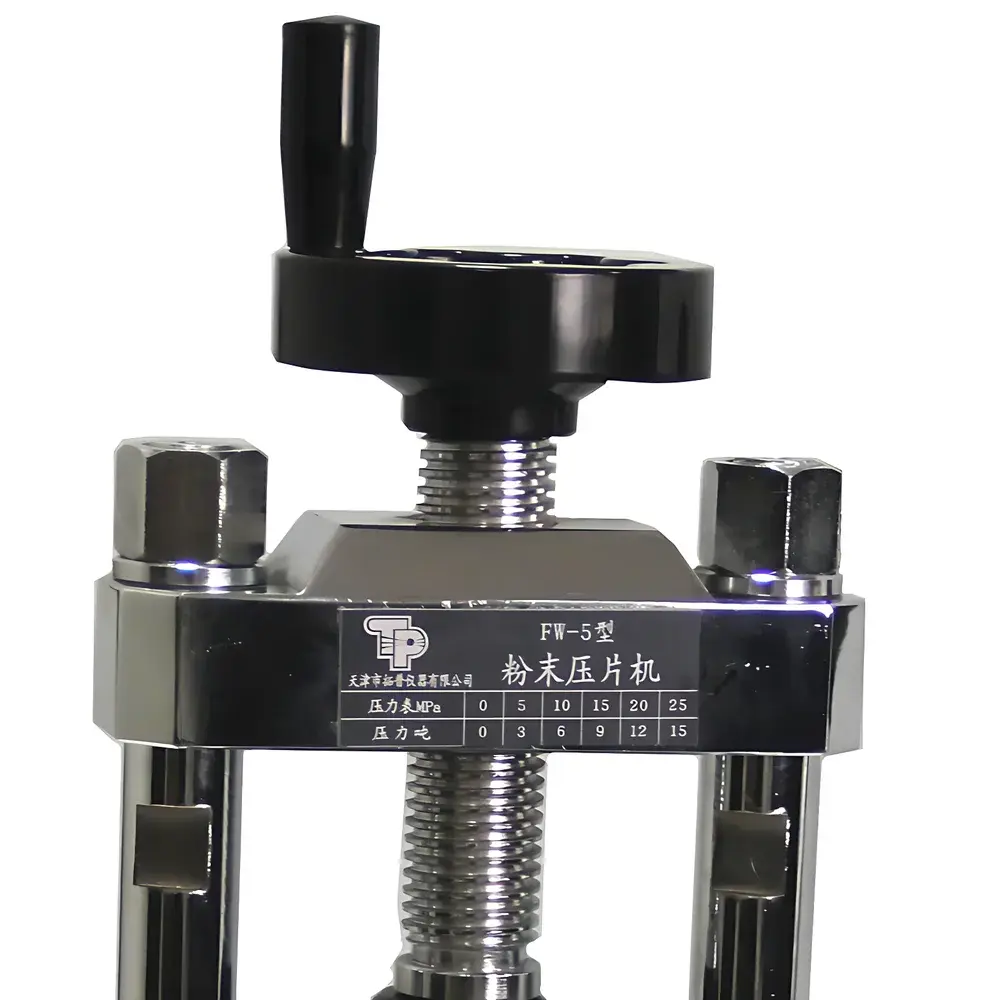
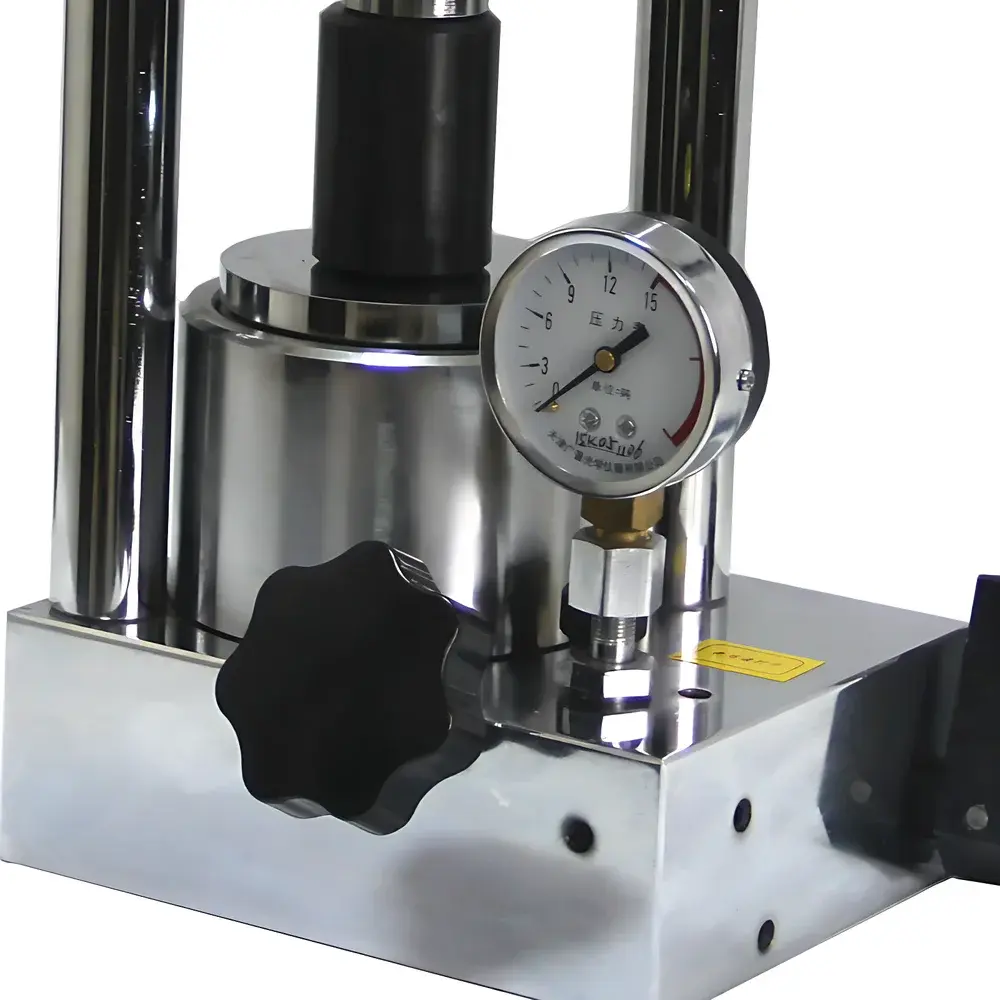
Topo FW-5 Manual Hydraulic Pellet Press
| Brand | Topo / TP |
|---|---|
| Origin | Tianjin, China |
| Manufacturer Type | Direct Manufacturer |
| Region of Origin | Domestic (China) |
| Model | FW-5 |
| Price Range | USD 140 – 700 |
| Instrument Type | Manual Hydraulic Pellet Press |
| Maximum Force Capacity | 0–15 t (147 kN) |
| Maximum Stroke | 30 mm |
| Piston Diameter | 90 mm |
| Working Chamber Dimensions | 110 mm × 120 mm |
| Oil Reservoir Capacity | 300 mL |
| Overall Dimensions | 200 mm × 140 mm × 420 mm |
| Operating Pressure Limit | ≤44 MPa |
Overview
The Topo FW-5 Manual Hydraulic Pellet Press is a precision-engineered laboratory instrument designed for the reproducible preparation of uniform, high-density pellets from powdered samples—primarily for Fourier Transform Infrared (FTIR) spectroscopy analysis. It operates on a simple yet robust hydraulic principle: manual force applied to a small-diameter input piston is amplified via Pascal’s law through an incompressible hydraulic fluid (ISO VG 46 mineral oil), generating controlled compressive loads up to 15 metric tons (147 kN) at the main working piston. Its compact footprint and vertical single-acting architecture make it ideal for integration into analytical workflows where space efficiency, mechanical stability, and operator control are prioritized over automation. Unlike motorized or pneumatic systems, the FW-5 delivers deterministic load application with zero electrical dependency—critical for labs operating under strict electromagnetic compatibility (EMC) constraints or in environments lacking stable power infrastructure.
Key Features
- Manual hydraulic actuation ensures full tactile feedback and precise incremental pressure control—essential for optimizing pellet density without sample degradation.
- Sturdy cast-iron frame with reinforced base and vertical column provides exceptional rigidity, minimizing lateral deflection during compression and ensuring consistent pellet thickness across repeated runs.
- Large working chamber (110 mm × 120 mm) accommodates standard FTIR die sets—including the compatible HF-2B mold—and permits simultaneous pressing of multiple small-diameter pellets (e.g., Ø13 mm or Ø32 mm).
- Calibrated pressure gauge (0–60 MPa range) enables direct correlation between applied hydraulic pressure and compressive force, supporting traceable method development per ISO/IEC 17025 requirements.
- Oil reservoir (300 mL) features sight-level indicator and sealed fill port; system includes integrated bleed valve and calibrated relief mechanism to prevent over-pressurization beyond 44 MPa (15 t limit).
- Compact form factor (200 × 140 × 420 mm) allows benchtop deployment adjacent to FTIR spectrometers without requiring dedicated floor space or anchoring—though optional bolt-down mounting is supported for high-throughput or vibration-sensitive labs.
Sample Compatibility & Compliance
The FW-5 supports a broad spectrum of inorganic and organic powders, including KBr, NaCl, CsI, BaF₂, and polymer blends used in transmission-mode FTIR sample preparation. It is routinely employed in quality control laboratories adhering to ASTM E1252 (Standard Practice for General Techniques for Qualitative Infrared Analysis) and USP (Infrared Absorption Spectrophotometry). The press itself conforms to ISO 7500-1:2018 (metallic materials — calibration of static uniaxial testing machines) for force measurement accuracy when used with certified reference dies and calibrated load cells. No electrical safety certifications (e.g., CE, UL) apply, as the device contains no powered components—however, its mechanical design complies with EN 692:2005+A1:2009 (safety requirements for mechanical presses) regarding structural integrity and overload protection.
Software & Data Management
As a purely mechanical instrument, the FW-5 does not incorporate embedded electronics, firmware, or digital interfaces. Consequently, it requires no software installation, network configuration, or cybersecurity validation. All operational parameters—including applied pressure, stroke position, and dwell time—are recorded manually in laboratory notebooks or electronic lab notebooks (ELNs) compliant with 21 CFR Part 11 when paired with audit-trail-enabled platforms (e.g., LabArchives, Benchling). For GLP/GMP environments, users may document press calibration history, oil maintenance logs, and die lot traceability separately to satisfy regulatory expectations for equipment qualification (IQ/OQ).
Applications
- Preparation of transparent KBr pellets for quantitative and qualitative FTIR analysis of pharmaceutical active ingredients, excipients, and counterfeit detection.
- Compaction of geological mineral powders for mid-IR spectral library generation under controlled pressure gradients (5–12 t).
- Routine QC of catalyst powders, battery electrode materials, and ceramic precursors prior to XRD or SEM characterization.
- Method development for attenuated total reflectance (ATR) accessory validation using pressed reference standards.
- Teaching laboratories requiring student-safe, low-complexity instrumentation for demonstrating solid-state sample preparation principles.
FAQ
What is the maximum safe operating pressure for the FW-5?
The rated maximum hydraulic pressure is 44 MPa, corresponding to 15 metric tons of compressive force. Exceeding this value risks seal failure, piston deformation, or catastrophic hydraulic fluid leakage.
Which die sets are compatible with the FW-5?
The press is engineered for use with the HF-2B series of stainless-steel die molds (e.g., Ø13 mm, Ø25 mm, Ø32 mm), though custom dies with outer diameters ≤110 mm may be accommodated within the working chamber.
How often should hydraulic oil be replaced?
Under normal usage (≤50 cycles/week), inspect oil clarity and level monthly; replace every 12 months or after 500 compression cycles—whichever occurs first—to maintain viscosity stability and prevent particulate-induced valve wear.
Is anchoring the press to the workbench mandatory?
Anchoring is not required for routine operation but is strongly recommended in shared labs or facilities subject to ambient vibration (e.g., near centrifuges or HVAC units) to preserve pellet thickness repeatability ±0.02 mm.
Can the FW-5 be used for cold isostatic pressing (CIP)?
No—the FW-5 applies uniaxial (not isostatic) load and lacks the sealed elastomeric mold cavity required for CIP. It is strictly intended for rigid-die, room-temperature compaction.



