
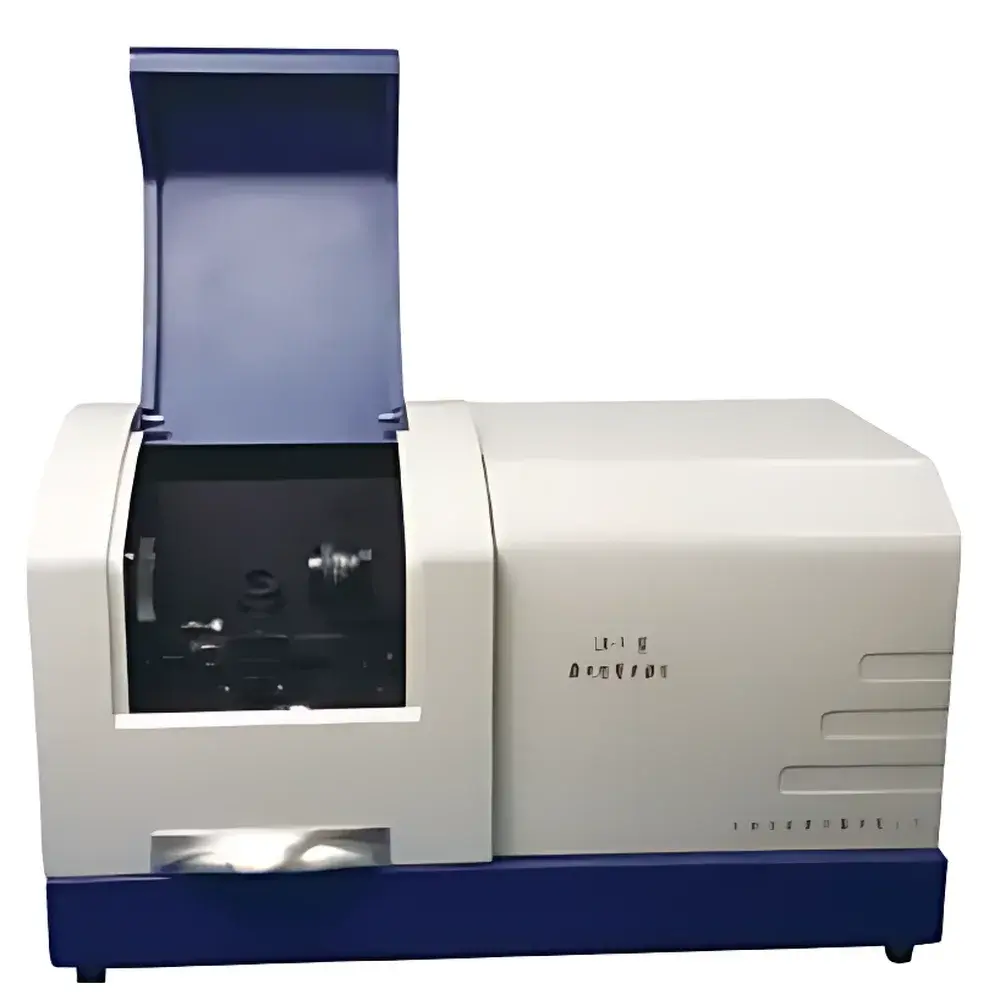
Topo LR-3 Advanced Raman Spectrometer
| Brand | Topo |
|---|---|
| Model | LR-3 |
| Type | Grating-Based Raman Spectrometer |
| Spectral Range | 200–800 nm |
| Spectral Resolution | ≤0.4 nm |
| Wavelength Accuracy | ≤0.4 nm |
| Wavelength Repeatability | ≤0.2 nm |
| Excitation Source | 532 nm Semiconductor Laser |
| Laser Power | ≥50 mW |
| Slit Mechanism | Motorized Auto-Adjustable (Precision: 0.01 mm) |
| Monochromator | f/5.5, 1200 lines/mm Grating |
| Detection | Photon-Counting PMT with Discriminator Circuitry |
| Sample Stages | 5-Axis Adjustable, Backscattering, Liquid Cuvette, Solid, Capillary, and Polarization-Compatible Mounts |
| Software Compatibility | Windows XP / 2000 / Vista |
| Origin | Tianjin, China |
| Manufacturer | Topo Instrument Co., Ltd. |
Overview
The Topo LR-3 Advanced Raman Spectrometer is a benchtop, grating-based dispersive Raman system engineered for high-fidelity vibrational spectroscopy of solids, liquids, crystals, and powders. It operates on the principle of inelastic light scattering—where monochromatic 532 nm laser excitation induces molecular vibrational transitions, generating Stokes and anti-Stokes Raman shifts that are spectrally resolved by a high-efficiency Czerny–Turner monochromator. The instrument’s optical architecture integrates a collimated excitation path, polarization-controllable external optics (including optional polarizers, waveplates, and analyzers), and a backscattering collection geometry optimized for signal-to-noise ratio and spatial reproducibility. Designed for pedagogical rigor and research-grade fidelity, the LR-3 delivers calibrated wavenumber accuracy traceable to NIST-traceable standards, supporting both qualitative fingerprinting and semi-quantitative analysis across academic teaching labs and applied materials characterization workflows.
Key Features
- Motorized auto-adjustable slit mechanism with 0.01 mm positional resolution—enabling rapid optimization of spectral resolution versus throughput without manual realignment.
- High-stability monochromator featuring a 1200 lines/mm holographic grating and f/5.5 optical design, delivering ≤0.4 nm spectral resolution across the full 200–800 nm detection range.
- 532 nm single-mode semiconductor laser with ≥50 mW output power, TEM00 beam profile, and integrated polarization control—ensuring consistent excitation conditions and enabling polarization-resolved Raman measurements.
- Modular external optical path accommodating polarization optics, notch filters, and fiber-coupled accessories—facilitating configuration flexibility for resonance Raman, micro-Raman, or stress/strain mapping setups.
- Five-axis precision sample stage with interchangeable mounts: vertical, backscattering, cuvette-based liquid holders, capillary tubes, and solid-sample clamps—supporting reproducible positioning under varied experimental geometries.
- Photon-counting detection system based on a low-noise photomultiplier tube (PMT) and fast-discrimination electronics, providing high dynamic range and sub-second acquisition capability for weak Raman signals.
Sample Compatibility & Compliance
The LR-3 accommodates diverse sample forms—including bulk crystalline solids, thin films, colloidal suspensions, organic solvents, gels, and biological tissues—via its configurable sample interface. All optical components comply with ISO 10110 surface quality specifications, and mechanical assemblies adhere to ISO 2768-mK general tolerances. While not certified for GMP production environments, the system supports GLP-aligned documentation practices: spectral data files include embedded metadata (timestamp, laser power, integration time, slit width, grating position), and software logs all user-initiated parameter changes—enabling audit-ready records per FDA 21 CFR Part 11 principles when deployed with validated IT infrastructure. The instrument meets CE electromagnetic compatibility (EMC) Directive 2014/30/EU and Low Voltage Directive 2014/35/EU requirements.
Software & Data Management
The LR-3 is controlled via TopoSpec v3.x—a native Windows application compatible with Windows XP, 2000, and Vista platforms. The software provides real-time spectrum preview, multi-scan averaging, baseline correction (asymmetric least squares), peak identification (with built-in Raman shift library for >1,200 compounds), and export to ASCII, CSV, or JCAMP-DX formats. Raw spectra retain full calibration coefficients; wavelength calibration is performed using Hg/Ne emission lines and stored in non-volatile memory. All acquisitions are timestamped and tagged with operator ID, instrument serial number, and environmental parameters (if connected to optional ambient sensors). Data integrity is enforced through write-once file generation and optional password-protected user roles.
Applications
- Undergraduate and graduate laboratory instruction in physical chemistry, solid-state physics, and materials science—demonstrating phonon modes, symmetry selection rules, and crystal lattice dynamics.
- Identification and verification of pharmaceutical polymorphs, excipients, and counterfeit drug formulations via spectral fingerprint matching against reference libraries.
- Characterization of carbon allotropes (graphene, nanotubes, diamond-like carbon) through G-band, D-band, and 2D-band intensity ratios and line-shape analysis.
- In situ monitoring of catalytic reactions and electrochemical processes using flow cells or custom electrochemical Raman cells.
- Stress/strain mapping in microelectronics packaging materials and thin-film semiconductor heterostructures using polarization-dependent Raman imaging protocols.
FAQ
What laser safety class does the LR-3 operate under?
The 532 nm laser subsystem is classified as Class IIIb per IEC 60825-1:2014; interlocked enclosure and key-switch operation ensure compliance with institutional laser safety programs.
Can the LR-3 be upgraded to support near-infrared excitation?
No—the optical train, grating blaze, and PMT detector are optimized for visible-range detection (200–800 nm); NIR configurations require fundamentally different gratings, detectors, and filtering schemes.
Is spectral calibration traceable to international standards?
Yes—wavelength calibration uses mercury and neon emission lines, which are NIST-traceable primary standards; calibration certificates are provided with each instrument shipment.
Does the software support automated batch processing of multiple samples?
Basic batch acquisition is supported; advanced scripting (e.g., Python API integration) requires third-party middleware and is not natively included in TopoSpec v3.x.
What maintenance is required for long-term wavelength stability?
Annual verification of grating mount alignment and detector dark-current drift is recommended; no routine optical realignment is needed under normal lab conditions (20–25°C, <60% RH).





