
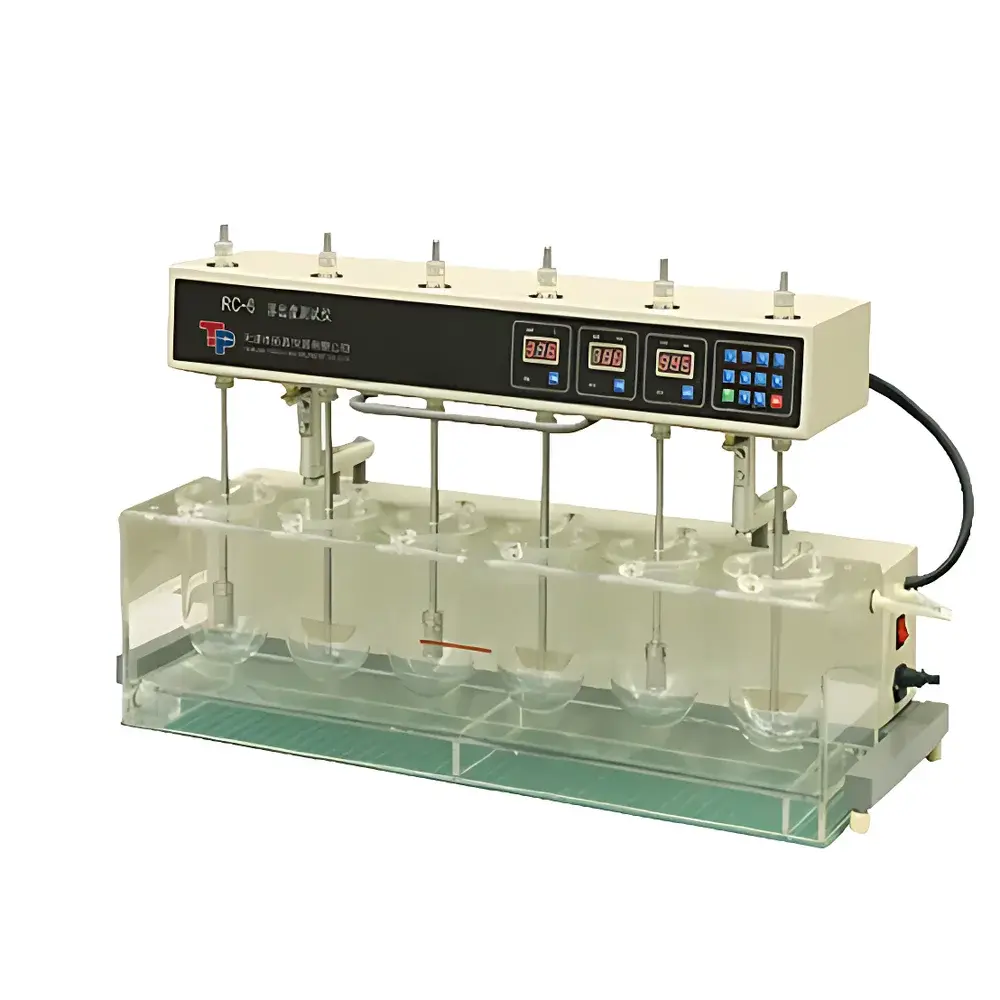
Topo RC-6 Intelligent Dissolution Tester
| Brand | Topo |
|---|---|
| Model | RC-6 |
| Origin | Tianjin, China |
| Manufacturer | Topo Instrument Co., Ltd. |
| Type | Online Dissolution Testing System |
| Number of Vessels | 6 |
| Temperature Range | 20–39.9 °C |
| Temperature Accuracy | ±0.2 °C |
| Rotation Speed Range | 20–200 rpm |
| Speed Accuracy | ±2 rpm |
| Bath Volume | 17.5 L |
| Vessel Positioning | Linear single-row arrangement |
| Drive Mechanism | Magnetic-coupled peristaltic circulation pump |
| Material | SUS316L stainless steel (paddles, baskets, shafts) |
| Power Supply | 220 V / 50 Hz / 1000 W |
| Dimensions (W×D×H) | 960 × 320 × 480 mm |
| Timing Range | 0–999 min (6 programmable time points) |
| Basket Wobble Tolerance | ±1 mm |
| Paddle Centering Tolerance | ±0.5 mm |
| Compliance | Chinese Pharmacopoeia (ChP) 2000 Edition, ZBC95001–89 National Professional Standard |
Overview
The Topo RC-6 Intelligent Dissolution Tester is a six-vessel online dissolution testing system engineered for precision and regulatory compliance in pharmaceutical quality control laboratories. It operates on the principles defined in USP <711>, Ph. Eur. 2.9.3, and ChP General Chapter 0931, utilizing standardized paddle (USP Apparatus 2) or basket (USP Apparatus 1) configurations to quantify the rate and extent of drug release from solid oral dosage forms—including tablets, capsules, and multiparticulates—into a specified dissolution medium under controlled hydrodynamic and thermal conditions. The instrument maintains rigorous adherence to hydrodynamic equivalence requirements through calibrated rotational stability, precise temperature uniformity across all six vessels, and reproducible mechanical alignment of paddles/baskets relative to vessel geometry. Its architecture supports routine batch testing, method development, and stability-indicating dissolution profiling in accordance with ICH Q5A and Q5C guidelines.
Key Features
- Six independent dissolution vessels arranged in a linear single-row configuration, enabling parallel testing while minimizing cross-vessel thermal interference.
- Manually actuated, counterbalanced head assembly with smooth pivot mechanism for consistent, low-torque vessel access and probe insertion.
- Critical wetted components—including paddles, baskets, shafts, and vessel caps—fabricated from medical-grade SUS316L stainless steel, ensuring corrosion resistance, non-reactivity, and compliance with ISO 10993 biocompatibility expectations for contact surfaces.
- Magnetically coupled recirculating water bath system with integrated thermostatic control, delivering uniform temperature distribution (±0.2 °C) across all 17.5 L bath volume without mechanical seals or direct pump immersion.
- Microprocessor-based controller with real-time dual-display interface: one screen shows user-defined setpoints (temperature, speed, timing), the other continuously monitors actual measured values with timestamped logging capability.
- Automated diagnostic routines including motor stall detection, temperature sensor validation, and bath-level monitoring—triggering audible/visual alerts upon deviation beyond preset thresholds.
- Built-in pharmacopoeial method library storing preconfigured parameters aligned with ChP, USP, and Ph. Eur. monographs, accessible via intuitive menu navigation without external software dependency.
- Multi-point timed operation mode supporting up to six discrete sampling intervals with programmable acoustic notification and automatic transition to subsequent time point—enabling unattended sequential data collection.
Sample Compatibility & Compliance
The RC-6 accommodates standard USP-compliant 1000 mL cylindrical dissolution vessels and accepts both 1000 mL and 900 mL test media volumes. It supports all common dissolution apparatus types (Apparatus 1 and 2) and permits optional integration with automated sampling systems (e.g., AS-6 or equivalent) via TTL/RS-232 interface. The system conforms to national and international regulatory frameworks including ChP 2020 General Chapter 0931, ZBC95001–89, and ASTM D7812–14 (Standard Guide for Validation of Dissolution Apparatus). While not inherently 21 CFR Part 11 compliant out-of-the-box, its firmware architecture allows audit-trail-enabled data export in CSV/Excel format for integration into validated LIMS or ELN environments under GLP/GMP practices.
Software & Data Management
The RC-6 operates autonomously via embedded firmware with no requirement for PC connectivity during routine operation. All test parameters—including temperature setpoint, rotation speed, start time, and six-stage timer sequence—are stored in non-volatile memory and retained after power cycling. Real-time operational data (actual temperature, RPM, elapsed time) are displayed simultaneously with user-defined targets. Data export is supported via USB flash drive interface, generating timestamped CSV files containing vessel ID, time point, temperature reading, and speed confirmation—structured for direct import into statistical analysis packages (e.g., JMP, Minitab) or electronic batch record systems. Firmware updates are performed locally using signed binary files, ensuring integrity verification prior to installation.
Applications
- Quality control release testing of immediate-release and extended-release solid oral dosage forms per compendial specifications.
- Dissolution profile comparison for generic product bioequivalence assessment (ICH Q5E).
- Stability-indicating method development for detecting formulation degradation under accelerated dissolution stress conditions.
- In-process monitoring during tablet coating optimization and excipient screening studies.
- Supporting regulatory submissions requiring dissolution data traceability, repeatability, and equipment qualification documentation (IQ/OQ/PQ).
FAQ
Does the RC-6 support USP Apparatus 3 (Reciprocating Cylinder) or Apparatus 4 (Flow-Through Cell)?
No—the RC-6 is designed exclusively for Apparatus 1 (basket) and Apparatus 2 (paddle) configurations as specified in ChP and USP standards.
Is calibration certificate included with shipment?
A factory-issued calibration report covering temperature sensor accuracy (±0.2 °C) and rotational speed verification (±2 rpm) is provided; full IQ/OQ documentation kits are available as optional add-ons.
Can the instrument be connected to a laboratory network for centralized data aggregation?
The RC-6 does not feature Ethernet or Wi-Fi connectivity; however, its USB export functionality enables periodic batch transfer to networked servers or shared drives within secure internal networks.
What maintenance intervals are recommended for long-term reliability?
Biannual inspection of magnetic coupling integrity, annual recalibration of temperature sensors, and quarterly cleaning of bath chamber and vessel ports using deionized water and lint-free wipes are advised per manufacturer’s maintenance schedule.
Is the RC-6 suitable for use in GMP-regulated environments?
Yes—when operated within a documented qualification framework (including equipment logs, change control records, and operator training verification), the RC-6 meets foundational GMP expectations for dissolution apparatus used in batch release testing.
Related Products





