
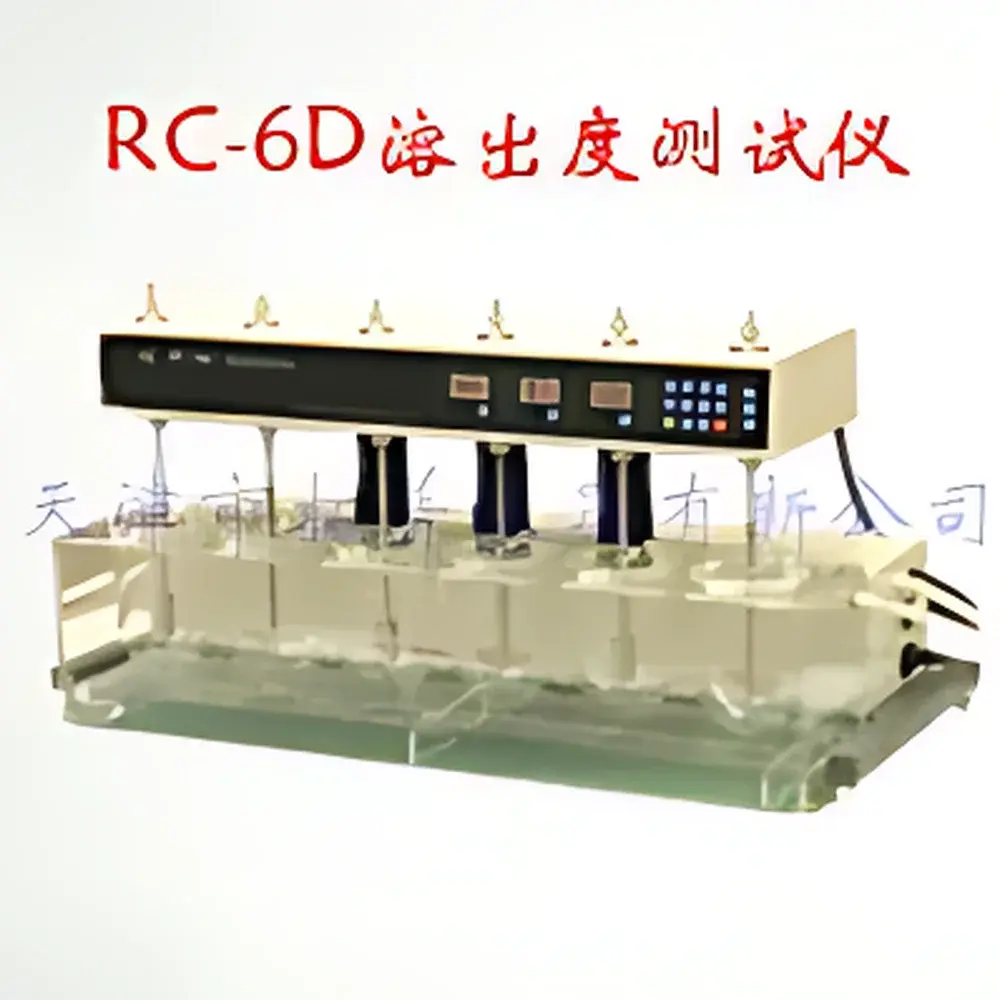
Topo RC-6D Intelligent Dissolution Tester
| Brand | Topo |
|---|---|
| Origin | Tianjin, China |
| Manufacturer Type | Direct Manufacturer |
| Model | RC-6D |
| Instrument Type | Online Dissolution Tester |
| Number of Vessels | 6 |
| Temperature Range | 20–39.9 °C |
| Temperature Accuracy | ±0.2 °C |
| Rotation Speed Range | 20–200 rpm |
| Water Bath Volume | 17.5 L |
| Speed Control Accuracy | ±2 rpm |
| Vessel Positioning Tolerance (Basket Wobble) | ±1 mm |
| Paddle Shaft Wobble | ±0.5 mm |
| Timer Range | 0–999 min (6 programmable time points) |
| Power Supply | 220 V / 50 Hz / 1000 W |
| Dimensions (W×D×H) | 960 × 400 × 480 mm |
Overview
The Topo RC-6D Intelligent Dissolution Tester is a fully automated, six-vessel online dissolution system engineered for pharmaceutical quality control laboratories requiring compliance with pharmacopoeial standards—including the Chinese Pharmacopoeia (ChP) 2020 Edition, USP , and EP 2.9.3. It operates on the principle of paddle or basket dissolution methodology, where solid dosage forms (e.g., tablets, capsules) are immersed in a standardized dissolution medium maintained at physiological temperature (typically 37.0 ± 0.5 °C), and drug release is quantified via UV-Vis spectrophotometry or HPLC analysis of sampled aliquots. The RC-6D integrates real-time control of three critical parameters—temperature, rotation speed, and timing—via an embedded microcontroller architecture, ensuring high reproducibility across batch testing and long-term method validation studies.
Key Features
- Intelligent motorized head lift mechanism enables precise, vibration-free positioning of paddles or baskets into dissolution vessels—critical for minimizing mechanical perturbation during sampling.
- Six independent stainless-steel dissolution vessels (SUS316L construction) with integrated temperature sensors and magnetic-coupled circulation pumps ensure uniform thermal distribution across the 17.5 L water bath, achieving ±0.2 °C stability per ChP requirements.
- Dual-mode agitation control supports both USP Apparatus 1 (basket) and Apparatus 2 (paddle), with speed regulation from 20 to 200 rpm and accuracy within ±2 rpm at all setpoints.
- Onboard parameter memory stores up to 20 preconfigured dissolution methods aligned with ChP 2020 monographs, including default settings for delayed-release, extended-release, and immediate-release formulations.
- Multi-point timed operation allows sequential activation of up to six discrete sampling intervals; each point triggers audible alert and optional external signal output for synchronized autosampler triggering.
- Self-diagnostic firmware continuously monitors motor load, temperature drift, and timing synchronization, initiating visual/audible alarms upon deviation beyond configurable thresholds.
Sample Compatibility & Compliance
The RC-6D accommodates standard USP/ChP-compliant 1000 mL dissolution vessels and accepts common tablet/capsule sizes (up to 25 mm diameter). Its mechanical design conforms to ISO 18186:2021 (Pharmaceutical dissolution testing equipment — Requirements and test methods) and meets the dimensional and operational criteria specified in ChP General Chapter 0931 and ZBC95001–89. All wetted parts are fabricated from medical-grade SUS316L stainless steel, ensuring corrosion resistance against acidic, alkaline, and surfactant-containing media (e.g., 0.1 N HCl, pH 6.8 phosphate buffer, SDS solutions). The system supports GLP-compliant workflows through audit-trail-ready operation logs (when paired with validated third-party data acquisition software).
Software & Data Management
While the RC-6D operates as a standalone instrument with front-panel LCD interface, it provides RS-232 and analog output ports for integration with LIMS or chromatographic data systems. Time-stamped event logs—including start/stop timestamps, temperature ramp profiles, speed deviations, and alarm triggers—are exportable via serial connection. When used in regulated environments (e.g., FDA-submitted ANDA filings), the instrument can be qualified under IQ/OQ protocols per ASTM E2503 and supports 21 CFR Part 11 compliance when interfaced with validated electronic lab notebook (ELN) or CDS platforms that enforce user authentication, electronic signatures, and immutable audit trails.
Applications
- Release testing of immediate-release (IR), modified-release (MR), and enteric-coated oral solid dosage forms per ICH Q5C and Q6A guidelines.
- Comparative dissolution profiling for bioequivalence assessment (e.g., f2 similarity factor calculation).
- Stability-indicating method development and forced degradation studies under varying pH and agitation conditions.
- In-process quality control during tablet coating and granulation process optimization.
- Supporting regulatory submissions to NMPA, FDA, EMA, and PMDA with documented instrument qualification and performance verification records.
FAQ
Does the RC-6D support USP Apparatus 3 (reciprocating cylinder) or Apparatus 4 (flow-through cell)?
No—the RC-6D is designed exclusively for Apparatus 1 (basket) and Apparatus 2 (paddle) configurations per USP and ChP 0931.
Can the instrument maintain temperature stability during extended 24-hour dissolution runs?
Yes—the magnetic-coupled circulation system and insulated 17.5 L bath enable stable thermal control within ±0.2 °C over multi-hour cycles, provided ambient room temperature remains within 20–25 °C and humidity <60% RH.
Is calibration documentation included with shipment?
The unit ships with a factory calibration certificate covering temperature sensor accuracy and rotational speed verification against traceable NIST-calibrated references.
What maintenance is required for long-term reliability?
Biannual inspection of pump seals, vessel alignment verification, and cleaning of heating element surfaces with deionized water are recommended. No lubrication of drive shafts is required due to sealed bearing design.
Can the RC-6D be integrated into a networked QC laboratory environment?
Yes—via RS-232 or optional Ethernet-to-serial gateway, enabling centralized monitoring, remote parameter adjustment, and automated log archival using industry-standard SCADA or MES platforms.





