
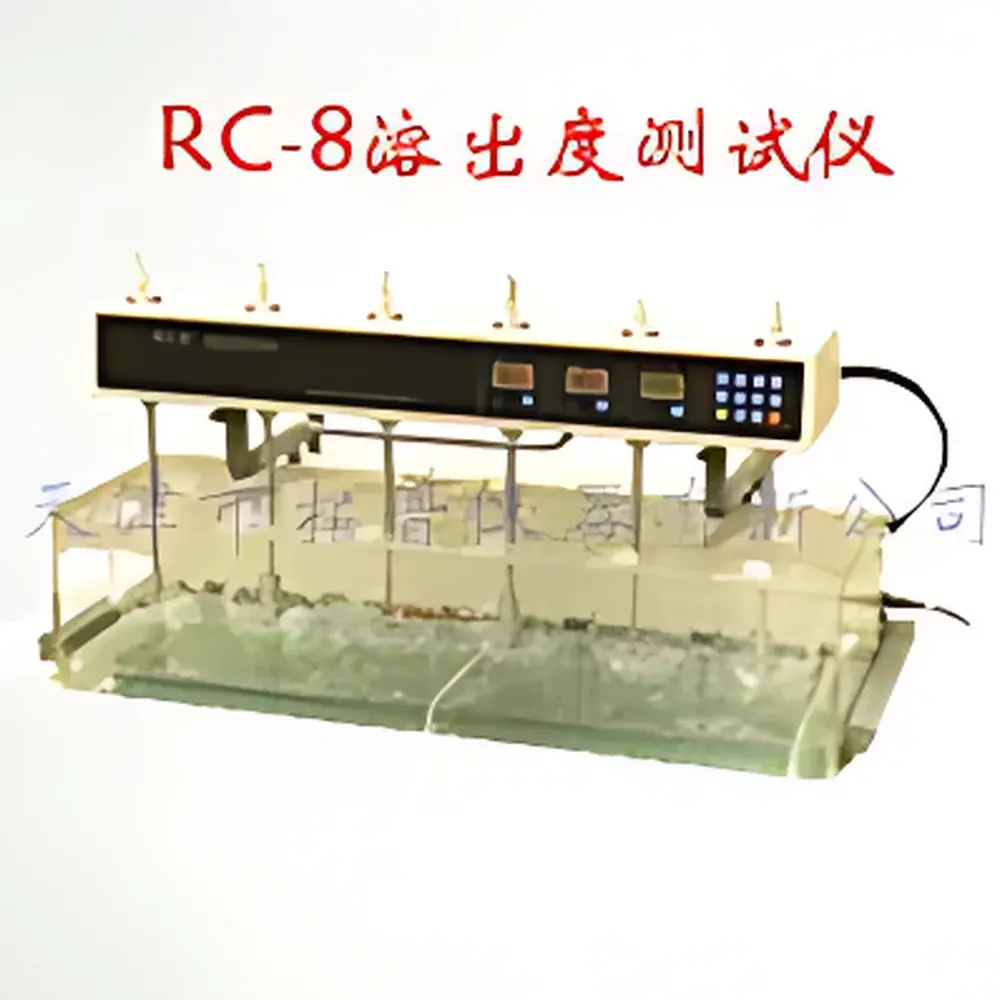
Topo RC-8 Advanced Dissolution Tester
| Brand | Topo |
|---|---|
| Origin | Tianjin, China |
| Manufacturer Type | Direct Manufacturer |
| Product Origin | Domestic (China) |
| Model | RC-8 |
| Instrument Type | Online Dissolution Tester |
| Number of Vessels | 8 |
| Temperature Range | 20–39.9 °C |
| Temperature Accuracy | ±0.2 °C |
| Rotational Speed Range | 20–200 rpm |
| Water Bath Volume | 17.5 L |
| Speed Control Accuracy | ±2 rpm |
| Vessel Positioning | 6-position front row (active dissolution), 2-position rear row (auxiliary/replenishment vessels) |
| Basket Wobble Tolerance | ±1 mm |
| Paddle Shaft Wobble Tolerance | ±0.5 mm |
| Timing Range | 0–999 min (6 programmable time points) |
| Power Supply | 220 V / 50 Hz / 1000 W |
| Dimensions (W×D×H) | 960 × 320 × 480 mm |
| Construction Material | SUS316L stainless steel (basket, paddle shafts, vessel holders) |
Overview
The Topo RC-8 Advanced Dissolution Tester is a fully automated, online-capable pharmaceutical dissolution testing system engineered for precision compliance with pharmacopoeial standards including the Chinese Pharmacopoeia (ChP) 2000 Edition and the national standard ZBC95001-89 for dissolution apparatus. It operates on the principle of USP Apparatus I (basket) and Apparatus II (paddle), enabling quantitative assessment of drug release kinetics from solid oral dosage forms—including tablets, capsules, and multiparticulates—under controlled hydrodynamic and thermal conditions. The instrument features an 8-vessel configuration: six primary dissolution vessels arranged in the front row for concurrent sample testing, and two auxiliary vessels in the rear row designated for solvent replenishment or reference calibration. Its thermally stable water bath (17.5 L capacity) maintains uniform temperature distribution across all vessels via a magnetically coupled circulation pump system, minimizing thermal gradients that could compromise assay reproducibility.
Key Features
- Eight-vessel architecture with dual-row layout: six active dissolution positions + two auxiliary (replenishment/calibration) positions
- Manually actuated, counterbalanced head assembly for smooth, vibration-free vessel access and probe insertion
- Critical wetted components—including baskets, paddle shafts, and vessel supports—fabricated from medical-grade SUS316L stainless steel for corrosion resistance and extractables control
- Intelligent temperature regulation system with ±0.2 °C accuracy over 20–39.9 °C range; integrated magnetic-drive water circulation ensures uniform thermal homogeneity
- Motor-driven rotational control (20–200 rpm) with ±2 rpm speed stability, independently adjustable per vessel group
- Multi-point programmable timer (0–999 min, up to six discrete intervals) with synchronized audio alerts and automatic transition between phases
- Onboard parameter memory stores preconfigured ChP-compliant dissolution methods, supporting rapid method recall and audit-ready traceability
- Self-diagnostic firmware continuously monitors motor load, temperature deviation, and timing integrity, triggering visual and audible alarms upon out-of-specification events
Sample Compatibility & Compliance
The RC-8 accommodates standard USP/ChP-compliant dissolution vessels (1000 mL capacity) and supports both basket and paddle configurations without hardware modification. Its mechanical tolerances—basket wobble ≤ ±1 mm and paddle shaft wobble ≤ ±0.5 mm—meet or exceed ISO 17025-aligned verification requirements for dissolution apparatus qualification. The system is designed to support GLP- and GMP-regulated environments: all operational parameters (temperature setpoint, actual bath temperature, rotational speed, elapsed time) are digitally recorded with timestamped values, forming the basis for 21 CFR Part 11–compliant data archives when paired with validated third-party software. Routine performance verification aligns with USP General Chapter <711> and ChP General Chapter 0931, covering mechanical calibration, temperature mapping, and hydrodynamic profiling.
Software & Data Management
While the RC-8 operates as a standalone instrument with embedded LCD interface and real-time parameter display, it provides RS-232 and optional USB connectivity for integration with laboratory information management systems (LIMS) or validated dissolution data acquisition platforms. All user-defined protocols—including multi-stage dissolution profiles with variable rpm, temperature, and sampling intervals—are stored in non-volatile memory with method ID tagging. Audit trail functionality logs operator actions, parameter changes, and alarm events chronologically. When deployed in regulated QC laboratories, the instrument supports electronic signature workflows and export of CSV-formatted datasets compatible with statistical process control (SPC) tools and regulatory submission packages (e.g., eCTD modules).
Applications
- Quality control release testing of immediate- and extended-release solid oral dosage forms
- Comparative dissolution profiling for generic product development and bioequivalence studies
- Stability-indicating method development under varying pH, surfactant, or sink condition protocols
- In-process monitoring during formulation optimization and scale-up activities
- Apparatus qualification and routine preventive maintenance verification per ASTM E2503 and USP <711>
- Regulatory submission support for NDA, ANDA, and DMF dossiers requiring documented dissolution apparatus performance
FAQ
Does the RC-8 comply with USP Apparatus I and II specifications?
Yes—the mechanical design, dimensional tolerances, and operational parameters conform to USP <711> requirements for both basket and paddle configurations.
Can the instrument be integrated into a networked QC lab environment?
Yes—via RS-232 serial interface or optional USB-to-serial adapter, enabling connection to LIMS or validated dissolution data capture software.
Is the water bath temperature uniformity verified across all eight vessels?
Yes—its magnetically driven circulation system and insulated 17.5 L bath volume ensure ≤ ±0.2 °C inter-vessel variation under steady-state conditions, consistent with ChP validation guidelines.
What materials contact the dissolution medium during operation?
All fluid-path components—including baskets, paddles, shafts, and vessel clamps—are manufactured from passivated SUS316L stainless steel, minimizing metal leachables and ensuring compatibility with aggressive dissolution media (e.g., 0.1 N HCl, SDS solutions).
How is instrument performance verified for regulatory audits?
The RC-8 supports full apparatus qualification per USP <711> and ChP 0931, including mechanical calibration kits, temperature mapping reports, and digital log files for speed/timing/temperature traceability.





