
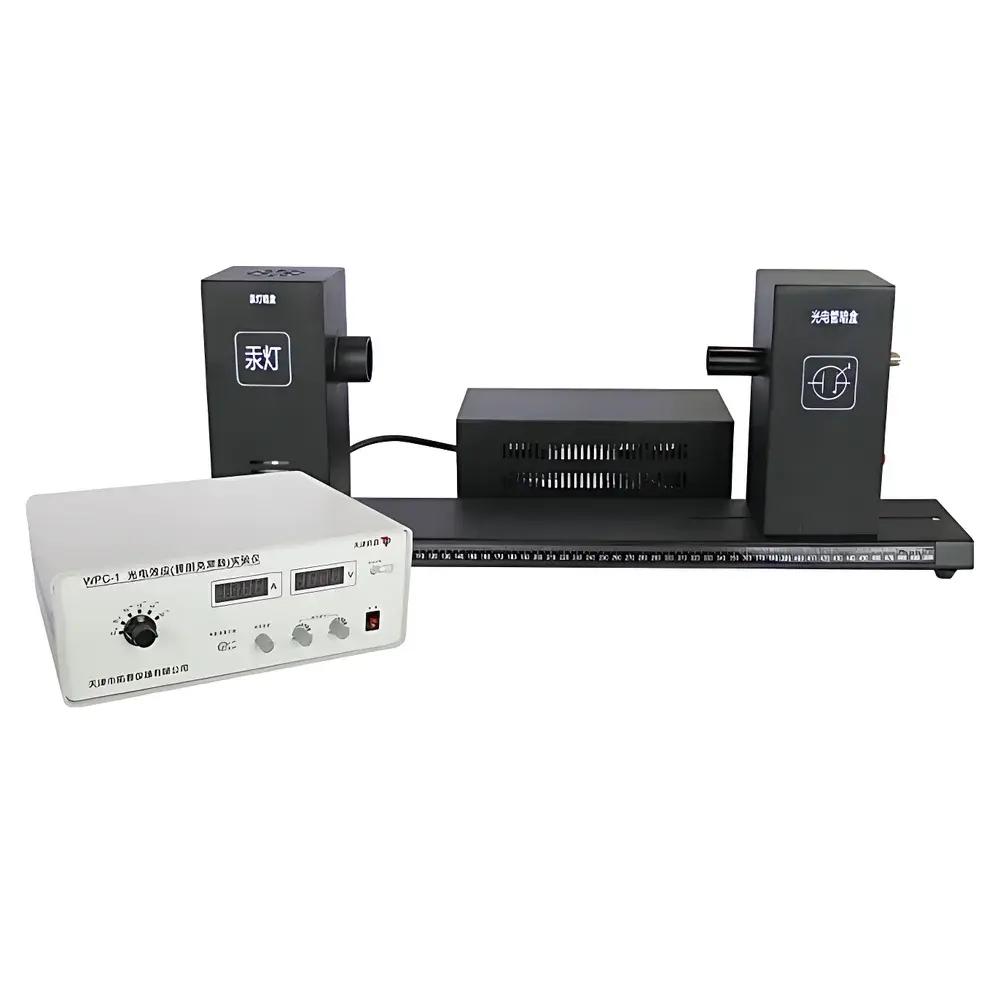
Topo TP-PCM-1 Photoelectric Effect Experiment System for Planck’s Constant Determination
| Brand | Topo / TP |
|---|---|
| Origin | Tianjin, China |
| Manufacturer Type | Direct Manufacturer |
| Regional Classification | Domestic (China) |
| Model | TP-PCM-1 |
| Pricing | Upon Request |
Overview
The Topo TP-PCM-1 Photoelectric Effect Experiment System is a precision educational instrument engineered for undergraduate and graduate physics laboratories to quantitatively verify Einstein’s photoelectric equation and determine Planck’s constant (h) through direct measurement of stopping potential versus incident light frequency. Based on the fundamental principle of photon–electron interaction, the system utilizes a calibrated mercury vapor lamp as a polychromatic source, combined with interference filter sets to isolate discrete spectral lines (e.g., 365 nm, 405 nm, 436 nm, 546 nm, and 577 nm). Each monochromatic beam passes through an adjustable aperture diaphragm—enabling controlled variation of effective beam area—and is directed onto a vacuum-type photocell with a photosensitive cathode (typically alkali metal, e.g., potassium or sodium). The resulting photoelectrons generate a measurable photocurrent, which is amplified via a low-noise, high-input-impedance microcurrent amplifier. By applying a reverse bias voltage and identifying the stopping potential (Vs) at which photocurrent drops to zero, students experimentally establish the linear relationship Vs = (h/e)ν − φ/e, where ν is the incident photon frequency and φ is the work function of the cathode material.
Key Features
- Modular optical train with precision-aligned mercury lamp housing, interchangeable interference filters, and a calibrated iris diaphragm (adjustable aperture diameter: 2 mm to 8 mm in 1 mm increments) for systematic control of irradiance and beam geometry.
- Dual-range microcurrent amplifier (±1 pA to ±100 nA full scale; resolution: 0.1 pA in low range, 10 pA in high range) with auto-zeroing and thermal drift compensation for stable baseline performance over extended measurement sessions.
- Integrated digital voltmeter (DVM) with 4½-digit resolution (±0.01 mV accuracy) for precise stopping potential acquisition, synchronized with current readout via analog-to-digital conversion at 10 Hz sampling rate.
- Interchangeable photocathode modules—including standard K-based and Na-based vacuum photocells—allow comparative study of work function dependence and quantum efficiency variations across materials.
- Distance-variable optical rail (0–500 mm travel, ±0.5 mm positioning repeatability) enabling inverse-square law verification and quantitative illumination intensity calibration using a reference silicon photodiode traceable to NIM (National Institute of Metrology, China).
Sample Compatibility & Compliance
The TP-PCM-1 supports standardized photocell configurations compliant with IEC 60050-841 (International Electrotechnical Vocabulary – Lighting) definitions for photoemissive devices. All optical components meet ISO 9022-3 (Environmental testing – Optics and optical instruments) specifications for surface quality and transmission stability under laboratory ambient conditions (20–25 °C, RH < 65 %). The system architecture adheres to GLP-aligned pedagogical protocols: all voltage and current measurements are logged with timestamped metadata, supporting reproducibility assessment per ASTM E29-22 (Standard Practice for Using Significant Digits in Test Data). While not certified for industrial QA/QC, its measurement methodology aligns with university-level physics curriculum standards referenced in the American Association of Physics Teachers (AAPT) Laboratory Guidelines and the European Physical Society (EPS) Teaching Recommendations.
Software & Data Management
The TP-PCM-1 operates in conjunction with TopoLab Suite v3.2 (Windows 10/11 compatible), a dedicated data acquisition and analysis platform. It enables real-time plotting of I–V curves, automatic stopping potential extraction via tangent-intersection algorithm, and least-squares linear regression of Vs vs. ν datasets. Export formats include CSV, MATLAB .mat, and PDF reports with embedded uncertainty propagation (based on instrumental uncertainties in wavelength calibration ±0.3 nm, voltage ±0.02 mV, and distance ±0.3 mm). Audit trail functionality records operator ID, session timestamp, filter selection, and aperture setting—supporting documentation requirements for course accreditation under ABET Criterion 3 (Student Outcomes) and UK QAA Subject Benchmark Statements for Physics.
Applications
- Determination of Planck’s constant (h) with typical student experimental uncertainty ≤ 3.5% relative to CODATA 2018 value (6.62607015 × 10⁻³⁴ J·s).
- Empirical derivation of the photoelectric threshold frequency and cathode work function for different alkali metals.
- Quantitative investigation of irradiance dependence: validating linear photocurrent–intensity relationship and assessing space-charge limitation effects at high flux densities.
- Comparative analysis of spectral response functions across photocell types—supporting discussions on quantum efficiency, responsivity (A/W), and cut-off wavelength limitations.
- Extension experiments including external photoelectric effect in gases (with optional gas cell add-on) and introductory exploration of photoelectron kinetic energy distribution via retarding potential analysis.
FAQ
What safety certifications does the TP-PCM-1 comply with?
The unit conforms to GB 4793.1-2019 (equivalent to IEC 61010-1:2010) for electrical safety in laboratory equipment, including double insulation, leakage current < 0.1 mA, and overvoltage category II rating.
Is wavelength calibration traceable to national standards?
Yes—interference filters are factory-calibrated against NIM-certified spectroradiometric reference standards; calibration certificate included with each delivery.
Can the system interface with third-party DAQ hardware?
Analog output terminals (0–10 V for current, 0–5 V for voltage) support integration with NI USB-6009 or similar DAQ systems via BNC connections; driver-free operation under Windows.
What maintenance is required for long-term stability?
Annual verification of filter center wavelength shift (< ±0.2 nm) and photocell dark current (< 1 fA at −1 V bias) is recommended; no user-serviceable optics or vacuum components.
Is student lab manual documentation available in English?
Yes—comprehensive bilingual (English/Chinese) instructor guide and student workbook are provided, including pre-lab theory, step-by-step procedures, error analysis templates, and sample datasets.






