
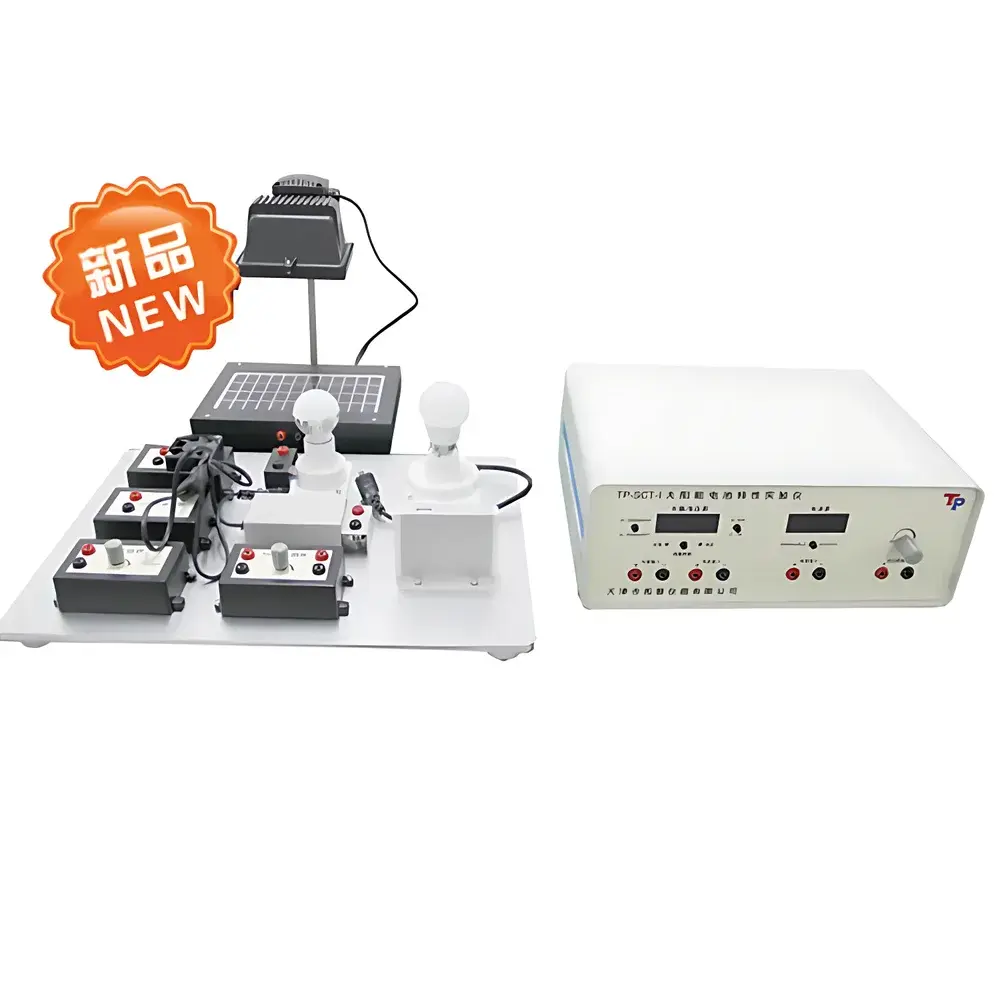
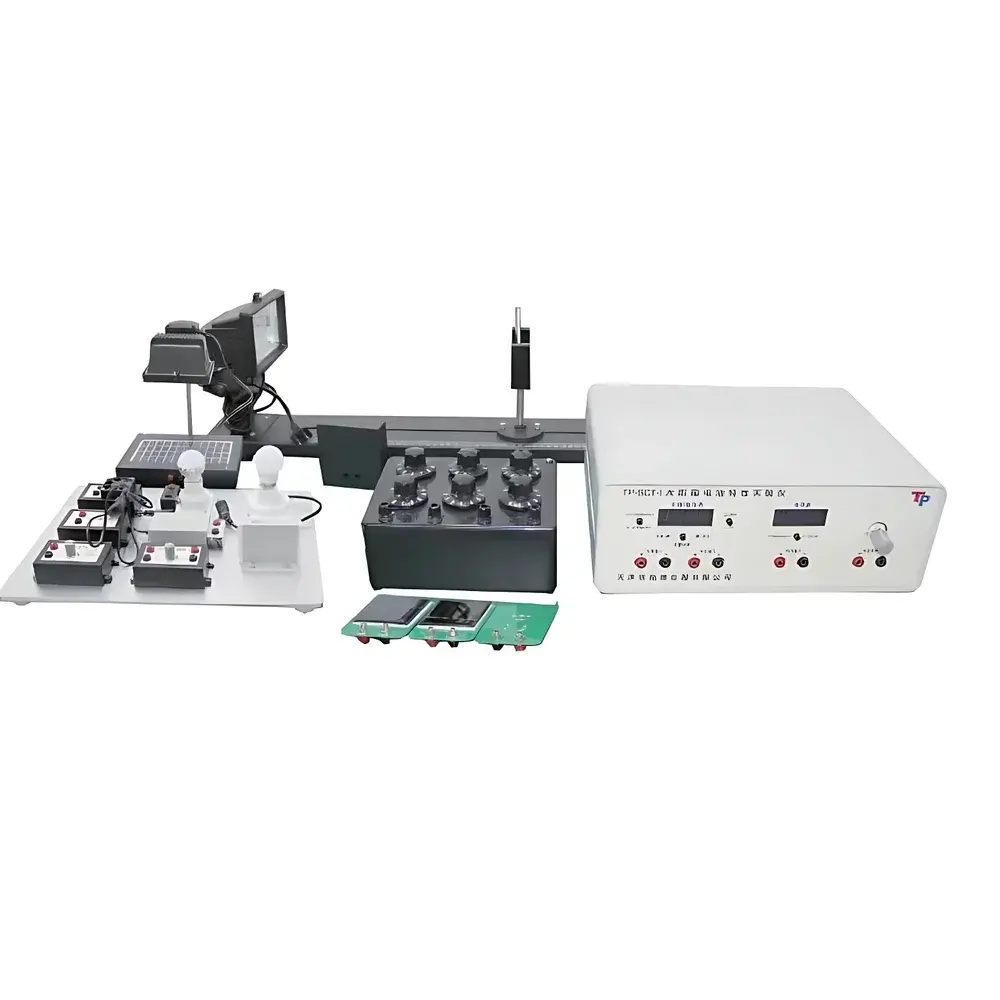
Topo TP-SCT-2 Solar Cell Characterization and Application Training System
| Brand | Topo / TP |
|---|---|
| Origin | Tianjin, China |
| Manufacturer Type | Direct Manufacturer |
| Region | Domestic (China) |
| Model | TP-SCT-2 |
| Pricing | Available Upon Request |
Overview
The Topo TP-SCT-2 Solar Cell Characterization and Application Training System is an education- and research-grade instrumentation platform engineered for hands-on investigation of photovoltaic (PV) device physics and applied energy conversion principles. It employs a calibrated tungsten-halogen lamp as a stable, spectrally controllable light source to simulate terrestrial solar irradiance (AM1.5G spectral approximation), enabling quantitative characterization of crystalline silicon (mono- and polycrystalline) and amorphous silicon solar cells under controlled illumination conditions. The system measures fundamental electrical output parameters—including short-circuit current (ISC), open-circuit voltage (VOC), maximum power point (PMAX), and fill factor (FF)—via integrated voltage/current sensing circuitry and real-time load sweep functionality. Designed for laboratory-based pedagogy and undergraduate/graduate-level renewable energy coursework, the TP-SCT-2 bridges theoretical semiconductor physics with empirical device behavior, supporting ISO 9001-aligned lab practices and alignment with ASTM E1036 (Standard Test Methods for Electrical Performance of Nonconcentrator Terrestrial Photovoltaic Modules and Systems) educational implementation guidelines.
Key Features
- Stable tungsten-halogen broadband light source with adjustable optical path geometry, enabling systematic variation of incident irradiance via source-to-cell distance modulation (range: 10–50 cm)
- Dual-range digital lux meter with auto-ranging capability (0–2000 lx and 0–20,000 lx) for traceable irradiance quantification compliant with CIE S 026/E:2018 photometric reference standards
- Modular test board accommodating interchangeable PV samples: monocrystalline Si, multicrystalline Si, and amorphous Si cells (standard 5×5 cm format, pre-soldered terminals)
- Integrated variable resistive load bank (0–1 kΩ, 10-turn precision potentiometer) with simultaneous analog voltage and current readouts for I-V curve acquisition
- Expandable application topology: includes dedicated charging circuitry for rechargeable Ni-MH or Li-ion storage modules, DC-DC converter stage, and configurable resistive/electronic load interfaces
- Robust aluminum chassis with ESD-safe surface finish, safety interlocks on high-intensity illumination mode, and CE-marked power supply (230 V AC, 50 Hz)
Sample Compatibility & Compliance
The TP-SCT-2 supports standardized PV sample formats used in academic laboratories worldwide, including ASTM F2624-compliant cell mounting frames and IEC 61215-defined terminal spacing. All included silicon cells meet IEC 61215-1:2021 visual inspection criteria and are certified for educational use with documented spectral response curves (350–1100 nm). The system’s irradiance measurement subsystem is factory-calibrated against NIST-traceable reference sensors and maintains linearity within ±3% across its operational range. While not intended for certification-grade testing per IEC 61215-2 or UL 1703, the TP-SCT-2 fulfills GLP-aligned training requirements for photovoltaic curriculum delivery and satisfies institutional accreditation benchmarks for engineering laboratory equipment (ABET Criterion 3, Outcome 3a–3c).
Software & Data Management
The system operates in standalone analog mode or integrates with optional PC-based data acquisition via USB-RS232 bridge (included). A cross-platform LabVIEW-compatible driver and MATLAB Instrument Control Toolbox interface are provided for scripted I-V sweep automation, real-time parameter extraction (ISC, VOC, PMAX, FF), and comparative dataset export (CSV, XLSX). All acquired data include embedded metadata: timestamp, irradiance value (lx), ambient temperature (via onboard thermistor), and user-defined sample ID. Audit trails are maintained per ISO/IEC 17025:2017 clause 7.7.1, supporting reproducibility verification and student report generation with version-controlled calibration logs.
Applications
- Undergraduate laboratory exercises in semiconductor devices, energy conversion, and sustainable systems engineering
- Empirical validation of the single-diode model for PV cells under variable irradiance and temperature conditions
- Comparative analysis of quantum efficiency trends across crystalline vs. thin-film absorber materials
- Design and testing of maximum power point tracking (MPPT) algorithms using programmable load profiles
- Energy storage integration studies: charge/discharge cycling, coulombic efficiency evaluation, and battery state-of-charge correlation with PV output
- Capstone project platforms for solar-powered microgrid emulation and DC micro-inverter prototyping
FAQ
Is the tungsten-halogen lamp spectrally matched to AM1.5G?
The lamp provides broadband visible-NIR emission (350–2500 nm) with a correlated color temperature (~3200 K) suitable for qualitative and semi-quantitative PV characterization; spectral mismatch correction factors are supplied for mono-Si and a-Si calibration.
Can third-party PV samples be mounted on the test board?
Yes—the platform accepts standard 5×5 cm cells with 2 mm pitch solder pads or spring-loaded pogo-pin adapters (optional accessory kit available).
Does the system support automated I-V curve tracing?
Manual sweep is standard; automated linear/logarithmic sweeps require optional DAQ module and software license (TP-SCT-DAQLINK v2.1).
What safety certifications does the TP-SCT-2 hold?
CE, RoHS, and IEC 61010-1:2010 compliance for laboratory electrical safety; no UL listing due to educational-use classification.
Is firmware upgradable in the field?
Yes—USB-based firmware updates are supported via Topo’s secure engineering portal; version history and release notes are provided with each update package.



