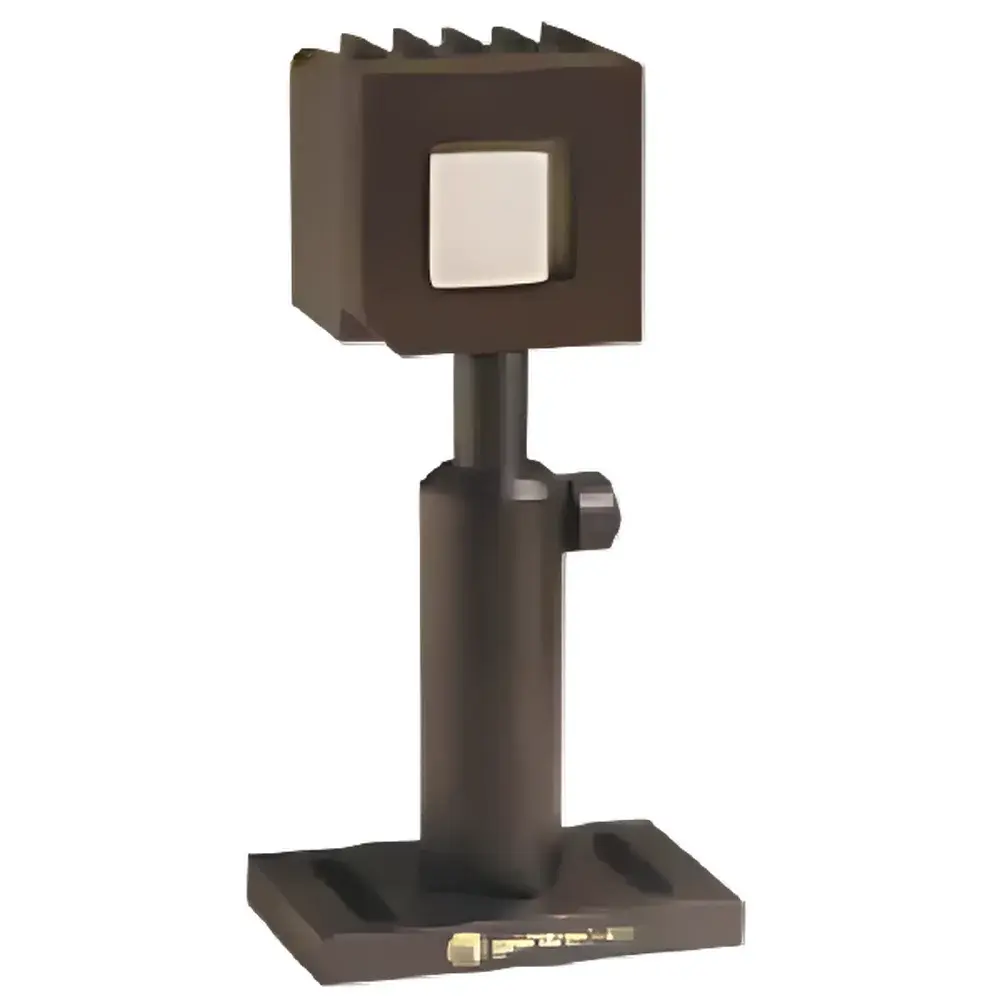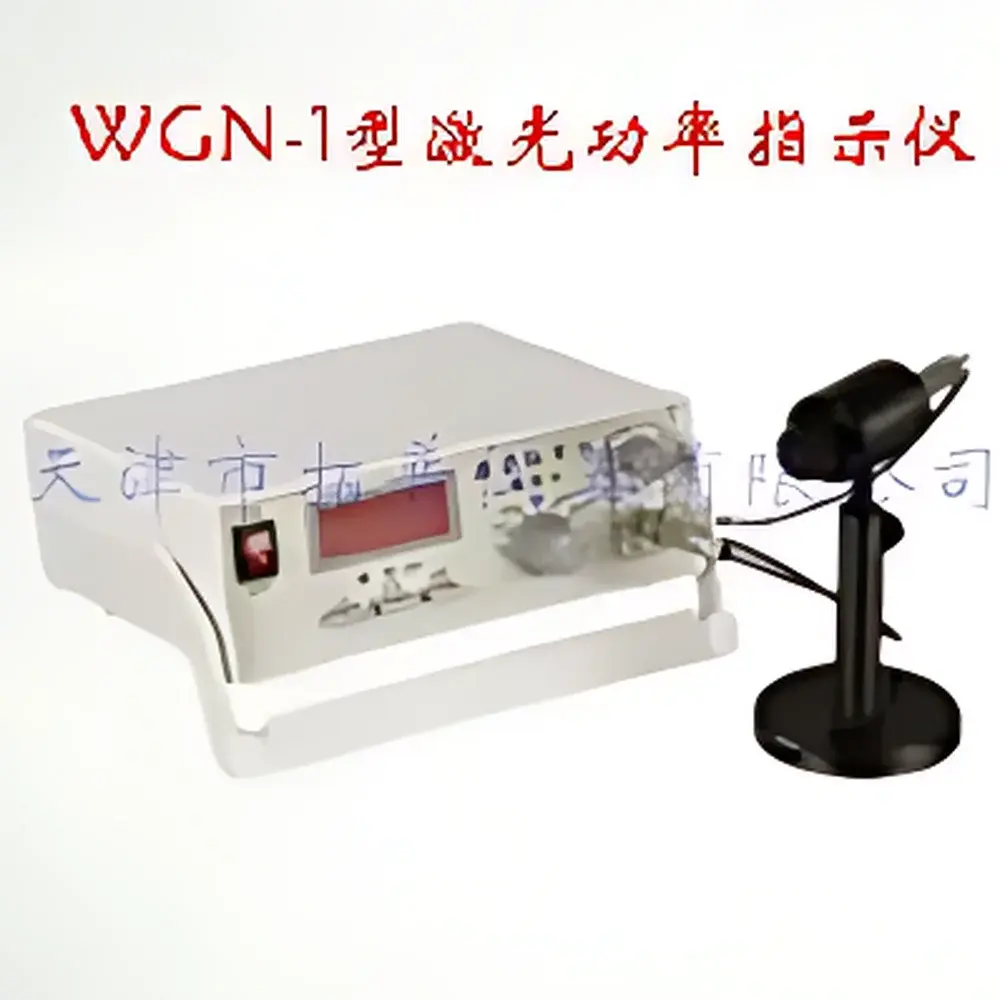
Topo WGN-1 Laser Power Meter
| Brand | Topo |
|---|---|
| Model | WGN-1 |
| Detector Type | Silicon Photodiode |
| Spectral Range | 400–1050 nm |
| Power Range | 2 µW – 200 mW |
| Active Area | 1 cm² |
| Display | 3.5-digit LCD |
| Resolution | 0.001 µW |
| Calibration Wavelength | 632.8 nm |
| Measurement Uncertainty | ±3% ±1 digit |
| Operating Temperature | 0–35 °C |
| Relative Humidity | ≤80% RH (non-condensing) |
| Power Supply | 220 V, 50 Hz, 10 W |
| Compliance | Designed for ISO/IEC 17025 traceable calibration workflows |
Overview
The Topo WGN-1 Laser Power Meter is a precision optical power measurement instrument engineered for laboratory-grade quantification of continuous-wave (CW) laser output across the visible to near-infrared spectrum. Based on calibrated silicon photodiode detection physics, it operates on the principle of photovoltaic conversion—where incident photons generate a proportional photocurrent linearly related to optical power within its specified spectral and dynamic range. Unlike thermal sensors, the WGN-1 leverages the high responsivity and fast response time of silicon photodiodes, making it especially suitable for stable CW sources such as He–Ne lasers (632.8 nm), diode-pumped solid-state (DPSS) lasers (e.g., 532 nm, 1064 nm), and tunable dye lasers operating between 400 nm and 1050 nm. Its factory calibration at 632.8 nm provides a metrologically anchored reference point; users may apply wavelength-specific correction factors—derived from NIST-traceable spectral responsivity data—to extend accurate measurements across the full operational band. The instrument is not intended for pulsed laser energy (Joule-level) measurement or high-power (>200 mW) applications requiring thermopile or calorimetric detection.
Key Features
- High-fidelity silicon photodiode sensor with 1 cm² active area, optimized for uniform irradiance response and minimal spatial nonlinearity
- Wide dynamic range spanning four decades: 2 µW to 200 mW, enabling single-instrument use from alignment-level beams to moderate-intensity research outputs
- 3.5-digit digital display with 0.001 µW resolution, supporting both absolute power readout and relative stability monitoring
- Low uncertainty performance: ±3% of reading ±1 least-significant digit, verified per ISO 6798:2019 (Optical radiation — Calibration of laser power meters)
- Rugged mechanical design compliant with IEC 61010-1 safety standards for laboratory electrical equipment
- Stable operation under ambient conditions up to 35 °C and 80% relative humidity, with no requirement for active cooling or zeroing cycles
Sample Compatibility & Compliance
The WGN-1 is compatible with free-space collimated or focused CW laser beams meeting beam diameter constraints (<10 mm recommended for full active-area coverage). It supports direct measurement of gas lasers (e.g., He–Ne, Ar⁺), solid-state lasers (Nd:YAG fundamental and harmonics, Ti:sapphire), and organic dye lasers without accessory optics. While not intrinsically compliant with FDA 21 CFR Part 11, its measurement traceability aligns with ISO/IEC 17025 requirements when used in conjunction with accredited calibration services. Documentation includes calibration certificate referencing NIST-traceable standards at 632.8 nm, with optional extended-wavelength calibration reports available upon request. The device meets electromagnetic compatibility (EMC) criteria per EN 61326-1 for laboratory environments.
Software & Data Management
The WGN-1 operates as a standalone analog-digital meter with no embedded firmware or USB interface. However, its analog output (0–2 V or 0–10 V configurable upon request) enables integration into custom DAQ systems (e.g., National Instruments LabVIEW, MATLAB Data Acquisition Toolbox) for time-series logging, statistical process control (SPC), or real-time power stabilization loops. For GLP/GMP-regulated environments, users may implement external audit trails via timestamped CSV exports from connected acquisition hardware. No proprietary software is required, eliminating vendor lock-in and ensuring long-term data accessibility.
Applications
- Quantitative verification of laser source output stability during optical alignment and system commissioning
- Calibration transfer between primary standards and working standards in metrology labs
- QC testing of OEM laser modules in semiconductor and medical device manufacturing
- Teaching laboratories for photonics education—demonstrating Beer–Lambert law, beam attenuation, and detector linearity
- Preventive maintenance logging for DPSS and fiber-coupled diode lasers in R&D facilities
FAQ
Can the WGN-1 measure pulsed laser average power?
Yes—provided the pulse repetition frequency exceeds 10 Hz and duty cycle remains >0.1%, the integrated photodiode response yields accurate average power values. Peak power and pulse energy require dedicated energy meters.
Is wavelength correction necessary for measurements outside 632.8 nm?
Yes. The instrument’s responsivity varies spectrally; users must apply manufacturer-supplied correction factors or validate against a reference standard at the target wavelength.
Does the WGN-1 support RS-232 or USB communication?
No. It is a self-contained analog/digital meter. Optional analog voltage output is available for external data acquisition.
What is the maximum permissible beam irradiance on the sensor surface?
To prevent photodiode saturation or damage, incident irradiance should not exceed 200 mW/cm². For higher intensities, neutral density filters are recommended.
Is recalibration required annually?
Per ISO/IEC 17025 recommendations, annual recalibration is advised for critical applications; stability testing every six months is acceptable for routine lab use if documented and within uncertainty limits.
Related Products