
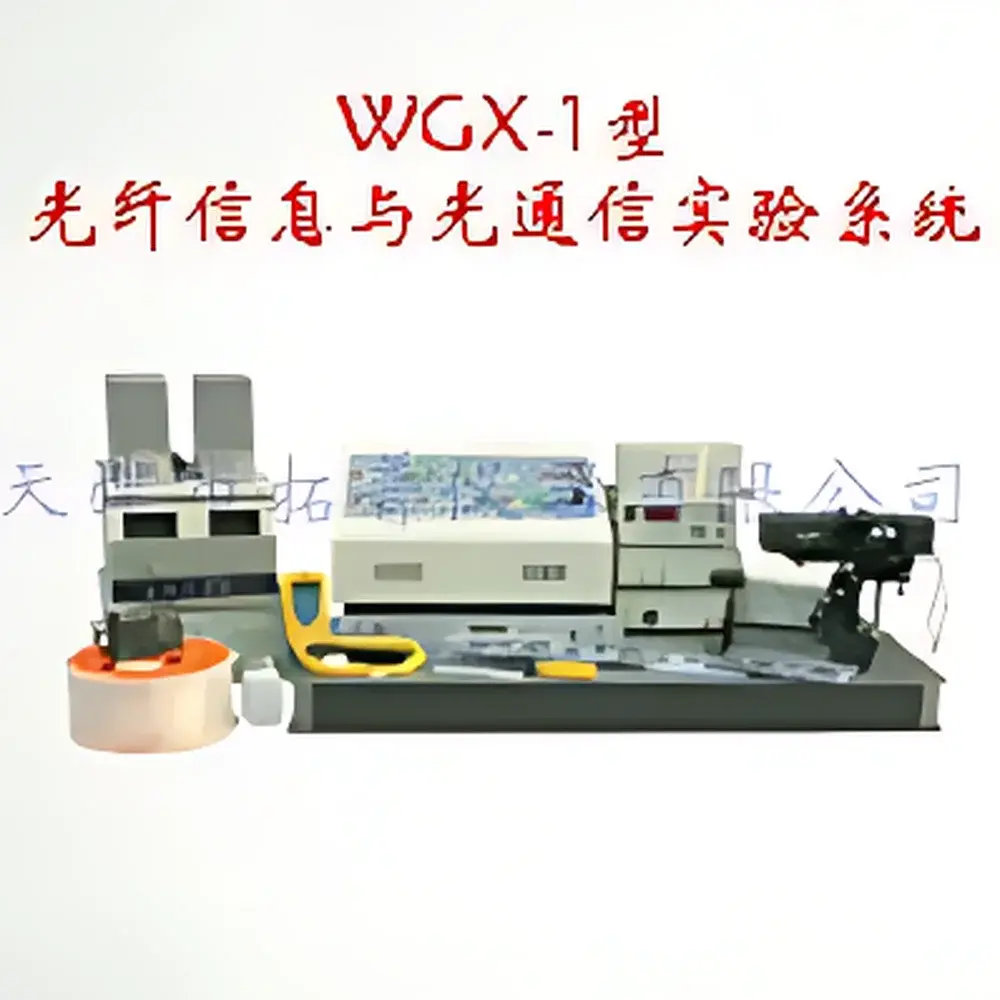
Topo WGX Series Fiber Optics & Optical Communications Educational Laboratory System
| Brand | Topo / TP |
|---|---|
| Origin | Tianjin, China |
| Manufacturer Type | OEM Manufacturer |
| Regional Classification | Domestic (China) |
| Model | WGX Series |
| Pricing | Available Upon Request |
Overview
The Topo WGX Series Fiber Optics & Optical Communications Educational Laboratory System is a modular, pedagogically engineered platform designed for undergraduate and graduate-level instruction in photonics engineering, optical communications, and fiber sensor technologies. Built upon fundamental principles of guided-wave optics and interferometric measurement, the system enables hands-on exploration of light propagation, coupling, modulation, dispersion, and sensing mechanisms in both single-mode and multimode optical fibers. Each configuration (WGX-1 through WGX-6) is structured around standardized experimental workflows aligned with IEEE Photonics Society curriculum guidelines and ISO/IEC 17025-compliant laboratory practices. The system supports four primary operational wavelengths—632.8 nm (He–Ne), 650 nm (red diode), 1310 nm (O-band), and 1550 nm (C-band)—ensuring relevance to both legacy telecom infrastructure and modern coherent transmission systems. Its architecture emphasizes physical insight over black-box operation: students directly observe modal interference, spectral response shifts in fiber Bragg gratings (FBGs), extinction ratio degradation in transmitters, and wavelength-dependent attenuation—all while using industry-standard components such as precision fiber couplers, tunable attenuators, and erbium-doped fiber amplifiers (EDFAs).
Key Features
- Multi-wavelength support across visible and near-infrared bands: 632.8 nm (He–Ne laser), 650 nm (diode), 1310 nm, and 1550 nm—enabling comparative study of dispersion, coupling efficiency, and material absorption.
- Integrated host unit housing optical alignment stages, power monitoring interfaces, signal routing switches, and calibrated photodetector inputs—reducing setup time and minimizing alignment drift during extended lab sessions.
- Dual Mach–Zehnder interferometer configurations: free-space (spatial) and all-fiber variants—facilitating direct comparison of coherence length requirements, environmental sensitivity, and phase stability under controlled conditions.
- Fiber Bragg grating (FBG)-based sensing modules for strain and temperature characterization—aligned with ASTM E2847 and IEC 61757-1 standards for optical fiber sensor performance evaluation.
- Modular component set including EDFA, polarization-maintaining couplers, isolators, variable optical attenuators (VOAs), and dual-window (1310/1550 nm) power meters—supporting reproducible measurements traceable to NIST-calibrated references.
- Comprehensive experimental coverage spanning geometric optics, physical optics, and modern photonics—including WDM multiplexing, extinction ratio analysis, NA measurement, and analog audio signal transmission over fiber links.
Sample Compatibility & Compliance
The WGX Series accommodates standard silica-based optical fibers (SMF-28e+, MMF 50/125 µm and 62.5/125 µm), FC/PC and FC/APC terminated patch cords, and commercially available FBG sensors with reflectivity >90% and bandwidth <0.3 nm. All optical sources comply with Class 3R laser safety requirements per IEC 60825-1:2014. Experimental protocols are structured to meet GLP-aligned documentation expectations for academic labs conducting accredited coursework. While not certified for industrial deployment, the system’s component specifications—including output power stability (<±2% over 1 h), wavelength accuracy (±0.5 nm for tunable sources), and power meter linearity (±0.1 dB from –50 to +10 dBm)—are consistent with entry-level R&D validation environments.
Software & Data Management
No proprietary software is bundled; instead, the system is designed for interoperability with open-source and commercial platforms including MATLAB® Data Acquisition Toolbox, Python-based PyVISA drivers, and LabVIEW™ modular instrument control frameworks. All power meters, tunable sources, and oscilloscopes feature USB or GPIB connectivity compliant with SCPI command sets. Raw intensity, spectral shift (for FBGs), and temporal waveform data can be exported in CSV or HDF5 format—supporting traceable analysis workflows required under FDA 21 CFR Part 11–aligned academic research governance policies. Audit trails for calibration records and student experiment logs may be maintained externally via LMS-integrated digital lab notebooks.
Applications
- Undergraduate photonics laboratories: foundational experiments on numerical aperture, Fresnel losses, and mode field diameter estimation.
- Graduate coursework in optical communications: WDM channel spacing verification, EDFA gain flatness profiling, and transmitter eye diagram analysis using external oscilloscopes.
- Sensor physics labs: quantitative correlation of thermal expansion coefficients and Young’s modulus via FBG wavelength shift (Δλ_B ∝ ΔT, Δε).
- Interferometry training: contrast optimization, fringe visibility assessment, and coherence length determination using Michelson and Mach–Zehnder topologies.
- Cross-disciplinary projects: integration with Arduino or Raspberry Pi microcontrollers for real-time FBG readout, or with RF signal generators for intensity-modulated analog transmission studies.
FAQ
Is the system compatible with third-party optical spectrum analyzers or network analyzers?
Yes—optical outputs are accessible via FC/APC ports rated for ≤500 mW average power; all sources provide stable CW or modulated output suitable for external spectral or frequency-domain characterization.
Can the WGX-5 configuration support full-duplex WDM experiments?
Yes—dual-window power meters and bidirectional couplers enable simultaneous upstream/downstream channel monitoring at 1310 nm and 1550 nm, consistent with ITU-T G.694.2 grid specifications.
Are calibration certificates provided for included instruments?
Factory calibration reports are supplied for all power meters and laser sources; NIST-traceable recalibration services are available through authorized regional partners.
What safety certifications apply to the He–Ne laser module?
The integrated He–Ne source meets IEC 60825-1:2014 Class 3R requirements, with interlock-ready housing and beam shutter controls compliant with ANSI Z136.1-2022 educational use provisions.
Does the system support student-developed firmware or custom control logic?
All programmable modules expose SCPI command sets over USB/VISA; example Python scripts for automated NA measurement and FBG thermal scanning are provided in the instructor’s guide.
Related Products




