
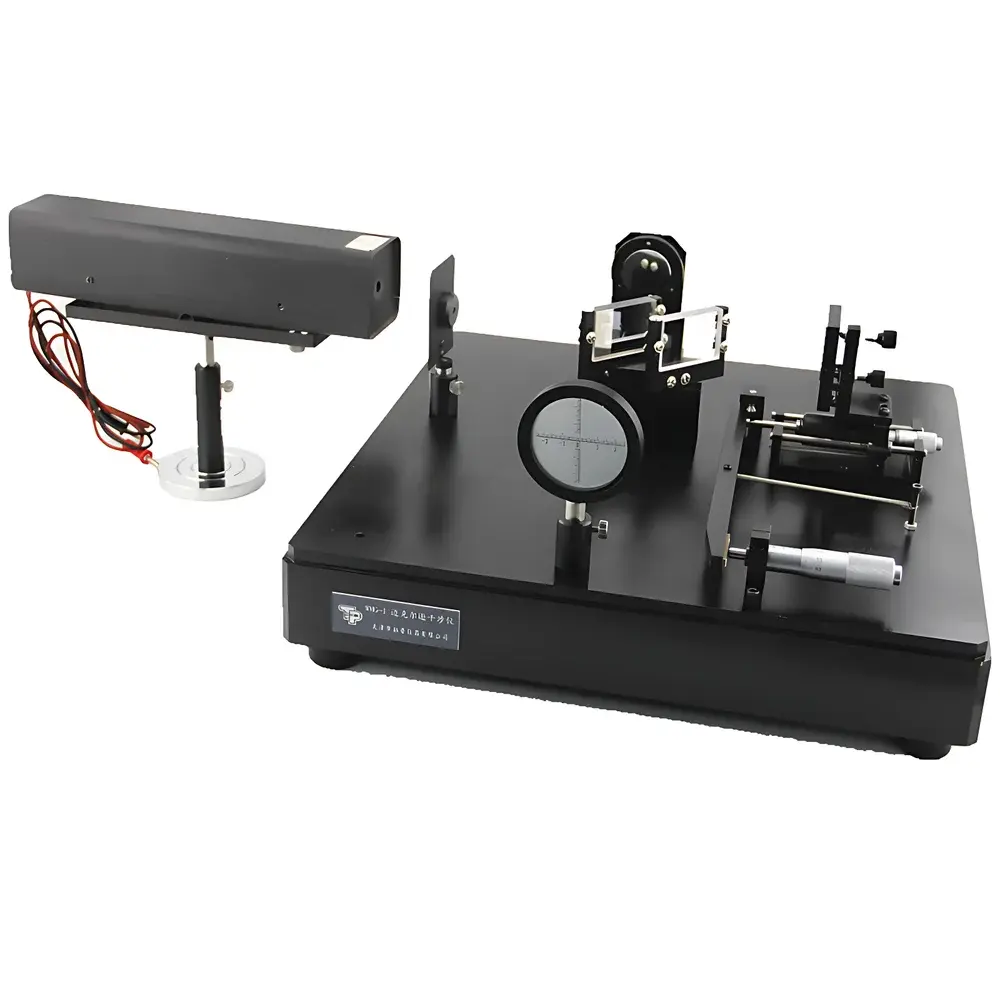
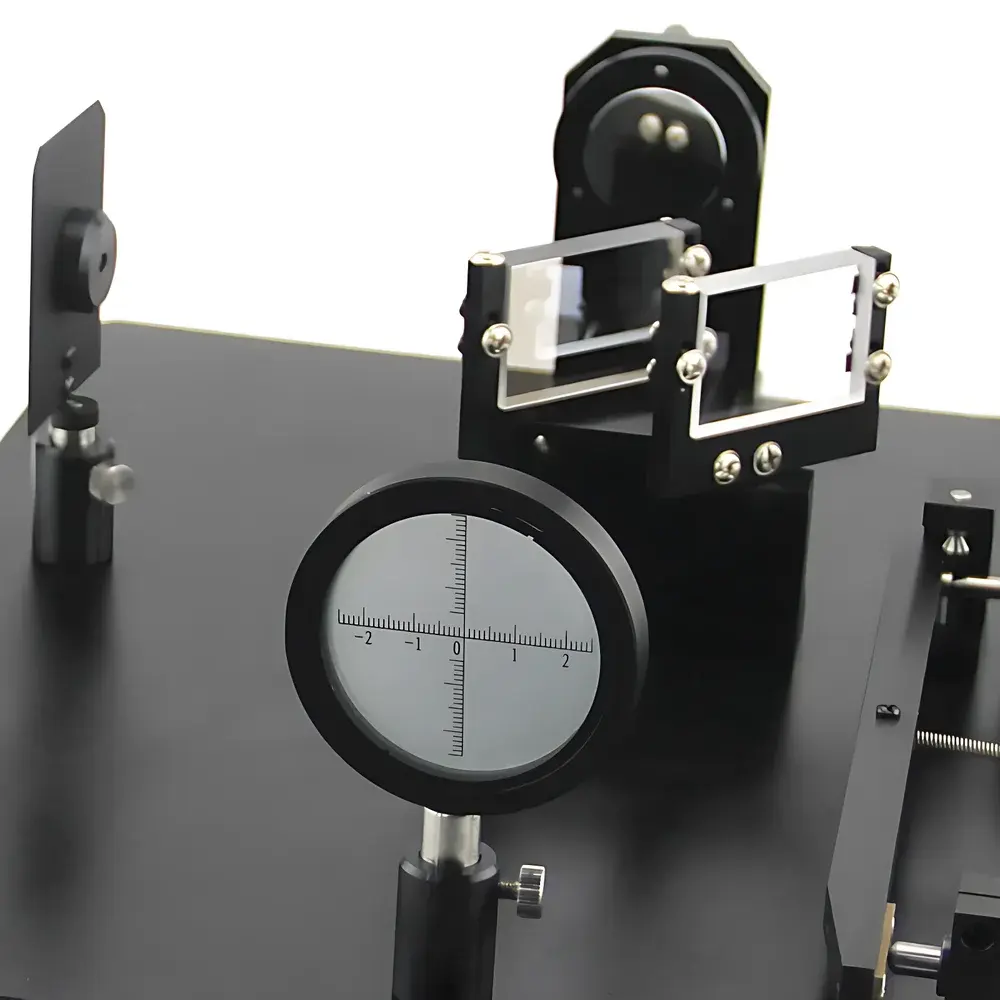
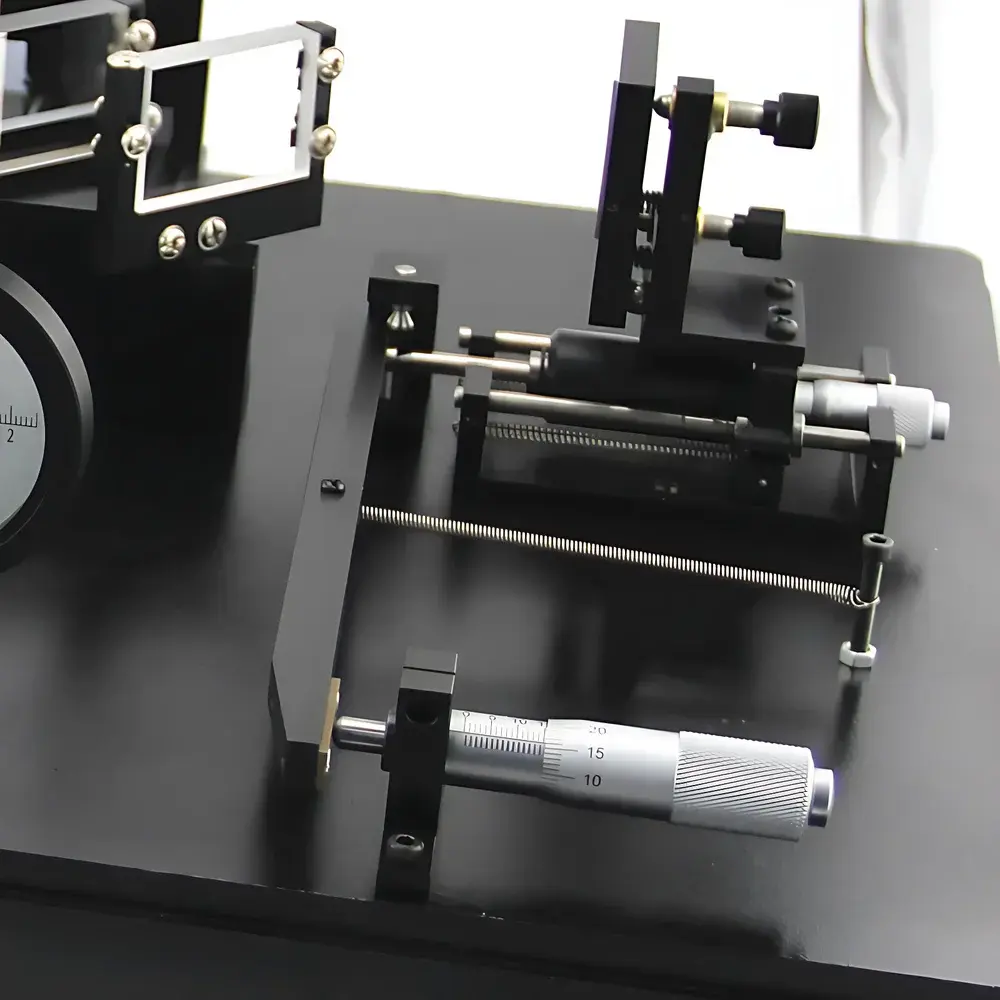
Topo WMG-1 Michelson Interferometer
| Brand | Topo |
|---|---|
| Origin | Tianjin, China |
| Manufacturer Type | Manufacturer |
| Model | WMG-1 |
| Price Range | USD 1,400 – 7,000 |
| Moving Mirror Fine Adjustment Precision | 0.0004 mm |
| Moving Mirror Coarse Adjustment Precision | 0.01 mm |
| Moving Mirror Fine Travel Range | 1 mm |
| Moving Mirror Coarse Travel Range | 12 mm |
| Beam Splitter & Compensator Plate Flatness | ≤ λ/20 |
| He-Ne Laser Output Power | 0.8–1 mW |
| Standard Configuration | Interferometer Main Unit, He-Ne Laser Source, One-Dimensional Adjustable Elevation Base |
| Optional Accessories | Low-Pressure Sodium Lamp, White Light Source, Gas Cell Assembly (Gas Chamber, Pressure Gauge, Hand Pump), Fabry–Pérot Etalon |
Overview
The Topo WMG-1 Michelson Interferometer is a precision optical instrument engineered for undergraduate physics laboratories, graduate-level optics education, and foundational research in physical optics. Based on the classical Michelson interferometric configuration—where a coherent light beam is divided by a beam splitter into two orthogonal paths, reflected by fixed and movable mirrors, and recombined to produce interference fringes—the WMG-1 enables quantitative analysis of wavelength, refractive index, and optical path difference with high reproducibility. Its rigid cast-iron platform base minimizes mechanical drift and vibration sensitivity, ensuring stable fringe formation during extended observation or measurement sessions. Designed explicitly for pedagogical rigor and experimental versatility, the system supports both monochromatic (e.g., He-Ne laser at 632.8 nm) and broadband (white-light) interferometry, facilitating direct visualization of non-localized interference, equal-inclination (fringes of constant inclination), equal-thickness (fringes of constant thickness), and coherence-length-limited white-light fringes.
Key Features
- High-stability cast-iron optical base with vibration-damping geometry and leveling feet for long-term alignment retention.
- Precision micrometer-driven moving mirror with dual-range translation: coarse adjustment (12 mm travel, 0.01 mm resolution) and fine adjustment (1 mm travel, 0.0004 mm resolution) for sub-wavelength optical path control.
- Optimized beam splitter and compensator plates manufactured to ≤ λ/20 surface flatness (measured at 632.8 nm), minimizing wavefront distortion and ensuring high-contrast, low-aberration interference patterns.
- Integrated He-Ne laser source (0.8–1 mW output power, TEM00 mode) with adjustable mounting and collimation for optimal beam alignment and spatial coherence.
- Modular mechanical design supporting rapid reconfiguration for diverse experimental geometries—including gas-phase refractive index measurements using optional gas cell assemblies with calibrated pressure gauges and hand pumps.
- Standard one-dimensional elevation-adjustable base enabling precise vertical alignment of the interference pattern on viewing screens or CCD detectors.
Sample Compatibility & Compliance
The WMG-1 accommodates a broad range of optical samples and illumination sources without modification. It is compatible with standard He-Ne lasers (632.8 nm), low-pressure sodium lamps (589.0 / 589.6 nm doublet), broadband white-light sources (for coherence length determination), and gas-filled cells for refractive index metrology of transparent media. While not certified for industrial metrology standards such as ISO/IEC 17025, the instrument’s mechanical and optical specifications align with common academic laboratory requirements outlined in ASTM E284 (Standard Terminology of Appearance) and ISO 10110-7 (optical element surface quality). Its open architecture allows integration into curricula compliant with ABET-accredited physics program learning outcomes and supports GLP-aligned documentation practices when used with external data logging systems.
Software & Data Management
The WMG-1 operates as a standalone optical bench instrument with no embedded firmware or proprietary software. All measurements—including fringe counting, mirror displacement calibration, and wavelength calculation—are performed manually or via third-party imaging and analysis tools (e.g., MATLAB, Python with OpenCV, or ImageJ). Users may digitize interference patterns using standard USB CCD cameras or CMOS sensors and apply Fourier-transform-based fringe analysis algorithms to extract phase shifts and optical path differences. The system supports traceable calibration workflows when paired with NIST-traceable laser wavelength references or certified etalons (e.g., optional Fabry–Pérot standard etalon). For regulated environments, raw image datasets and manual logbook entries can be archived to satisfy basic 21 CFR Part 11 audit-trail expectations when combined with institutional electronic lab notebook (ELN) platforms.
Applications
- Determination of laser wavelength and spectral line separation (e.g., Na D-line doublet Δλ ≈ 0.6 nm).
- Measurement of refractive index of solid thin films and gaseous media under controlled pressure conditions.
- Quantitative evaluation of optical flatness and surface figure error via fringe deformation analysis.
- Coherence length characterization using white-light fringes and envelope detection methods.
- Verification of wave-particle duality and superposition principles in quantum optics instruction.
- Calibration reference for Fabry–Pérot interferometers and other cavity-based optical sensors.
FAQ
Is the WMG-1 suitable for quantitative research beyond teaching labs?
Yes—its sub-micron mirror positioning resolution, λ/20 optical components, and mechanical stability support repeatable measurements in pilot-scale research on gas-phase dispersion or thin-film optical constants.
Can the system be upgraded for automated data acquisition?
Yes—motorized translation stages, stepper motor controllers, and USB cameras can be integrated using standard mounting interfaces; no proprietary protocols are required.
What safety certifications does the included He-Ne laser meet?
The integrated He-Ne laser complies with IEC 60825-1:2014 Class II safety requirements for visible-light laser products.
Are replacement beam splitters available with custom coating specifications?
Yes—Topo offers optional dielectric-coated beam splitters optimized for specific wavelength bands (e.g., 532 nm, 780 nm, or broadband 400–700 nm) upon request.
Does the instrument include alignment aids such as pinholes or alignment lasers?
No—alignment is performed visually using the interference fringes themselves, consistent with pedagogical best practices for developing optical intuition; auxiliary alignment tools may be added as user-supplied accessories.



