
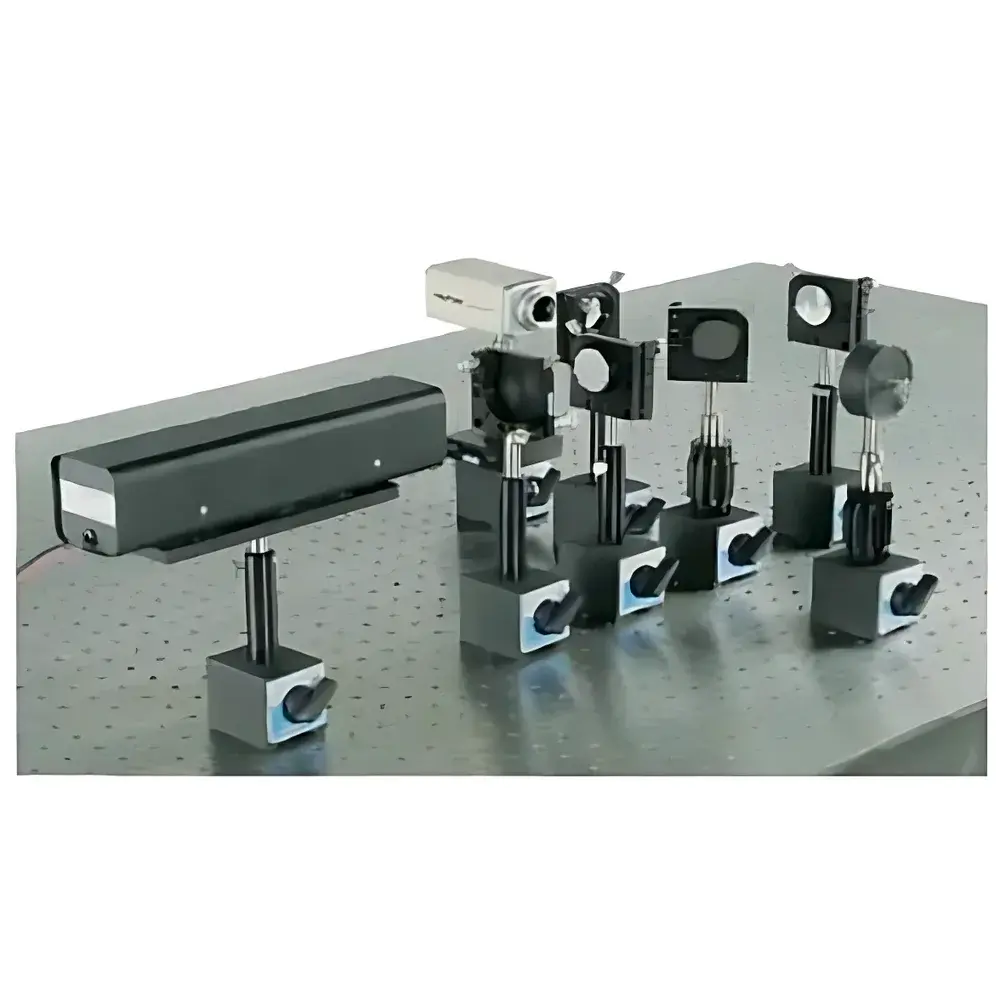
Topo WSG-1 Electronic Speckle Pattern Interferometry (ESPI) Educational System
| Brand | Topo |
|---|---|
| Model | WSG-1 |
| Origin | Tianjin, China |
| Manufacturer Type | OEM Manufacturer |
| Product Category | Domestic Scientific Instrumentation |
| Pricing | Available Upon Request |
Overview
The Topo WSG-1 Electronic Speckle Pattern Interferometry (ESPI) Educational System is a fully integrated, hands-on optical metrology platform engineered for undergraduate and graduate-level physics, mechanical engineering, and materials science laboratories. ESPI is a non-contact, full-field optical interferometric technique that quantifies surface displacement—specifically out-of-plane deformation—with sub-micrometer sensitivity by analyzing the interference patterns generated when coherent laser light interacts with a rough surface before and after mechanical loading. This system employs a stabilized helium–neon (He–Ne) laser source (632.8 nm) to illuminate the test object, while a high-resolution monochrome CCD camera captures time-synchronized speckle interferograms. Digital subtraction and phase-shifting algorithms implemented in the bundled software reconstruct displacement maps, enabling direct visualization of deformation gradients and strain distribution across the entire field of view.
Key Features
- Modular optical bench design with precision kinematic mounts and adjustable mirror holders—enabling students to manually align and optimize the interferometric path, reinforcing foundational optics principles including coherence, diffraction, and interference conditions.
- Dedicated ESPI acquisition and processing software with real-time image preview, speckle contrast optimization, and automatic fringe enhancement—designed for intuitive operation without prior programming experience.
- Native support for phase-stepping sequences (0°, 90°, 180°, 270°) to extract quantitative displacement data with improved noise immunity and reduced ambiguity in sign determination.
- 3D surface deformation reconstruction capability: exported displacement fields are rendered as interactive isometric surface plots with customizable color mapping, contour overlays, and cross-sectional slicing tools.
- Complete educational kit includes all core components: He–Ne laser (1–2 mW output), 12-bit monochrome CCD camera (640 × 480 active pixels), PCI-based frame grabber card, optical mounts, beam splitters, reference and object mirrors, translation stages, calibration specimens, and alignment targets.
Sample Compatibility & Compliance
The WSG-1 accommodates flat or gently curved opaque surfaces with diffuse reflectivity (e.g., aluminum, acrylic, painted steel, composite laminates) ranging from 50 mm × 50 mm to 200 mm × 200 mm. Specimen mounting is facilitated via a rigid, vibration-isolated baseplate compatible with standard optical breadboards. While designed for pedagogical use rather than industrial certification, the system adheres to fundamental safety standards for Class II laser devices (IEC 60825-1:2014). All optical components meet ISO 10110 surface quality specifications (scratch-dig 60–40), and mechanical adjustments maintain repeatability within ±2 arcsec over thermal cycles from 15–25 °C. The experimental workflow aligns with common learning outcomes outlined in ABET-accredited curricula and supports laboratory assessments compliant with ASTM E1333 (Standard Guide for Optical Interferometric Measurements of Surface Displacement).
Software & Data Management
The included ESPI Analysis Suite runs on Windows 10/11 (64-bit) and provides native TIFF and HDF5 export for long-term archival and third-party analysis (e.g., MATLAB, Python SciPy). Each acquired dataset embeds metadata—including timestamp, laser power setting, camera exposure time, and stage position—ensuring traceability for student lab reports and instructor grading. Audit trails record user-initiated operations (e.g., fringe filtering, phase unwrapping method selection), supporting academic integrity requirements. While not FDA 21 CFR Part 11–compliant (as it is not used in regulated clinical or pharmaceutical environments), the software architecture follows GLP-aligned practices for educational documentation, including version-controlled configuration files and exportable calibration logs.
Applications
- Quantitative demonstration of bending moment distribution in cantilever beams under point loads.
- Visualization of thermal expansion coefficients via controlled heating of bimetallic strips.
- Analysis of residual stress relaxation in welded joints using localized tensile loading.
- Comparative study of Poisson’s ratio in isotropic vs. orthotropic polymer composites.
- Validation of finite element method (FEM) predictions through direct experimental correlation of displacement contours.
FAQ
Is the He–Ne laser replaceable with a diode laser?
Yes—optical paths are designed for wavelength flexibility; however, substitution requires recalibration of magnification and speckle grain size. Diode lasers (e.g., 650 nm) may reduce coherence length and increase speckle noise.
Can the system measure in-plane displacement?
The WSG-1 is configured for out-of-plane measurement only. In-plane capability requires additional shearography optics and dual-beam illumination geometry—not included in this educational variant.
What is the minimum detectable displacement resolution?
Under optimal alignment and low-vibration conditions, theoretical resolution approaches λ/4 ≈ 158 nm; typical classroom measurements achieve 300–500 nm repeatability due to environmental stability constraints.
Does the software support batch processing of multiple datasets?
Yes—scriptable macros allow sequential analysis of time-series deformation stacks, with automated generation of displacement vs. load plots and RMS error statistics.
Are teaching manuals and lab experiment guides provided?
Comprehensive bilingual (English/Chinese) instructor manuals, student worksheets, theory primers, and safety protocols are included—aligned with standard university physics and experimental mechanics syllabi.
Related Products






