
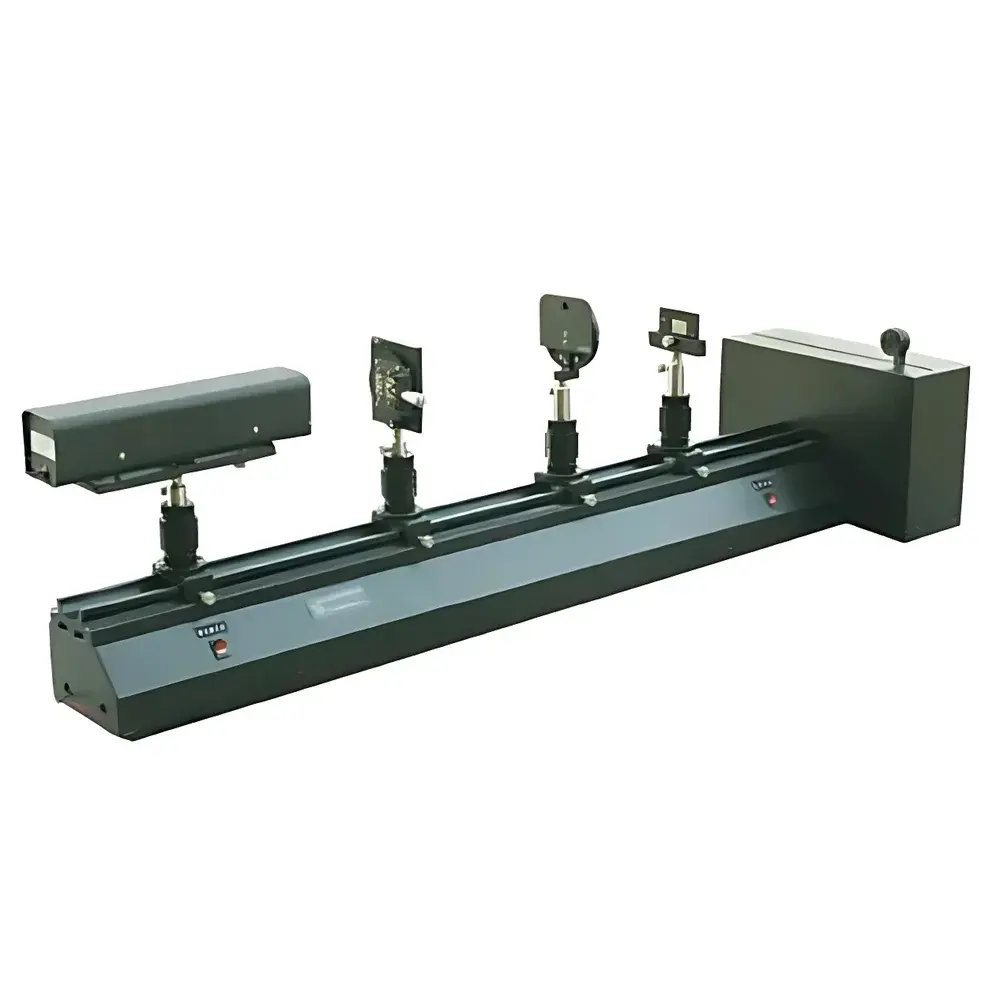
Topo WSZ-2A Automatic Diffraction Intensity Measurement System
| Brand | Topo |
|---|---|
| Model | WSZ-2A |
| Origin | Tianjin, China |
| Manufacturer Type | Direct Manufacturer |
| Product Category | Domestic Scientific Instrumentation |
| Light Source | He–Ne Laser (632.8 nm) |
| Structural Design | Precision Optical Rail Mounting System |
| Control Interface | PC-Based Acquisition & Analysis Software (Chinese GUI) |
| Included Components | Main Unit, Movable Detector Unit, Single Adjustable Slit, Laser Module |
Overview
The Topo WSZ-2A Automatic Diffraction Intensity Measurement System is a dedicated educational and pedagogical instrument engineered for quantitative verification of far-field diffraction intensity distributions in undergraduate and graduate optics laboratories. It operates on the fundamental principles of scalar diffraction theory—specifically Fraunhofer diffraction—enabling precise spatial mapping of intensity profiles generated by canonical apertures including single slits, double slits, multiple slits (N-slit gratings), circular apertures, and rectangular apertures. The system integrates a stabilized helium–neon laser (λ = 632.8 nm) as a coherent monochromatic source, a motorized linear translation stage for detector positioning, and a high-resolution photodetector mounted on a calibrated optical rail. This architecture ensures repeatable alignment, minimal mechanical drift, and direct correlation between theoretical predictions (e.g., sinc²(α) for single-slit, cos²(β)·sinc²(α) for double-slit) and measured intensity curves.
Key Features
- Precision optical rail platform with metric-scale graduations and micrometer-adjustable mounts for reproducible component positioning
- Computer-controlled detector translation via stepper motor drive, enabling automated intensity scanning across ±150 mm range
- Integrated He–Ne laser module with beam collimation optics and power stabilization (typical output: 1.0 mW, TEM₀₀ mode)
- Manually adjustable single slit with vernier scale (slit width range: 0.02–2.0 mm, resolution: 0.01 mm)
- Digital photodetector with analog voltage output (0–5 V) proportional to incident irradiance, sampled at up to 100 Hz
- Real-time data acquisition and curve plotting via proprietary Windows-based software with export capability (CSV, PNG, PDF)
Sample Compatibility & Compliance
The WSZ-2A accommodates standard aperture configurations used in university-level optics curricula: replaceable slit plates (single, double, triple, five-slit), interchangeable circular and rectangular aperture masks, and optional diffraction grating inserts. All optical components are mounted using standardized kinematic mounts compatible with industry-standard 1-inch or 25-mm optical rails. While designed for educational use—not certified metrological instrumentation—the system supports alignment verification per ISO 10110-7 (optical element surface form) and adheres to IEC 60825-1:2014 safety requirements for Class 3R lasers. Its modular construction facilitates integration into lab courses aligned with ASTM E1317 (Standard Practice for Calibration of Spectrophotometers) and national physics curriculum frameworks emphasizing experimental validation of wave optics.
Software & Data Management
The included acquisition software provides intuitive control over scan parameters (step size: 0.05–1.0 mm; dwell time: 50–500 ms per point), real-time intensity vs. position visualization, and overlay of theoretical diffraction envelopes calculated from user-input geometry (slit width, wavelength, screen distance). Data sets support batch processing, baseline subtraction, normalization, and peak identification algorithms. Export functions comply with FAIR data principles: all measurements embed metadata (timestamp, laser power reading, slit setting, detector gain), and CSV files are structured for direct import into MATLAB, Python (NumPy/Pandas), or OriginLab. Although the GUI is localized in Simplified Chinese, the underlying data schema follows international conventions (SI units, UTF-8 encoding), ensuring interoperability in multilingual academic environments.
Applications
- Quantitative validation of Fraunhofer diffraction theory for various aperture geometries
- Experimental determination of slit width and grating period via minima spacing analysis
- Investigation of coherence effects using variable slit separation and illumination geometry
- Comparative study of diffraction-limited resolution in circular vs. rectangular apertures
- Teaching laboratory exercises on Fourier optics, spatial filtering, and optical transfer functions
- Capstone projects involving custom aperture design, detector calibration, or uncertainty propagation modeling
FAQ
Is the WSZ-2A suitable for research-grade measurements?
It is optimized for instructional accuracy and repeatability in teaching labs—not for metrology-critical applications requiring NIST-traceable calibration.
Can third-party software (e.g., LabVIEW or Python) interface with the system?
Yes: the device exposes a virtual COM port with ASCII-based command protocol (documentation provided); Python libraries for serial communication are available upon request.
What safety certifications does the He–Ne laser module hold?
Complies with IEC 60825-1:2014 Class 3R requirements, including embedded key switch, emission indicator LED, and beam shutter interlock.
Is detector calibration traceable to national standards?
Factory calibration uses reference photodiodes calibrated against NIM (National Institute of Metrology, China) standards; full calibration certificate available as optional add-on.
Does the system support dual-wavelength experiments?
No—hardware is configured exclusively for 632.8 nm He–Ne operation; alternative wavelengths require external laser sources and custom mounting adapters.





