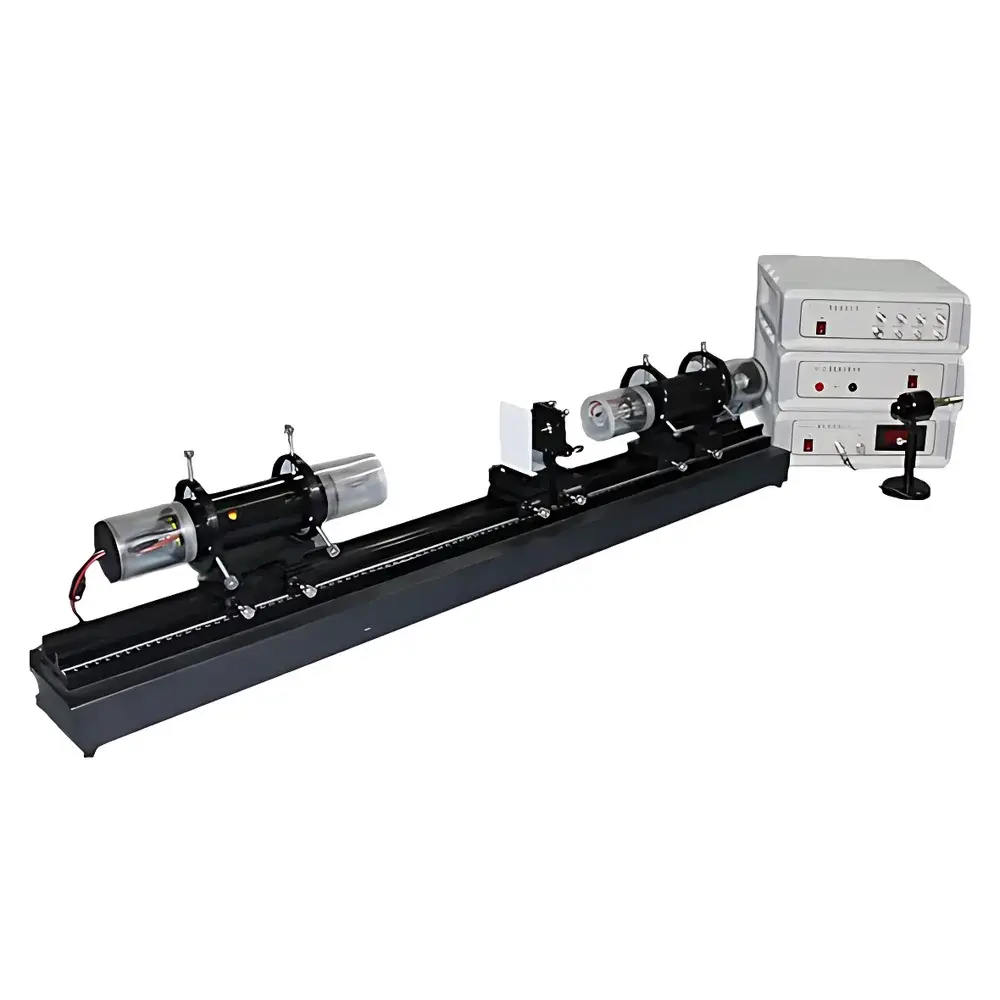
Topo XGL-3 Helium-Neon Laser Principles & Technology Comprehensive Experiment System
| Brand | Topo (TP) |
|---|---|
| Origin | Tianjin, China |
| Manufacturer Type | Direct Manufacturer |
| Country of Origin | China |
| Model | XGL-3 |
| Pricing | Upon Request |
Overview
The Topo XGL-3 Helium-Neon Laser Principles & Technology Comprehensive Experiment System is a pedagogical optical instrumentation platform engineered for undergraduate and graduate-level physics laboratories. It is fundamentally based on the operational principles of continuous-wave (CW) gas lasers, specifically the 632.8 nm red emission from a helium-neon (He–Ne) plasma medium under DC excitation. The system enables hands-on investigation of laser cavity alignment, longitudinal mode structure, threshold behavior, gain saturation, spatial beam profiling (TEM00 verification), polarization characteristics, and output power stability as a function of discharge current and mirror reflectivity. Designed to comply with standard university optics laboratory safety protocols (ANSI Z136.1 Class II/IIIa laser safety requirements), the XGL-3 integrates a stabilized He–Ne laser tube, adjustable external cavity optics, precision kinematic mounts, beam diagnostics accessories (including neutral density filters, polarizers, and photodetectors), and calibrated measurement interfaces—providing a complete experimental environment for validating theoretical models in laser physics and photonics engineering.
Key Features
- Integrated He–Ne laser source with nominal wavelength 632.8 nm, TEM00 transverse mode operation, and typical output power range 0.5–2.0 mW (adjustable via current control)
- Modular external cavity configuration supporting longitudinal mode analysis using Fabry–Pérot interferometer scanning or beat frequency techniques
- Precision XYZ translation stages and goniometric mirror mounts for iterative cavity alignment and stability assessment
- Real-time photodetection interface with analog voltage output (0–5 V) proportional to incident laser intensity, compatible with standard oscilloscopes and data acquisition systems
- Dedicated educational curriculum support including laboratory manuals, alignment procedures, error analysis templates, and theoretical derivations aligned with standard optics textbooks (e.g., Hecht, Pedrotti)
- Compliance with IEC 60825-1:2014 for Class 3R laser product classification; includes interlocked enclosure option and key-controlled enable switch
Sample Compatibility & Compliance
The XGL-3 is not intended for material sample analysis but serves as a controlled light source for optical metrology education. Its design supports interchangeable optical components—including dielectric mirrors (R > 99.9% at 632.8 nm), Brewster-angle windows, quarter-wave plates, and diffraction gratings—to explore polarization control, interference, and coherence length measurement. All mechanical components conform to ISO 2768-mK general tolerances; optical mounts meet DIN 31800 specifications for angular repeatability (< ±2 arcsec). The system adheres to GLP-aligned documentation practices for academic lab use, with traceable calibration records for photodetector responsivity (NIST-traceable Si photodiode reference) and wavelength verification (using iodine-stabilized reference cell option).
Software & Data Management
While the base XGL-3 operates without proprietary software, it provides analog signal outputs fully compatible with third-party data acquisition platforms such as National Instruments LabVIEW, MATLAB Data Acquisition Toolbox, and Python-based PyVISA frameworks. Optional digital upgrade kits include USB-interfaced DAQ modules with 16-bit resolution, enabling time-resolved recording of laser power drift, mode-hopping events, and transient response during warm-up. All collected datasets support export in CSV and HDF5 formats. Audit trails for experimental sessions—including operator ID, timestamp, ambient temperature/humidity logs, and instrument configuration settings—can be implemented via customizable metadata tagging in accordance with institutional GLP guidelines.
Applications
- Undergraduate laboratory instruction in quantum electronics, modern physics, and applied optics
- Verification of laser rate equations and small-signal gain coefficient estimation
- Measurement of coherence length via Michelson interferometry and fringe visibility analysis
- Characterization of beam divergence, M² factor (with optional beam profiler add-on), and astigmatism correction
- Study of laser noise sources: intensity noise (RIN), frequency jitter, and mode competition dynamics
- Preparation for advanced coursework in optical communications, interferometric sensing, and laser stabilization techniques
FAQ
Is the XGL-3 suitable for research-grade laser characterization beyond teaching labs?
Yes—when equipped with optional high-resolution spectrum analyzers or heterodyne detection modules, the XGL-3 supports quantitative investigations into linewidth broadening mechanisms and cavity Q-factor estimation.
Does the system include safety certification documentation for campus installation?
Yes—each unit ships with a full IEC 60825-1 compliance dossier, including laser classification test report, optical hazard distance calculation, and recommended administrative controls per ANSI Z136.1.
Can the He–Ne tube be replaced independently without recalibrating the entire system?
Yes—the laser tube is mounted in a standardized L-shaped bracket with electrical and thermal interfaces designed for field replacement; post-replacement alignment follows documented SOPs included in the maintenance manual.
Are curriculum materials available in English for international institutions?
Yes—Topo provides bilingual (English/Chinese) lab manuals, safety briefings, and instructor solution guides upon request, aligned with AAPT and OSA recommended learning outcomes.
What environmental conditions are required for stable operation?
Ambient temperature stability within ±1°C over 24 h is recommended; relative humidity between 30–70% non-condensing; vibration isolation table strongly advised for coherence-length measurements.