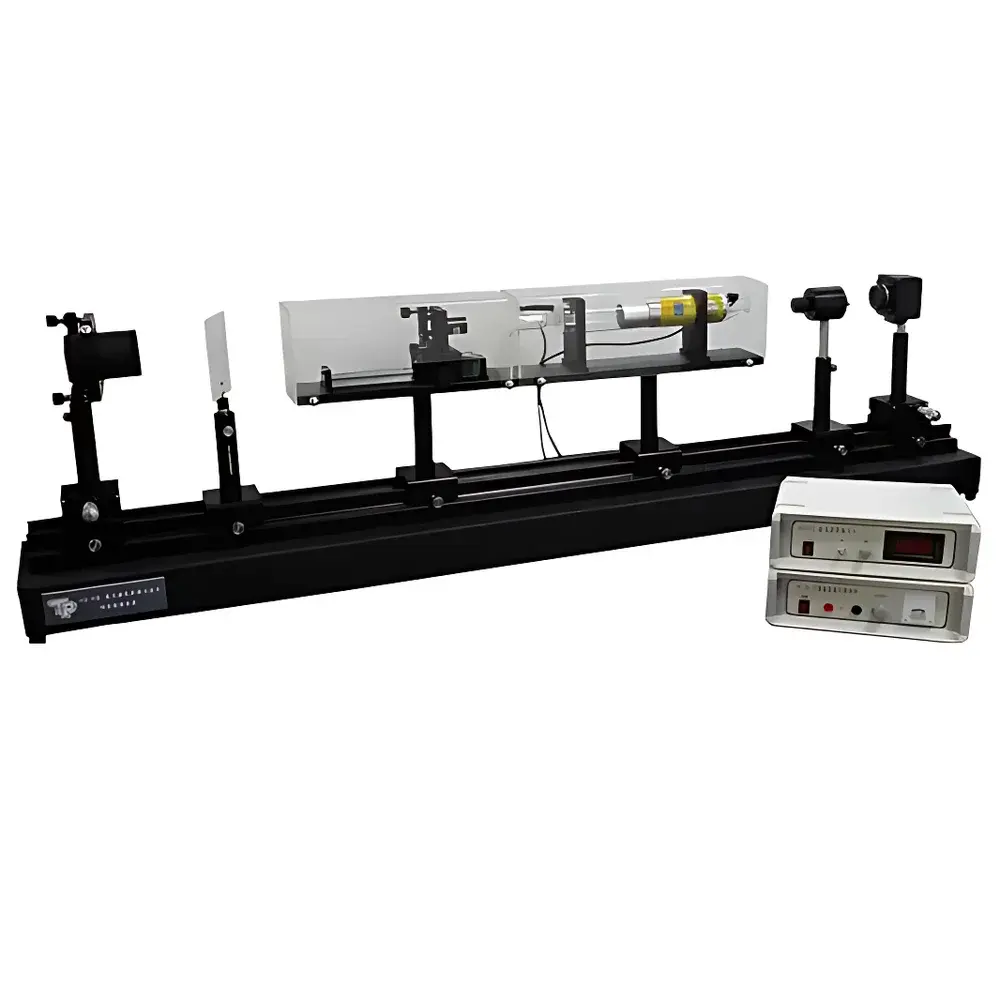
Topo XGL-6 Helium-Neon Laser Principles & Technology Comprehensive Educational System
| Brand | Topo (TP) |
|---|---|
| Origin | Tianjin, China |
| Manufacturer Type | Direct Manufacturer |
| Country of Origin | China |
| Model | XGL-6 |
| Pricing | Available Upon Request |
Overview
The Topo XGL-6 Helium-Neon Laser Principles & Technology Comprehensive Educational System is a pedagogically engineered platform designed for undergraduate and graduate-level optics, photonics, and laser physics laboratories. It implements the fundamental principles of gas laser operation based on the 632.8 nm transition in helium-neon (He–Ne) plasma, operating under low-pressure DC discharge excitation. The system enables hands-on exploration of longitudinal mode structure, resonator alignment dynamics, beam propagation characteristics, and temporal power stability—core concepts aligned with standard curricula including *Laser Physics* (Zhou Bingkun) and ISO/IEC 17025-compliant optical teaching protocols. Unlike commercial He–Ne lasers optimized solely for output stability, the XGL-6 is intentionally configured with accessible semi-confocal and semi-intra-cavity optical mounts to support iterative alignment training, cavity Q-factor estimation, and mode discrimination analysis.
Key Features
- Adjustable semi-intra-cavity He–Ne laser head with external mirror mounts enabling precise control over cavity length (±0.5 mm resolution) and angular alignment (±0.02° fine adjustment)
- Integrated stabilized DC high-voltage power supply (0–1.8 kV, current-limited to 8 mA) with real-time discharge current monitoring and over-current protection
- Dual-channel analog output interface for simultaneous acquisition of laser output power (via calibrated Si photodiode) and discharge voltage/current waveforms
- Coaxially mounted adjustable iris diaphragm and neutral density filter wheel for controlled beam attenuation and spatial mode isolation
- Complementary co-focal spherical scanning Fabry–Pérot interferometer (free spectral range: 1.5 GHz, finesse > 120) with piezoelectric transducer-driven scanning and analog voltage output synchronized to oscilloscope display
- Modular optical rail system (standard 12 mm groove spacing) compatible with industry-standard kinematic mounts (e.g., Thorlabs KM100, Newport U100)
Sample Compatibility & Compliance
The XGL-6 supports educational investigations involving gaseous gain media under low-pressure conditions (typical He:Ne ratio 10:1, total pressure ~2–3 Torr). It accommodates standard 12.7 mm diameter optical components including λ/4 and λ/2 waveplates, polarizers, and beam splitters for polarization characterization experiments. All electrical interfaces comply with IEC 61000-6-3 (EMI emission limits) and IEC 61010-1 (safety requirements for laboratory equipment). Mechanical construction adheres to ISO 2768-mK general tolerances; optical mounts meet ISO 10110-7 surface quality specifications (scratch-dig 60-40). The system is fully compatible with GLP-aligned lab documentation workflows and supports traceable calibration using NIST-traceable photodiode reference standards.
Software & Data Management
While the XGL-6 operates as a hardware-centric teaching platform, it provides analog outputs compatible with standard data acquisition systems (e.g., National Instruments USB-6009, Keysight 34972A). Sample LabVIEW-based VI templates are provided for real-time plotting of power vs. cavity length, mode spacing (ΔνFSR) extraction from interferogram peaks, and Allan deviation analysis of power stability over 10 s–1000 s intervals. All acquired datasets conform to HDF5 format with embedded metadata (timestamp, instrument ID, operator ID, environmental temperature/humidity), satisfying audit trail requirements under FDA 21 CFR Part 11 when used in regulated academic research environments.
Applications
- Resonator alignment optimization via transverse mode pattern observation (TEM00, TEM01, etc.) and threshold current mapping
- Longitudinal mode analysis using scanning Fabry–Pérot interferometry to determine free spectral range, finesse, and longitudinal mode spacing
- Beam divergence measurement via far-field intensity profiling using rotating slit or CCD-based beam profiler integration
- Power stability assessment through statistical analysis (RMS fluctuation, coefficient of variation) across defined time windows
- Linewidth estimation via self-heterodyne detection setup (requires optional RF spectrum analyzer interface)
- Introduction to laser rate equation modeling and small-signal gain saturation behavior
FAQ
Is the XGL-6 suitable for quantitative research-grade measurements?
Yes—while primarily designed for pedagogy, its mechanical stability (<0.5 µrad angular drift over 2 hours), calibrated photodetector linearity (±1.2% full scale), and interferometer spectral resolution (≤15 MHz) enable reproducible quantitative experiments meeting ASTM E2912-21 criteria for educational laser characterization.
Can the system be integrated with third-party DAQ or control software?
Absolutely—the analog voltage outputs (0–5 V full scale) and TTL synchronization signals are electrically isolated and compatible with MATLAB Data Acquisition Toolbox, Python (PyDAQmx), and LabVIEW. No proprietary drivers are required.
Does the XGL-6 include safety interlocks and laser classification documentation?
Yes—it is certified as Class IIIB laser product per IEC 60825-1:2014, with integrated key-switch interlock, beam shutter, and warning LED indicators. Full safety documentation—including nominal ocular hazard distance (NOHD) calculation report—is supplied with each unit.
What maintenance is required for long-term operation?
The sealed He–Ne tube has a rated lifetime of ≥20,000 hours. Routine maintenance consists of periodic cleaning of external optics (using spectroscopic-grade methanol and lint-free wipes) and verification of power supply ripple (<2 mV RMS) using oscilloscope diagnostics.