
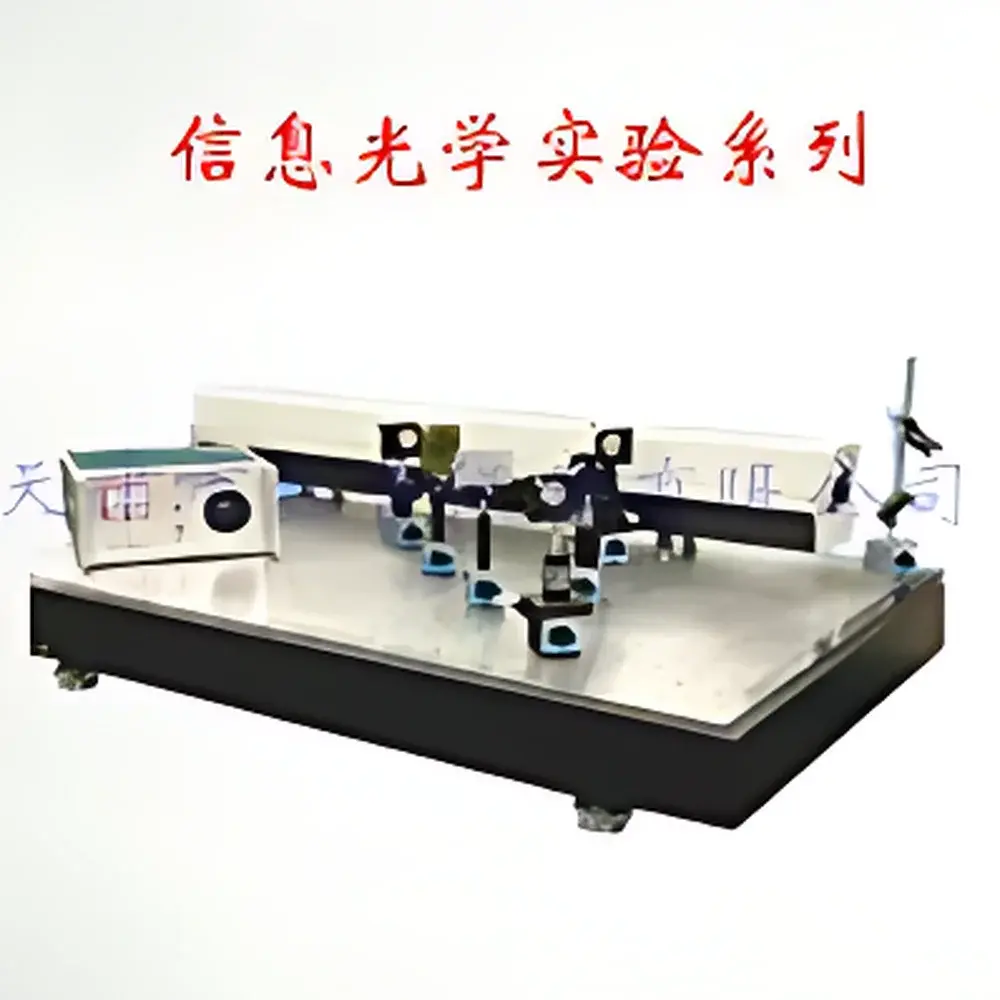
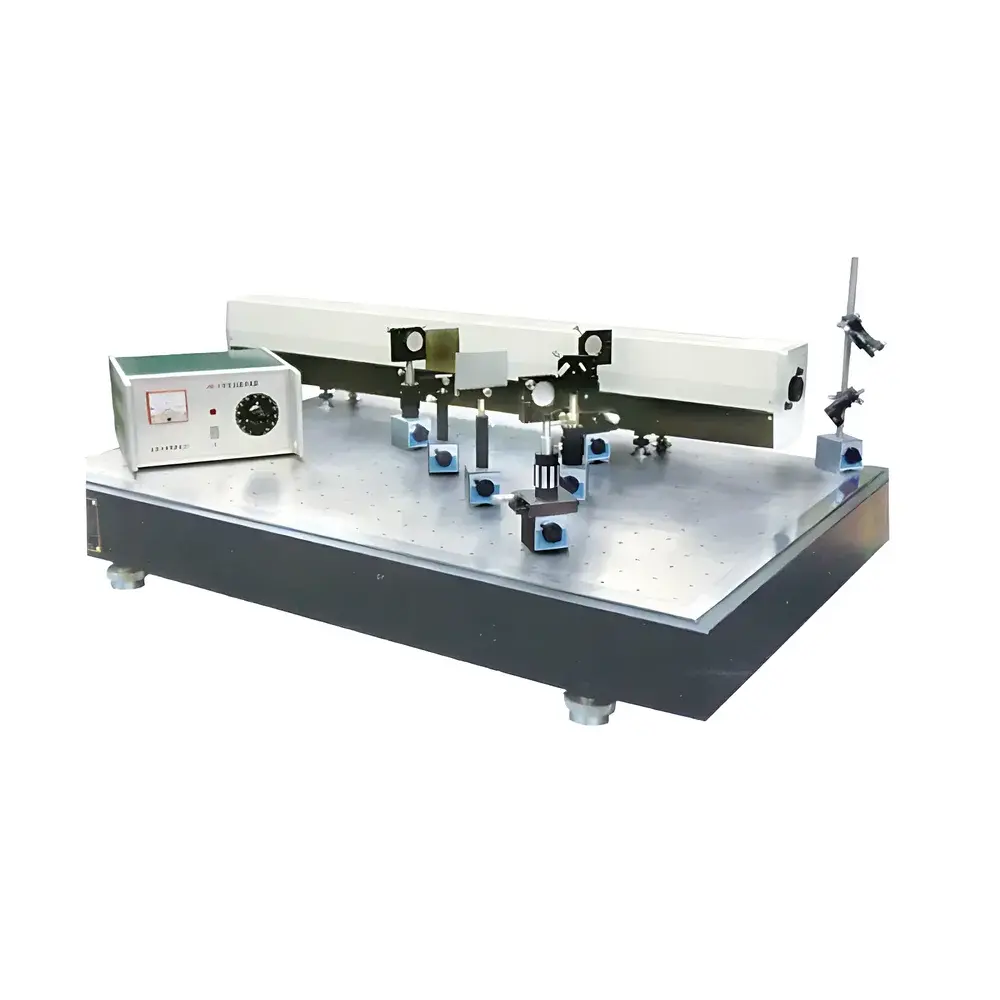
Topo XGS-1 Information Optics Teaching System
| Brand | Topo |
|---|---|
| Origin | Tianjin, China |
| Manufacturer Type | OEM Manufacturer |
| Country of Origin | China |
| Model | XGS-1 |
| Pricing | Upon Request |
Overview
The Topo XGS-1 Information Optics Teaching System is a modular, education-focused optical platform engineered for undergraduate and graduate-level instruction in classical and modern optics. It implements core principles of wave optics, coherent imaging, and spatial frequency domain analysis through hands-on laboratory experiments grounded in fundamental physical theory. The system operates on the principle of laser-based interferometric recording—leveraging coherent He–Ne or diode lasers (typically 632.8 nm or 650 nm) to generate stable interference patterns for holographic recording, diffraction grating fabrication, and spatial filtering demonstrations. Designed for pedagogical clarity and experimental reproducibility, the XGS-1 supports quantitative verification of Abbe’s theory of image formation, θ-modulation encoding, and chromatic synthesis via wavelength-selective reconstruction—making it suitable for courses in optical physics, photonics engineering, and applied metrology.
Key Features
- Stable dual-layer vibration-damped optical platform (1200 × 800 × 120 mm), constructed from magnetic stainless steel for secure component mounting and long-term alignment retention
- Adjustable optical axis height (180–240 mm) to accommodate varied student ergonomics and integration with standard optical benches or laser sources
- Comprehensive set of precision kinematic mounts—including XYZ translation stages, rotation mounts, and beam steering holders—optimized for alignment-sensitive holographic setups
- Included high-resolution silver-halide holographic emulsions (e.g., Slavich PFG-01 or equivalent), pre-characterized for optimal fringe contrast and diffraction efficiency at common He–Ne wavelengths
- Modular experiment scalability: compatible with XGS-2 through XGS-5 expansion modules for advanced topics including Fresnel holography, rainbow holography, and optical pattern recognition
Sample Compatibility & Compliance
The XGS-1 accommodates standard 5 × 7 cm or 10 × 12.5 cm holographic plates and photopolymer films. Its mechanical architecture complies with ISO 10110-7 (optical element surface quality) and ANSI Z80.10 (educational optical equipment safety standards) for classroom deployment. All optical mounts meet ISO 9001-certified manufacturing tolerances, ensuring repeatable angular alignment (±0.5 mrad) and lateral positioning (±5 µm). While not intended for clinical or regulated industrial use, the system supports GLP-aligned lab documentation practices—particularly when paired with calibrated laser power meters and spatial filter characterization kits (optional accessories).
Software & Data Management
The XGS-1 is hardware-native and does not require proprietary software; however, it integrates seamlessly with industry-standard tools for data acquisition and analysis. Instructors commonly pair it with MATLAB® or Python-based optical simulation suites (e.g., PyOptica, LightPipes) to model diffraction patterns, simulate Fourier plane filtering, or quantify modulation transfer functions (MTF) in Abbe imaging experiments. Optional digital CCD/CMOS cameras (e.g., Thorlabs DCC1545M) enable real-time fringe monitoring and quantitative intensity profiling—data exportable in TIFF, CSV, or HDF5 formats for post-processing and student report generation. Audit trails for experimental parameters (laser power, exposure time, filter aperture size) are maintained manually per institutional GLP guidelines.
Applications
- Undergraduate physics laboratories: Verification of Abbe’s sine condition and spatial frequency cutoff in coherent imaging systems
- Optics engineering curricula: Fabrication and characterization of transmission holographic gratings with controlled groove density (100–2000 lines/mm)
- Digital image processing labs: Spatial filtering experiments demonstrating low-pass, high-pass, and band-stop filtering in the Fourier domain
- Photonics research training: θ-modulation techniques for multiplexed color encoding and polarization-multiplexed holography
- Materials science instruction: Comparative analysis of holographic recording media response under varying exposure doses and development protocols
FAQ
Is the XGS-1 compatible with femtosecond laser sources for ultrafast holography?
No—the platform is optimized for continuous-wave (CW) He–Ne and diode lasers (≤5 mW output). Ultrafast pulse compatibility requires vacuum-sealed, dispersion-compensated optical paths not included in the base configuration.
Can the magnetic stainless steel platform support ferromagnetic optical mounts from other manufacturers?
Yes—mounts with M4 or M6 threaded bases adhere reliably; however, non-magnetic mounts (e.g., aluminum or brass) require mechanical clamping via the platform’s peripheral T-slots.
Does Topo provide curriculum materials or lab manuals for the XGS-1?
Yes—comprehensive English-language instructor guides, student worksheets, theoretical background primers, and safety protocols are supplied with each unit, aligned with AAPT-recommended learning outcomes for optics education.
What environmental conditions are required for stable holographic recording?
Ambient temperature stability (±1 °C/hour), relative humidity 30–50%, and acoustic isolation (NC-30 noise criterion) are recommended; the dual-layer damping reduces sensitivity to floor-borne vibrations by >20 dB below 10 Hz.
Is calibration certification available for the XGS-1 platform?
Topo provides factory alignment verification reports (traceable to NIST-calibrated autocollimators and laser interferometers); third-party ISO/IEC 17025 calibration is available upon request.




