
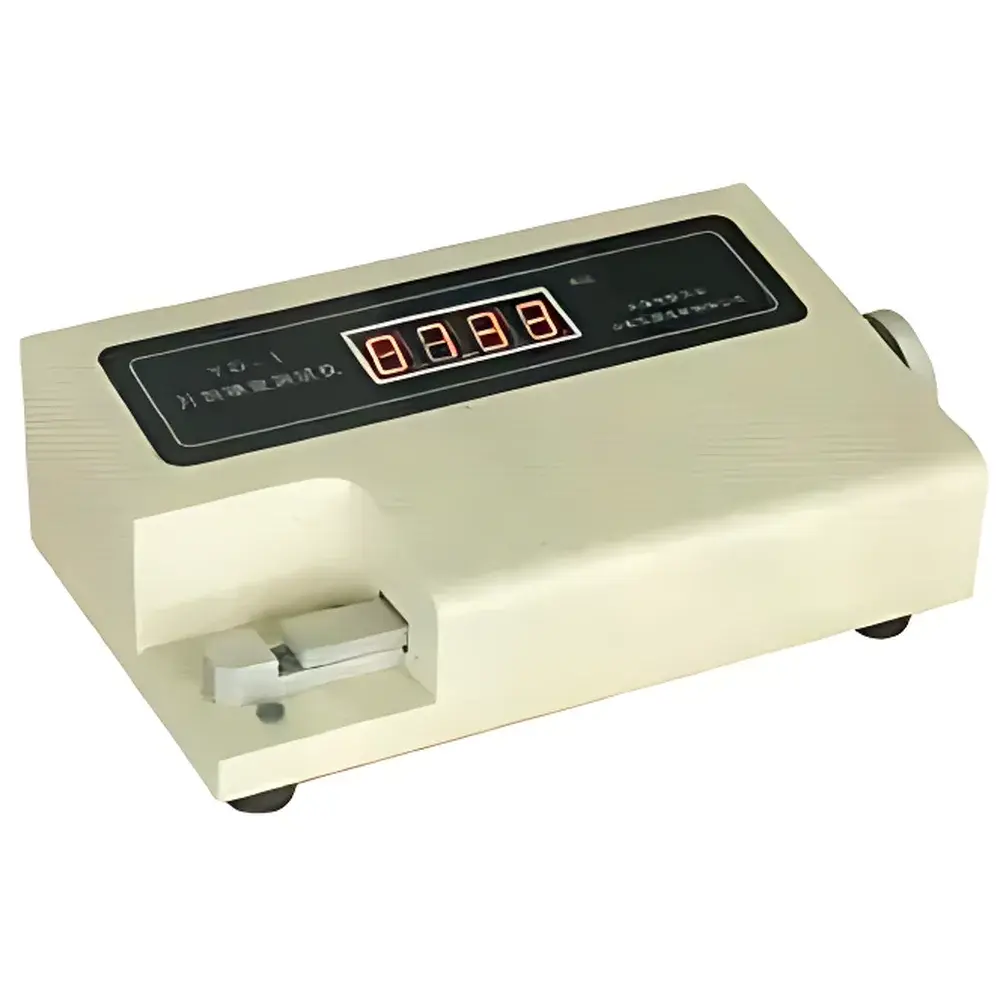
Topo YD-1 Tablet Hardness Tester
| Brand | Topo |
|---|---|
| Origin | Tianjin, China |
| Manufacturer Type | Direct Manufacturer |
| Region of Origin | Domestic (China) |
| Model | YD-1 |
| Pricing | Available Upon Request |
| Hardness Range | 0.01–20 kgf |
| Accuracy | ±5% or ±0.05 kgf (whichever is greater) |
| Probe Stroke | 20 mm |
| Stroke Tolerance | ±0.1 mm |
| Continuous Operation Time | >24 h |
| Power Supply | 220 V / 50 Hz / 10 W |
| Dimensions (L×W×H) | 280 × 180 × 110 mm |
| Weight | 5 kg |
| Operating Temperature | +18 °C to +28 °C |
| Storage Temperature | −10 °C to +50 °C |
| Relative Humidity | 20–80 % RH |
Overview
The Topo YD-1 Tablet Hardness Tester is a manually operated, microprocessor-controlled instrument engineered for the precise mechanical evaluation of tablet hardness in pharmaceutical quality control laboratories. It operates on the principle of axial compression force measurement: a calibrated load cell applies controlled, linearly increasing pressure via a stainless-steel probe onto a single tablet positioned horizontally between fixed and movable anvils. Upon fracture, the peak compressive force—recorded as hardness—is captured digitally in kilogram-force (kgf). This method aligns with pharmacopoeial guidance including USP “Mechanical Strength of Tablets” and EP 2.9.8 “Hardness of Tablets”, supporting routine QC release testing, formulation development, and stability studies where tablet integrity directly correlates with disintegration behavior, friability resistance, and downstream processing robustness.
Key Features
- Microcontroller-based operation ensures consistent test initiation, real-time force acquisition, and automatic peak-hold functionality upon tablet fracture.
- High-precision strain-gauge load cell with resolution down to 0.01 kgf and accuracy certified to ±5% or ±0.05 kgf (whichever is greater), meeting ISO 9001 calibration traceability requirements.
- Dual-mode display: 3-digit LED numeric readout showing instantaneous and locked hardness values; intuitive PC-membrane front panel eliminates mechanical key wear and enhances cleanroom compatibility.
- Fixed 20 mm probe stroke with mechanical limit stop and ±0.1 mm positional repeatability—designed to prevent over-compression and ensure uniform contact geometry across diverse tablet geometries (flat, convex, beveled).
- Low-power architecture (10 W nominal) enables stable, uninterrupted operation for >24 hours under continuous batch testing conditions without thermal drift.
- Compact benchtop footprint (280 × 180 × 110 mm) and lightweight construction (5 kg) facilitate integration into constrained QC lab spaces and mobile validation carts.
Sample Compatibility & Compliance
The YD-1 accommodates standard tablet diameters from 6 mm to 18 mm and thicknesses up to 8 mm, with optional anvil inserts available for irregular shapes (e.g., oval, capsule-shaped tablets). Its mechanical design conforms to ICH Q5A and Q5C environmental stability guidelines for equipment used in GMP-regulated environments. While the instrument itself does not generate electronic audit trails, its analog-digital hybrid architecture supports GLP-compliant documentation when paired with standardized SOPs for manual data transcription and secondary verification. All critical components—including the load cell, signal conditioning circuitry, and power supply—are sourced from ISO-certified suppliers, with full traceability documentation available upon request for regulatory submissions.
Software & Data Management
The YD-1 operates as a standalone hardware unit without embedded software or network connectivity. Data output is exclusively visual (LED display) and non-volatile—no internal memory, USB port, or wireless interface is provided. Users record results manually into laboratory notebooks or LIMS-compatible spreadsheets. For laboratories requiring electronic records per FDA 21 CFR Part 11, the device may be integrated into validated workflows using external digital calipers or force transducers with compliant data acquisition systems. Calibration certificates include NIST-traceable references and are issued annually or after any impact event affecting structural integrity.
Applications
- Routine hardness screening of finished dosage forms prior to packaging and release.
- Formulation optimization during preclinical and clinical development stages—correlating binder concentration, granulation method, and compaction pressure with mechanical strength.
- Stability protocol execution per ICH Q1A(R2), monitoring hardness changes under accelerated and long-term storage conditions.
- Supplier qualification of excipients where particle density and flow behavior influence compactibility.
- Educational use in pharmacy and pharmaceutical engineering curricula for hands-on understanding of tablet mechanical properties.
FAQ
Is the YD-1 compliant with USP or EP standards?
Yes—the measurement principle, force application geometry, and reporting units (kgf) conform to USP and Ph. Eur. 2.9.8. Full compliance requires adherence to associated procedural controls (e.g., sample conditioning, probe alignment, operator training).
Can the instrument be calibrated in-house?
Calibration must be performed using certified dead-weight standards traceable to national metrology institutes. Topo provides a factory calibration certificate; annual recalibration by an accredited third-party lab is recommended for GMP environments.
Does the YD-1 support statistical process control (SPC) data export?
No—data capture is manual. Integration with SPC software requires external digitization (e.g., via camera-based OCR or dedicated data logger interfaces).
What maintenance is required?
Monthly visual inspection of probe tip wear, anvil surface flatness, and mechanical play; biannual cleaning of internal dust accumulation; no lubrication or firmware updates are needed.
Is the device suitable for coated or film-coated tablets?
Yes—its low-speed, constant-rate compression minimizes surface chipping. However, hardness interpretation for coated tablets should consider coating elasticity separately from core strength in analytical reports.





