
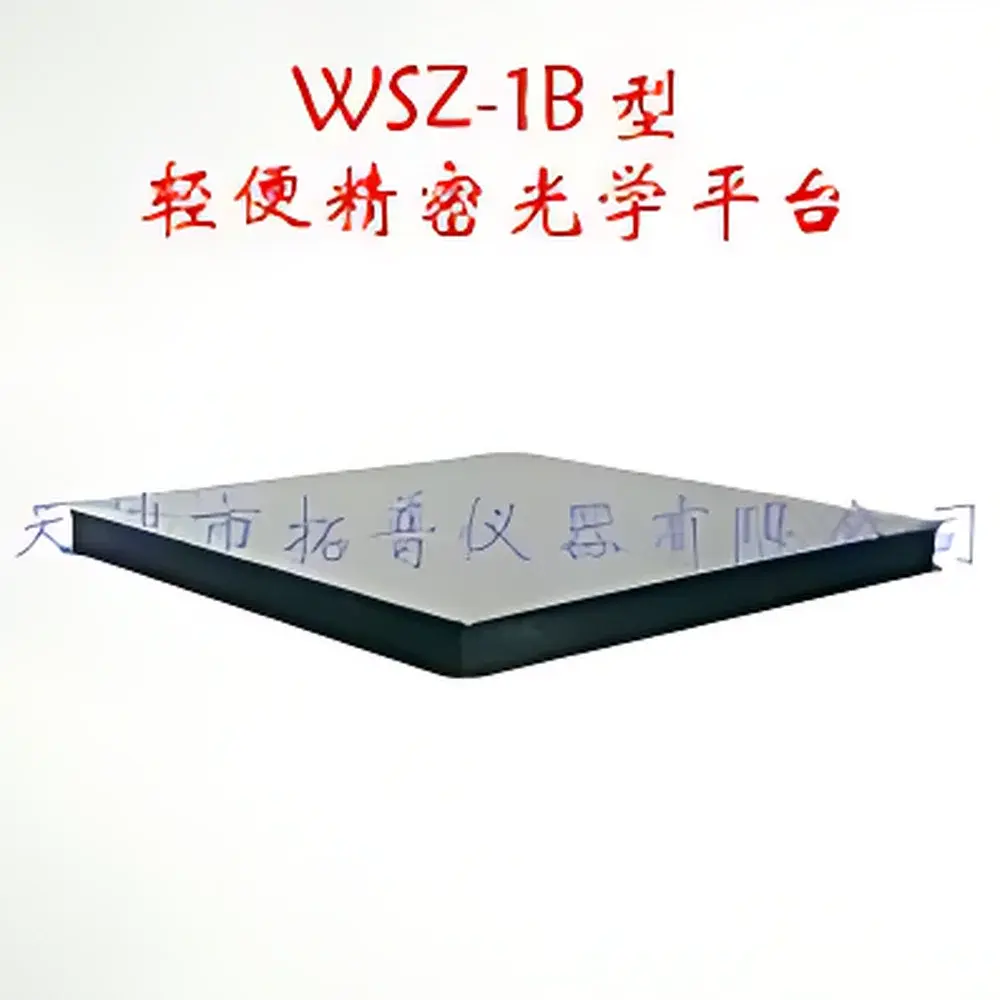
TopOptics WSZ-1B Series Portable Precision Optical Platform
| Brand | TopOptics |
|---|---|
| Model | WSZ-1B |
| Origin | Tianjin, China |
| Manufacturer Type | OEM Manufacturer |
| Platform Thickness Options | 50 mm (precision grade), 60 mm (standard), 100 mm (heavy-duty) |
| Surface Finish | Matte-black passivated stainless steel (precision variants) |
| Top Plate Material | High-permeability magnetic stainless steel (AISI 430 or equivalent) |
| Mounting Hole Pattern | M6 threaded holes on 25 × 25 mm or 50 × 50 mm grid |
| Dimensions Range | 300 × 300 mm to 1800 × 900 mm |
| Compliance | Designed for ISO 14644-1 Class 7 cleanroom-adjacent lab environments and GLP-compliant optical alignment workflows |
Overview
The TopOptics WSZ-1B Series Portable Precision Optical Platform is an engineered passive vibration isolation solution designed for laboratory-scale optical alignment, interferometry setup, laser cavity assembly, and compact photonics prototyping. Unlike active or pneumatic platforms, the WSZ-1B relies on intrinsic mechanical damping through a rigid, high-magnetic-permeability stainless steel top plate bonded to a honeycomb aluminum or steel core structure (depending on thickness variant), providing broadband attenuation of low-frequency ambient vibrations (1–100 Hz) without requiring compressed air, power, or real-time feedback control. Its modular footprint—ranging from 300 × 300 mm for benchtop laser diode characterization to 1800 × 900 mm for multi-axis optomechanical integration—enables scalability across academic teaching labs, R&D prototyping cells, and QC validation stations where spatial constraints and equipment mobility are critical design parameters.
Key Features
- Three structural tiers: WSZ-1B-1 (60 mm thick, standard duty), WSZ-1B-1/50 (50 mm thick, precision-grade with matte-black passivation), and WSZ-1B-2 (100 mm thick, enhanced rigidity for multi-kilogram payloads)
- Uniform M6 tapped hole array configurable in either 25 × 25 mm or 50 × 50 mm pitch—compatible with Thorlabs, Newport, and Standa standard optomechanics without adapter plates
- Surface-treated top plate (precision variants only): Electropolished + black oxide passivation per ASTM B137, reducing specular reflectance to <1.2% across 400–1100 nm and eliminating stray-light-induced measurement drift in confocal or heterodyne systems
- Weight-optimized architecture: 300 × 300 × 50 mm unit weighs ≤14.2 kg; 1200 × 900 × 100 mm unit weighs ≤118 kg—enabling manual repositioning without floor anchors or forklift assistance
- Thermal stability: Coefficient of linear expansion matched between top plate and core structure (<8.5 × 10⁻⁶ /°C), minimizing differential drift during 24-hour alignment stability tests per ISO 10110-7
Sample Compatibility & Compliance
The WSZ-1B platform accommodates standard optical components including kinematic mirror mounts (e.g., KM100, KCB1), translation stages (TS series), fiber launch systems, and CMOS-based wavefront sensors. Its non-magnetic base frame (optional upon request) ensures compatibility with SQUID magnetometers and ultra-low-field MRI test benches. All variants comply with mechanical interface requirements defined in ISO 10360-5 (coordinate measuring machine foundations) and support audit-ready documentation packages for GLP/GMP-regulated photonic device calibration labs. While not a certified ISO 14644-1 cleanroom platform, its sealed honeycomb core and passivated surface meet particle-shedding thresholds (<100 particles ≥0.5 µm/m³/min) required for Class 7 adjacent optical assembly under controlled HVAC conditions.
Software & Data Management
As a passive mechanical platform, the WSZ-1B requires no embedded firmware or driver software. However, it integrates natively into metrology data workflows via standardized mechanical reference points: four corner-mounted Ø6 mm dowel pin holes (ISO 8751-1 compliant) enable repeatable coordinate registration in Zemax OpticStudio, CODE V, and Synopsys LightTools alignment simulations. Optional factory-certified flatness maps (measured via Zygo Verifire™ Interferometer, λ/10 PV over full aperture) are delivered as ASCII .txt files compatible with MATLAB-based error compensation scripts used in adaptive optics loop calibration.
Applications
- Laser beam collimation and pointing stability verification (per ANSI Z136.1 Section 7.3.2)
- Fiber-to-free-space coupling efficiency optimization in telecom component testing
- Miniaturized OCT probe alignment under vibration-prone benchtop conditions
- Undergraduate optics pedagogy: Michelson, Mach-Zehnder, and Fabry-Pérot interferometer construction
- Pre-calibration staging for portable spectrometers prior to field deployment
- Mounting substrate for vacuum-compatible optical breadboards (with optional vacuum-flange adapters)
FAQ
Is the WSZ-1B suitable for use with active vibration cancellation systems?
Yes—the platform’s rigid base and standardized mounting pattern allow direct integration beneath tabletop active isolators (e.g., Minus K MK28 or Accurion AVI-200), serving as a stable intermediate layer between the isolator and optical components.
Can I specify custom hole patterns or non-standard dimensions?
Custom configurations—including asymmetric footprints, localized blind-hole zones, or hybrid 25/50 mm dual-grid layouts—are available under OEM engineering service agreement (lead time: 6–8 weeks).
Does the matte-black surface affect magnetic component mounting?
No—the passivation layer is non-ferromagnetic and does not impair holding force of rare-earth magnets (e.g., NeoMag N52) used in temporary optical element fixtures.
What is the maximum payload capacity for the 100 mm variant?
Static load rating is 120 kg uniformly distributed; point-load limit is 25 kg at any single M6 location, verified per ASTM E1777-18 static compression testing protocol.
Are calibration certificates traceable to NIST or PTB standards?
Flatness and parallelism certifications are traceable to national metrology institutes via third-party accredited labs (certificate includes uncertainty budget per ISO/IEC 17025:2017 Annex A.4).




