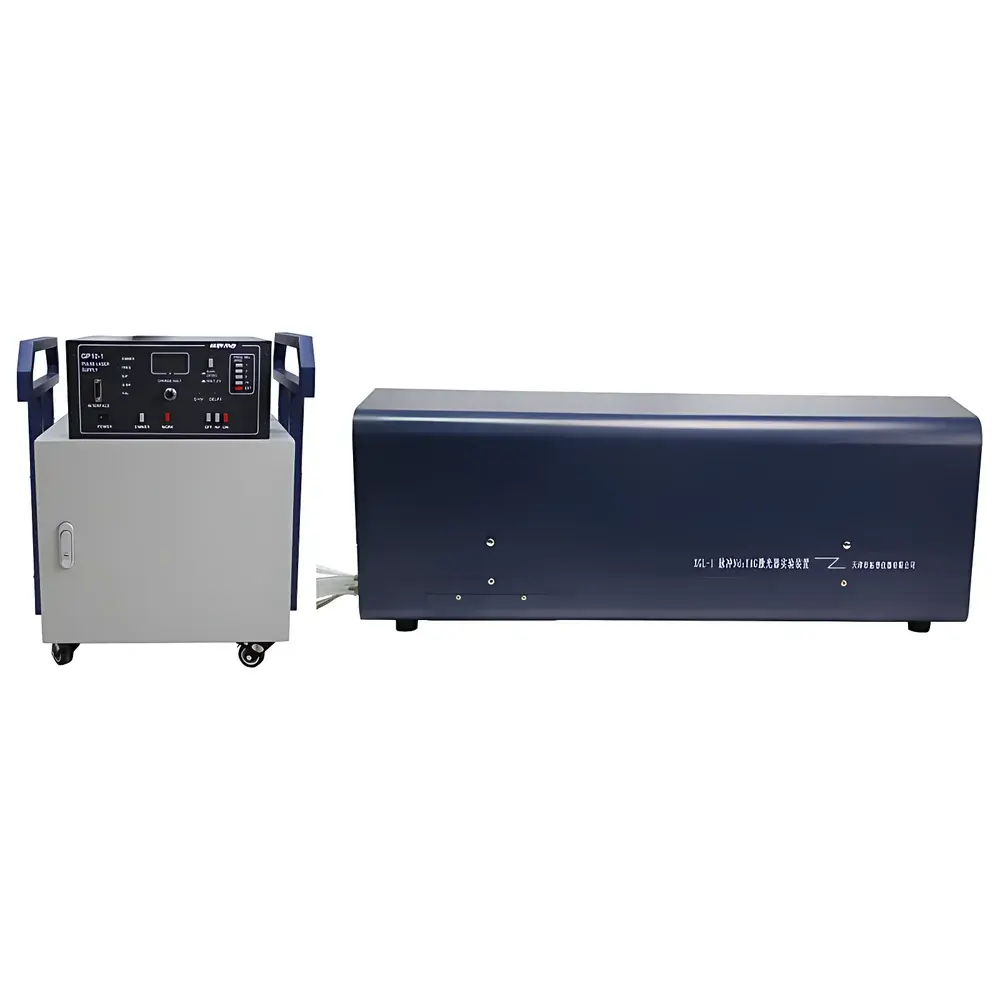
TopOptics XGL-1 Pulsed Nd:YAG Laser Training System
| Brand | TopOptics (TP) |
|---|---|
| Origin | Tianjin, China |
| Manufacturer Type | OEM Manufacturer |
| Model | XGL-1 |
| Output Wavelengths | 1064 nm & 532 nm |
| Beam Divergence | ≤5 mrad |
| Alignment Laser | 632.8 nm He–Ne |
| Electro-Optic Q-Switch Voltage Range | 1–5 kV (adjustable) |
| Pulse Energy | 600 mJ @ 1064 nm (free-running, no Q-switching) |
| Included Components | He–Ne alignment laser with power supply, λ/2 and polarizing optics for 1064 nm, Q-switch driver, HR/OC mirrors @ 1064 nm, iris diaphragm, water-cooling unit, Nd:YAG rod, flashlamp, KDP or BBO frequency-doubling crystal, LiNbO₃ or KD*P Q-switch crystal, beam target, elliptical pump cavity |
Overview
The TopOptics XGL-1 Pulsed Nd:YAG Laser Training System is a fully integrated, educational-grade solid-state laser platform engineered for hands-on instruction in laser physics, optical resonator design, and nonlinear frequency conversion. Based on the four-level energy structure of neodymium-doped yttrium aluminum garnet (Nd3+:Y3Al5O12), the system generates nanosecond-scale pulses at the fundamental infrared wavelength of 1064 nm via flashlamp pumping and optical cavity feedback. With optional intracavity second-harmonic generation using a type-I phase-matched KDP or BBO crystal, it delivers visible 532 nm output—enabling comparative study of wavelength-dependent beam propagation, thermal lensing, and nonlinear efficiency. Designed explicitly for university-level optics laboratories, the XGL-1 supports quantitative investigation of threshold behavior, transverse mode structure (TEM00, TEM01, etc.), pulse temporal profile, divergence dynamics, and cavity length sensitivity—all under controlled, repeatable conditions compliant with undergraduate and graduate pedagogical standards.
Key Features
- Modular, open-frame architecture permitting full optical access to resonator components—including mirror mounts, crystal holders, and pump cavity—facilitating alignment training and cavity stability analysis.
- Dual-wavelength operation: fundamental 1064 nm output (≥600 mJ, free-running) and frequency-doubled 532 nm output (typical conversion efficiency 8–12%, dependent on crystal temperature and cavity alignment).
- Integrated 632.8 nm He–Ne alignment laser with adjustable beam path, enabling precise co-alignment of pump axis, cavity axis, and nonlinear crystal phase-matching direction.
- Adjustable electro-optic Q-switch driver delivering 1–5 kV rectangular pulses with <10 ns rise time, supporting variable repetition rate (1–10 Hz) and controllable pulse width modulation.
- Water-cooled Nd:YAG rod and flashlamp assembly ensuring thermal stability over extended experimental sessions; cooling circuit includes flow sensor and overtemperature interlock.
- Comprehensive component set: broadband dielectric HR/OC mirrors, λ/2 waveplates, polarizing beam splitters, aperture stops, beam profiling targets, and elliptical pump cavity optimized for uniform lamp-to-rod coupling.
Sample Compatibility & Compliance
The XGL-1 is intended exclusively for use with solid-state laser media and passive optical components. It is not designed for liquid or gaseous gain media, nor for direct biological or hazardous material irradiation. All optical coatings meet ISO 10110 surface quality specifications (scratch-dig 20–10), and mechanical mounts conform to DIN 3187 tolerance classes for optical positioning. The system complies with IEC 60825-1:2014 Class 4 laser safety requirements when operated with appropriate engineering controls (interlocked enclosure, beam shutters, certified laser safety eyewear). Documentation includes full hazard classification report, optical layout diagrams, and alignment procedure manuals traceable to ANSI Z136.1–2022 guidelines.
Software & Data Management
While the XGL-1 operates primarily as a hardware-based teaching platform without embedded firmware or proprietary control software, it is fully compatible with industry-standard instrumentation interfaces. Analog monitor outputs (pulse trigger TTL, photodiode signal, lamp current) enable synchronization with external oscilloscopes (e.g., Keysight InfiniiVision series), energy meters (Coherent FieldMaxII-TO), and data acquisition systems (NI DAQmx-compatible platforms). Experimental datasets—including pulse energy vs. pump voltage, mode pattern images, and divergence measurements—are structured for import into MATLAB, Python (NumPy/SciPy), or OriginLab for statistical analysis, curve fitting, and uncertainty propagation per GUM (JCGM 100:2019). Audit trails and calibration logs may be maintained manually or via LIMS-integrated spreadsheets compliant with GLP documentation practices.
Applications
- Laser threshold determination via pump energy sweep and output energy measurement.
- Transverse mode analysis using knife-edge scanning or CCD-based near-field profiling.
- Beam divergence quantification using far-field angular measurement and ISO 11146-compliant calculations.
- Electro-optic Q-switching characterization: delay tuning, extinction ratio, and pulse shortening efficacy.
- Longitudinal mode selection via intra-cavity etalon or adjustable mirror spacing.
- Phase-matching angle optimization for SHG using rotation-stage-mounted nonlinear crystals.
- Cavity length sensitivity studies: variation of threshold, pulse energy, M² factor, and spectral linewidth with resonator length.
FAQ
Is the XGL-1 suitable for research-grade nonlinear optics experiments beyond teaching?
Yes—its modular design, high-energy pulse output, and compatibility with standard optomechanics allow extension to parametric oscillation, sum-frequency generation, or pump-probe alignment verification when paired with appropriate diagnostics.
Can the system be upgraded to include digital pulse monitoring or automated alignment aids?
No native digital interface is provided; however, all analog monitor signals are accessible via BNC connectors, enabling integration with third-party DAQ systems or motorized stages equipped with position encoders.
What safety certifications accompany the XGL-1 shipment?
Each unit ships with an IEC 60825-1 compliance certificate, laser hazard classification label, and full safety manual aligned with EN 60825-1:2014 and local institutional laser safety officer (LSO) protocols.
Are replacement consumables—such as flashlamps or Nd:YAG rods—available directly from TopOptics?
Yes; TP provides OEM-specified flashlamps (Xe-150 series), AR-coated Nd:YAG rods (φ6 × 75 mm, a-cut), and KDP/BBO crystals with certified phase-matching angles and damage thresholds.
Does the system support continuous-wave (CW) operation?
No—the XGL-1 is strictly a pulsed flashlamp-pumped system; CW operation requires diode-pumped architectures not implemented in this model.