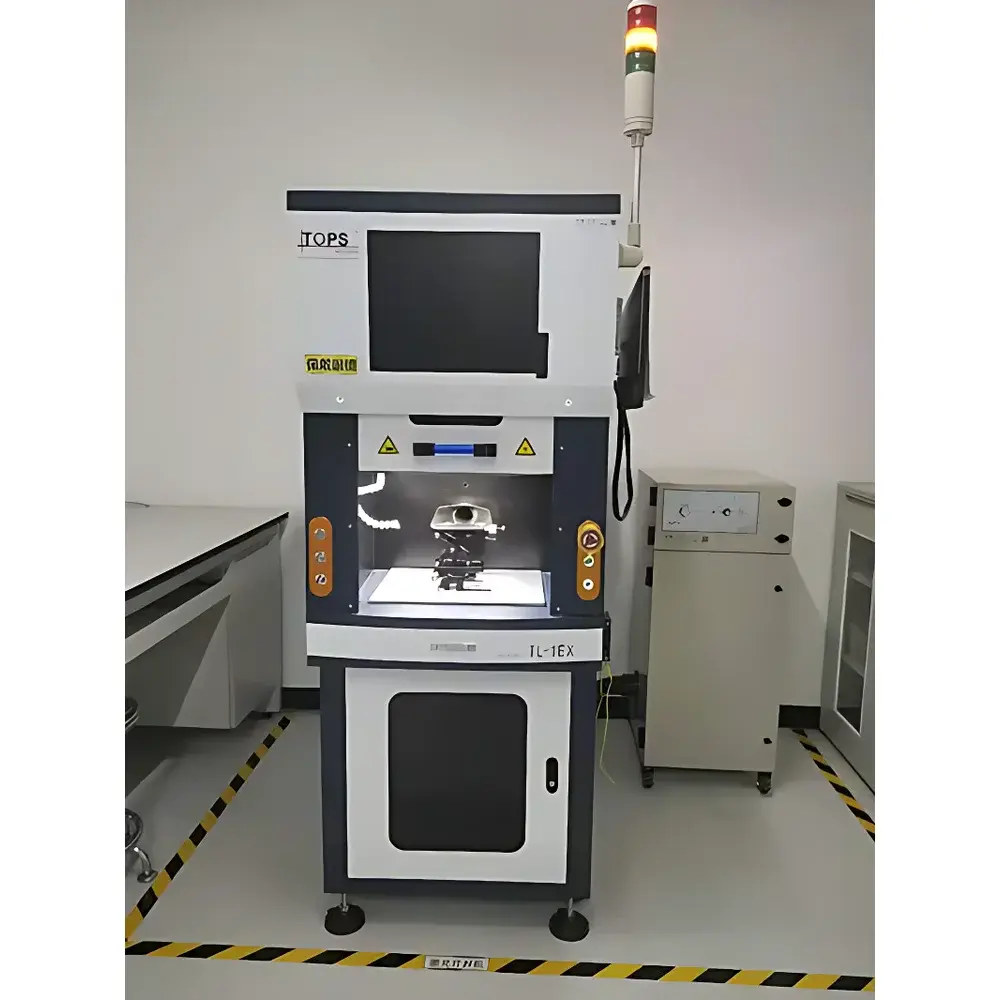
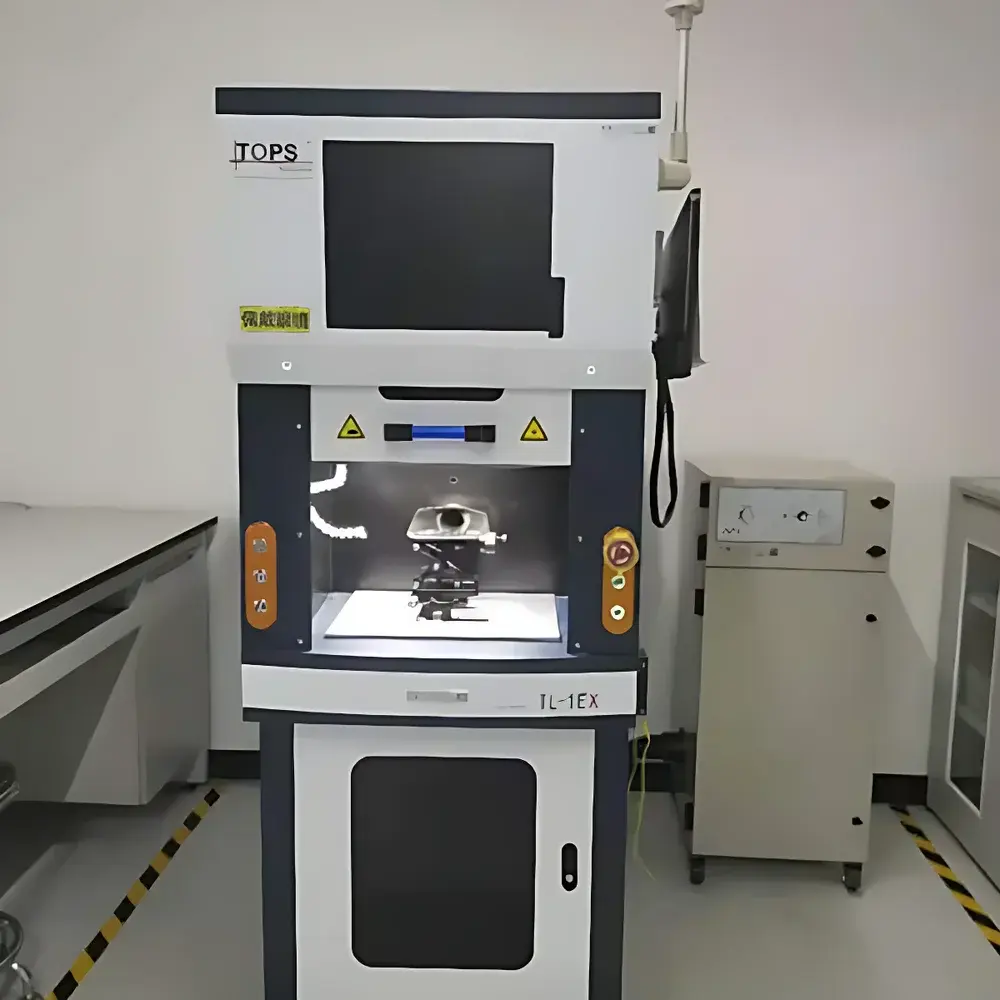
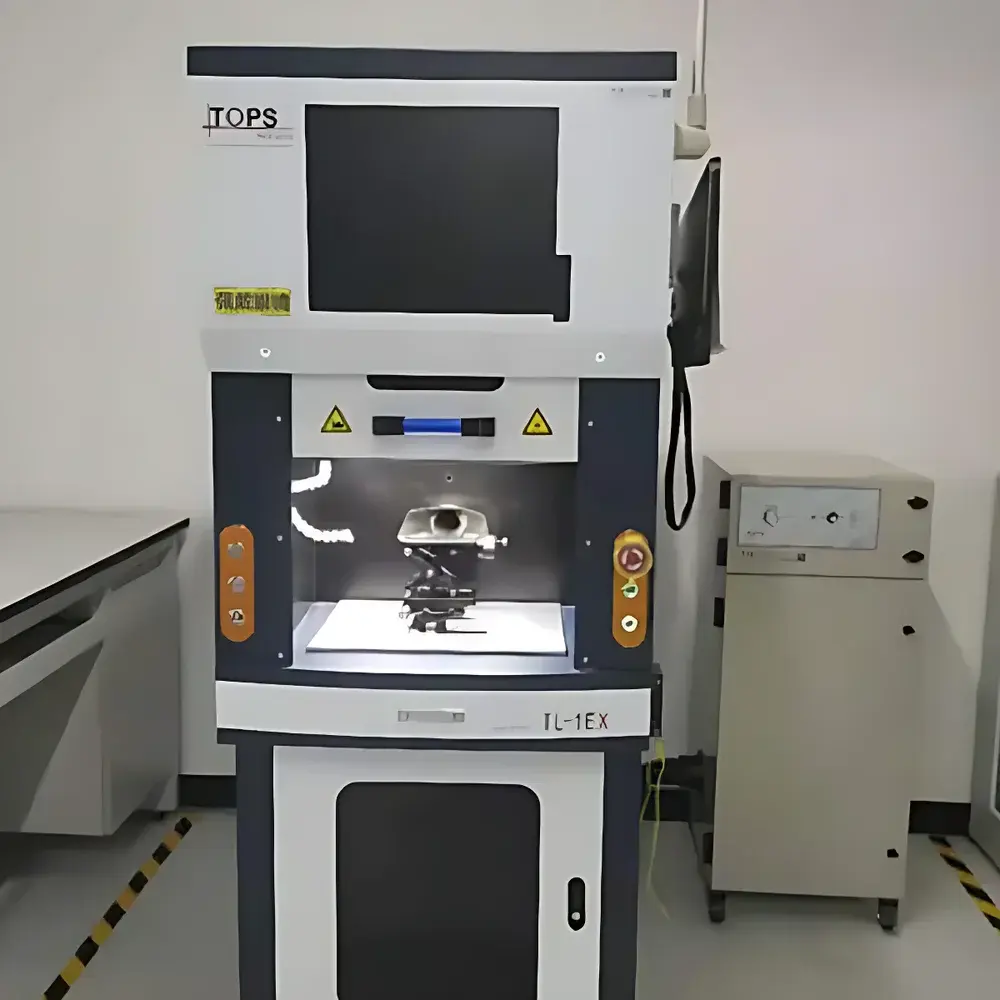
Tops TL-1 EX and TL-1 Plus Laser Decapsulation Systems
| Brand | Tops |
|---|---|
| Origin | Imported |
| Manufacturer Type | Authorized Distributor |
| Model | TL-1 EX, TL-1 Plus |
| Laser Source | Pulsed Fiber Laser (Nd:YAG, 1064 nm) |
| Operation Mode | Q-switched Pulsed |
| Laser Pulse Width | Nanosecond Range |
| Beam Delivery | Precision Galvo Scanning System |
| Safety Class | Class 4 Laser Product (IEC 60825-1) |
| Compliance | CE, RoHS, FDA 21 CFR Part 1040.10 |
Overview
The Tops TL-1 EX and TL-1 Plus Laser Decapsulation Systems are engineered for non-mechanical, high-precision removal of epoxy mold compound (EMC), silicone gel, and other encapsulation materials from integrated circuits (ICs) and semiconductor packages. Unlike traditional chemical decapsulation—requiring hazardous acids such as fuming nitric acid or sulfuric acid—the TL-1 series employs a pulsed Nd:YAG fiber laser operating at 1064 nm wavelength to selectively ablate packaging material via controlled photothermal interaction. This process preserves underlying metallization, bond wires, die surfaces, and interconnect structures with micron-level spatial resolution. The system is designed for failure analysis (FA) laboratories, reliability engineering groups, and quality assurance departments requiring repeatable, traceable, and residue-free exposure of die features for optical inspection, SEM/FIB cross-sectioning, or electrical probing.
Key Features
- Q-switched nanosecond pulsed fiber laser (1064 nm) optimized for high peak power and minimal thermal diffusion—enabling clean ablation of thermoset epoxies without charring or substrate damage.
- Dual-model platform: TL-1 EX offers baseline precision decapsulation for standard QFP, SOIC, BGA, and CSP packages; TL-1 Plus adds enhanced galvo scanning speed, expanded Z-axis travel (±15 mm), and programmable depth profiling for multi-layer package stacks.
- Integrated coaxial CCD imaging with 10×–50× digital zoom enables real-time monitoring and precise laser targeting prior to ablation—critical for avoiding bond wire severance or pad erosion.
- Motorized XYZ stage with 0.1 µm resolution positioning and vacuum chuck compatibility supports automated batch processing of up to 12 devices per run (depending on package footprint).
- Full enclosure with interlocked Class 4 laser safety housing compliant with IEC 60825-1:2014 and equipped with laser emission indicator, emergency stop, and beam shutter—meeting requirements for ISO/IEC 17025-accredited FA labs.
- Onboard laser energy calibration and pulse count logging ensure process repeatability and support GLP/GMP documentation needs.
Sample Compatibility & Compliance
The TL-1 systems accommodate standard JEDEC-compliant packages including but not limited to: QFN (3×3 mm to 12×12 mm), TQFP (up to 144 pins), PBGA (up to 1156 balls), WLCSP, and stacked-die modules. Both models are compatible with leaded and lead-free solder finishes, copper and aluminum bond wires (≥15 µm diameter), and low-k dielectric substrates. All operations adhere to ASTM F2018–22 (“Standard Guide for Failure Analysis of Microelectronic Devices”) and support root cause analysis workflows aligned with JESD22-A108 (temperature cycling), JESD22-A104 (highly accelerated stress test), and JEDEC MO-118 package standards. Full audit trail functionality—including operator ID, timestamped ablation parameters, and image capture metadata—is retained for FDA 21 CFR Part 11 compliance when integrated with validated LIMS environments.
Software & Data Management
Control is executed via Tops’ proprietary DecapControl™ software (v3.2+), running on an embedded industrial PC with Windows 10 IoT Enterprise. The interface supports script-based recipe management, layer-by-layer depth control (with auto-focus compensation), and real-time power density mapping. Process logs—including pulse energy (mJ/pulse), repetition rate (kHz), scan velocity (mm/s), and total pulses delivered—are exported in CSV and XML formats. Optional API integration enables bidirectional communication with mainstream FA workflow platforms (e.g., Thermo Fisher Phenom, Keysight PathWave FA Suite) and enterprise quality systems (SAP QM, ETQ Reliance). All software modules undergo annual verification per ISO/IEC 17025 Clause 5.9.2 for measurement software validation.
Applications
- Failure analysis of counterfeit or cloned ICs via die surface feature comparison against reference samples.
- Verification of die attach integrity and void detection in power modules prior to thermal cycling qualification.
- Exposure of underfill interfaces in flip-chip assemblies for delamination assessment per IPC-J-STD-033.
- Pre-FIB site preparation for targeted circuit edit or node-level reverse engineering.
- Qualification of new encapsulation formulations (e.g., halogen-free EMC, high-Tg resins) under JEDEC MSL testing protocols.
- Support for automotive AEC-Q100 stress testing labs requiring non-destructive pre-test package inspection.
FAQ
What types of encapsulants can the TL-1 series effectively remove?
Epoxy mold compounds (EMC), silicone gels, polyimide glob tops, and most thermoset polymers used in commercial and automotive-grade IC packaging. It is not recommended for highly reflective or transparent materials (e.g., glass lids, quartz substrates) without process optimization.
Does the system require acid handling or fume hoods?
No. The laser-based process eliminates the need for corrosive chemicals, acid baths, or dedicated wet bench infrastructure—reducing EHS overhead and enabling deployment in standard cleanroom environments (ISO Class 5–7).
Can the TL-1 Plus perform depth-controlled ablation through multiple layers?
Yes. Its extended Z-axis range and closed-loop focus tracking allow sequential ablation of mold compound, underfill, and redistribution layers—provided material absorption coefficients differ sufficiently at 1064 nm.
Is training and application support included with purchase?
Tops provides onsite installation qualification (IQ), operational qualification (OQ), and user training covering SOP development, preventive maintenance, and failure mode troubleshooting—delivered by certified semiconductor FA engineers.
How is laser calibration maintained over time?
The system includes built-in photodiode-based energy monitoring and scheduled auto-calibration routines traceable to NIST-certified reference sensors; calibration records are archived within the audit log.
Related Products