
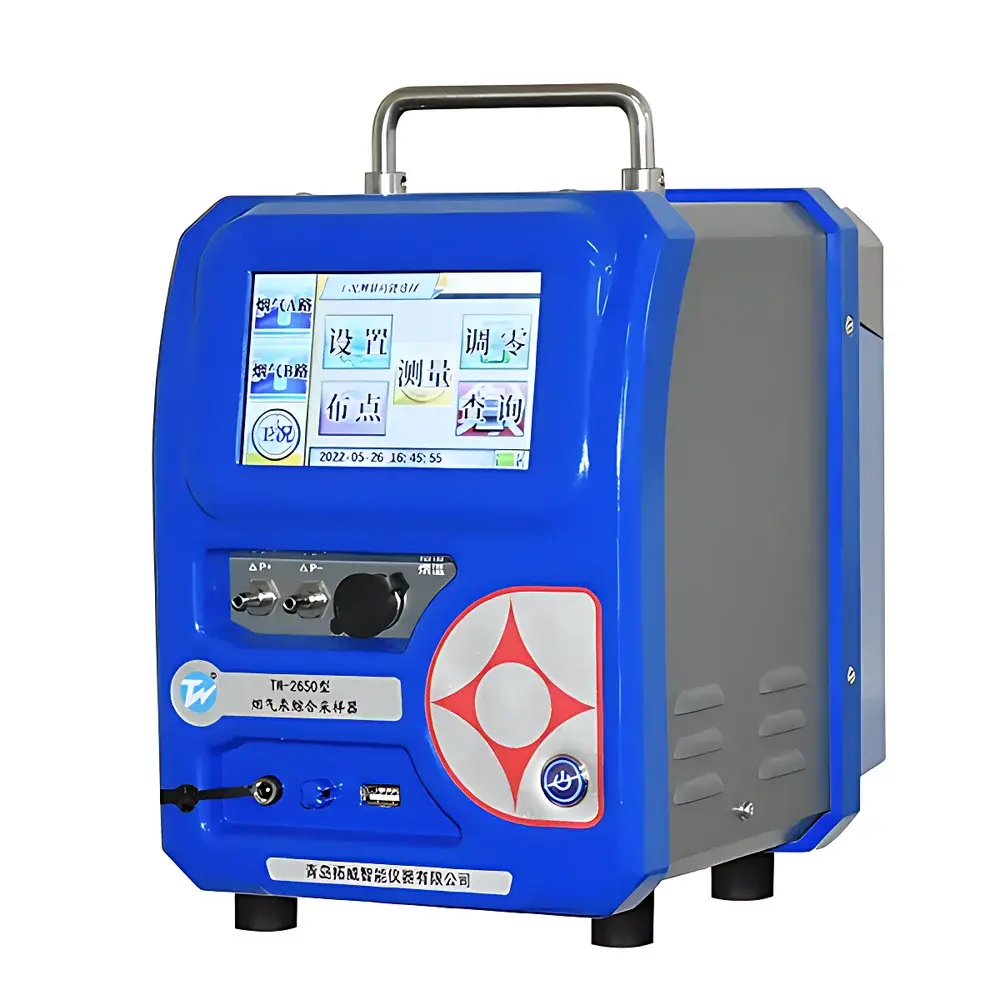
TOPWAY TW-2650 Flue Gas Mercury Integrated Sampler
| Brand | TOPWAY |
|---|---|
| Origin | Shandong, China |
| Model | TW-2650 |
| Sampling Flow Rate | 0.1–1.0 L/min |
| Flow Accuracy | ±2.0% (full scale) |
| Sampling Temperature Range | 0–500 °C |
| Gas Velocity Range | 0–45 m/s |
| Target Analytes | Elemental Mercury (Hg⁰) and Oxidized Mercury (Hg²⁺) |
Overview
The TOPWAY TW-2650 Flue Gas Mercury Integrated Sampler is a field-deployable, dual-mode sampling system engineered for regulatory-compliant mercury speciation in high-temperature flue gas streams from coal-fired power plants, industrial boilers, waste incinerators, and cement kilns. It implements EPA Method 29–equivalent solution absorption methodology—aligned with HJ 543–2009 and HJ 917–2017—enabling simultaneous, temperature-controlled collection of elemental mercury (Hg⁰) and oxidized mercury (Hg²⁺) in separate impingers using selective absorbent solutions (e.g., KCl–HNO₃ for Hg²⁺; KMnO₄–H₂SO₄ or Au-coated sorbents for Hg⁰). The instrument integrates real-time flue gas parameter measurement—including static/dynamic pressure, temperature, and velocity—via a co-located, heated probe assembly, ensuring accurate standard-condition volume correction (dry, 273.15 K, 101.325 kPa) per ISO 12141 and GB/T 16157–1996.
Key Features
- Heated sampling train architecture: Entire gas pathway—from probe tip to impinger inlet—is actively heated up to 180 °C (adjustable) using PTFE-sheathed, PID-controlled heating elements, preventing mercury adsorption and condensation losses.
- Dual independent sampling channels: Each channel supports programmable start/stop, flow setpoint control, and timed/interval/cyclic sampling protocols—enabling parallel speciated collection or redundancy validation.
- High-stability volumetric flow control: Dual imported diaphragm pumps coupled with corrosion-resistant, humidity-tolerant thermal mass flow sensors ensure ±2.0% full-scale accuracy across variable backpressure and ambient voltage fluctuations (100–240 V AC or 24 V DC).
- Integrated flue gas characterization: Built-in pitot-static probe, thermocouple (Type K), and differential pressure transducer enable automatic calculation of average flue gas velocity, stack cross-sectional area, and volumetric flow rate per ISO 16911–1.
- Onboard data integrity safeguards: Automatic leak-check routine prior to sampling; power-failure recovery with timestamped resume; audit-trail-enabled data logging compliant with GLP principles.
- Human-centered interface: 5-inch capacitive color touchscreen with intuitive menu navigation, multilingual UI support (English default), and on-device data review, filtering, and export configuration.
Sample Compatibility & Compliance
The TW-2650 is validated for use with standard 10–50 mL glass bubble absorption tubes (e.g., U-shaped or midget impingers) placed in an insulated ice bath (–2 °C to +4 °C) capable of holding 28 tubes simultaneously. It fully supports the analytical workflows defined in HJ 543–2009 (Cold Vapor Atomic Absorption Spectrometry, CVAAS) and HJ 917–2017 (Thermal Desorption–CVAAS), including pre-concentration on iodated carbon or gold-coated traps for gaseous Hg⁰. Regulatory alignment includes: HJ/T 47–1999 (Flue Gas Sampler Technical Specification), GB 13223–2011 (Emission Limits for Thermal Power Plants), GB/T 16157–1996 (Particulate and Gaseous Pollutant Sampling Methods), and JJG 956–2013 (Calibration Procedure for Ambient Air Samplers). Optional heated probe modules meet ASTM D6784–22 (Ontario Hydro Method) temperature stability requirements.
Software & Data Management
Internal firmware stores ≥10,000 complete sampling records—including date/time stamps, flow profiles, temperature/pressure logs, leak-test results, and calculated standard-volume metrics—with automatic time-synchronization via NTP-compatible RTC. Data export is supported via Bluetooth 5.0–enabled thermal printing (customizable report templates) or USB mass-storage mode (FAT32-formatted U-disk). All stored parameters are immutable post-acquisition; deletion requires administrator-level authentication. Audit trail functionality records operator ID, action type, and timestamp for every configuration change—supporting 21 CFR Part 11–aligned data governance in regulated QA/QC environments.
Applications
- Continuous emission monitoring system (CEMS) performance verification and relative accuracy testing (RAT) per EPA PS-12a.
- Mercury speciation profiling across selective catalytic reduction (SCR), wet flue gas desulfurization (WFGD), and activated carbon injection (ACI) control devices.
- Source testing for compliance with national mercury emission limits (e.g., China’s “Ultra-Low Emission” standards for coal power).
- Method development and inter-laboratory comparison studies requiring trace-level Hg⁰/Hg²⁺ differentiation under realistic stack conditions.
- Field calibration and validation of online mercury analyzers (e.g., CEMs based on CVAFS or atomic fluorescence).
FAQ
Does the TW-2650 comply with U.S. EPA Method 29 or Ontario Hydro Method?
It implements equivalent solution absorption principles and heated sampling train design per Method 29 and ASTM D6784–22, though formal EPA certification requires third-party validation under local regulatory authority oversight.
Can it operate unattended for extended periods?
Yes—internal lithium battery provides >10 hours of continuous operation at 0.5 L/min flow; external 24 V DC input enables multi-day field deployment with solar or vehicle power sources.
Is the ice bath temperature actively controlled?
No—the integrated cooling chamber maintains sub-ambient temperature passively via phase-change coolant packs; users must pre-chill packs to –2 °C prior to deployment.
What mercury species does it quantitatively differentiate?
Hg⁰ (elemental mercury) and Hg²⁺ (oxidized mercury, primarily HgCl₂), using chemically selective absorbents and validated separation protocols per HJ 543–2009.
How is flow calibration traceability ensured?
Each unit ships with a NIST-traceable calibration certificate for its thermal mass flow sensor, verified against primary-standard dry calibrators (e.g., Brooks 5850E) at three flow points within the 0.1–1.0 L/min range.
Related Products







