
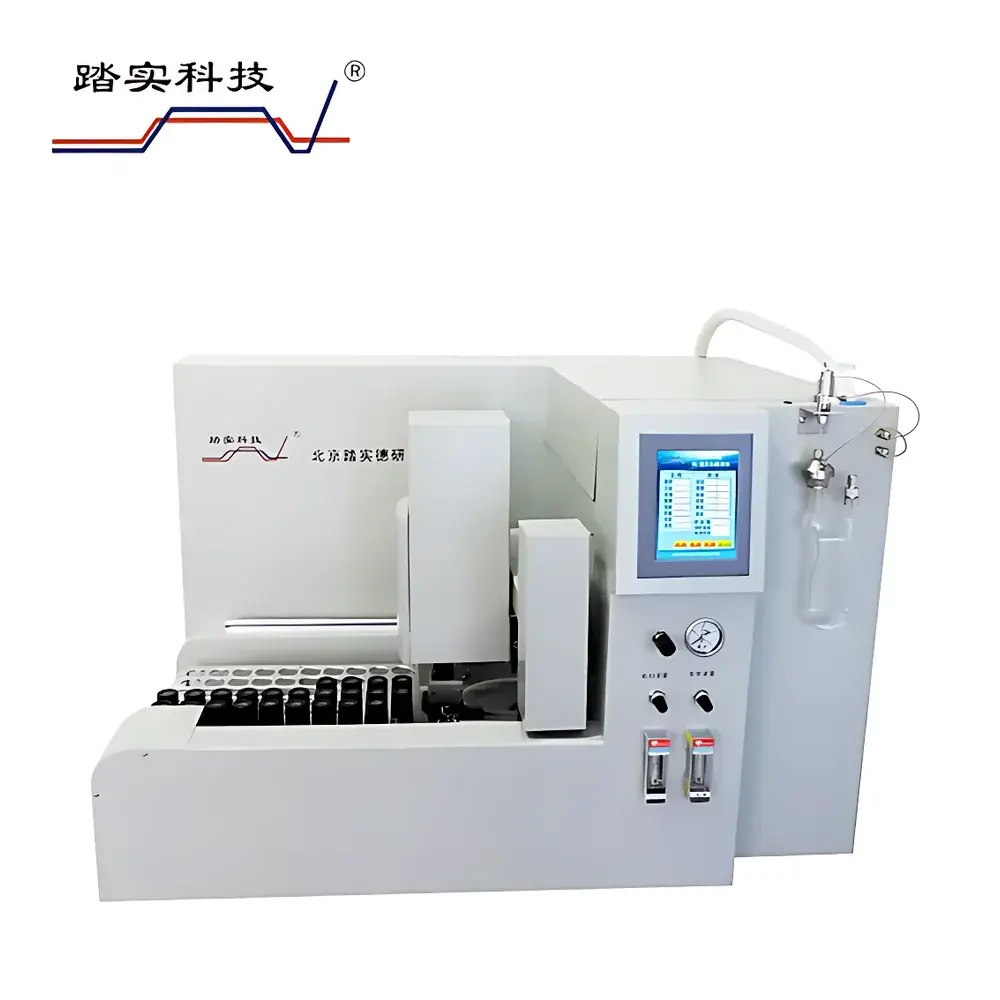
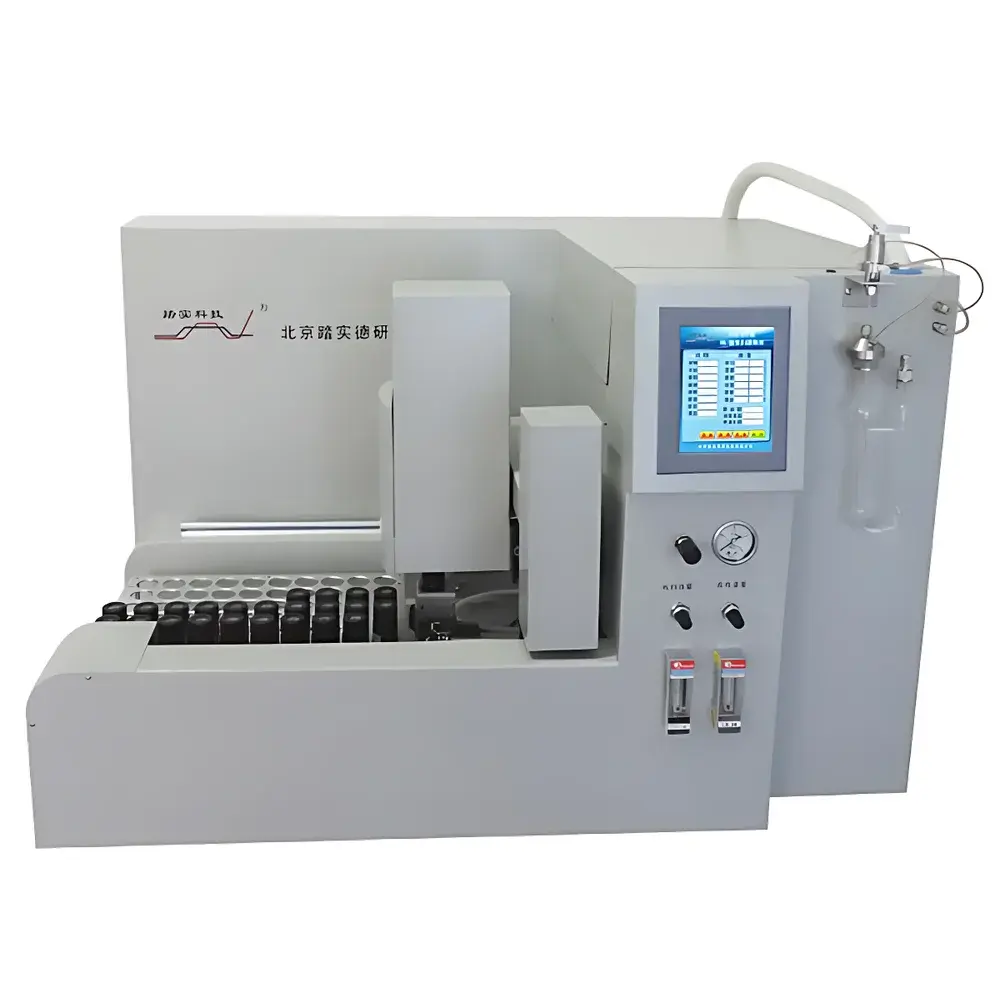
TouchScience PTC-III Solid/Liquid Integrated Purge and Trap Concentrator
| Brand | TouchScience |
|---|---|
| Origin | Beijing, China |
| Manufacturer Type | Direct Manufacturer |
| Instrument Category | Domestic |
| Model | PTC-III |
| Instrument Class | Water & Soil Combined Purge-and-Trap System |
| Sample Tray Capacity | 70 positions (40 mL VOA vials) |
| Sample Volume Precision | ±5 mL |
| Trap Temperature Range | 50–400 °C |
| Purge Heater Temperature Range | Ambient to 90 °C |
| Sample Chilling Temperature Range | Ambient to –30 °C |
| Cold Trap | Built-in electronic cryo-cooler |
| Foam Detection | Integrated foam sensor in purge tube |
| Water Removal | Dedicated desiccant trap at purge gas inlet |
| Tubing Material | PEEK and silanized stainless steel |
| Heated Zones | All fluidic paths and 6-port valve actively temperature-controlled |
| Power Requirement | 220 VAC ±10 %, 50 Hz, <800 VA |
| Dimensions (H×W×D) | 600 × 600 × 630 mm |
| Compliance | HJ 639–2012, HJ 686–2014, HJ 605–2011 |
Overview
The TouchScience PTC-III Solid/Liquid Integrated Purge and Trap Concentrator is a fully automated, 70-position thermal desorption system engineered for quantitative preconcentration of volatile organic compounds (VOCs) from both aqueous and solid environmental matrices. It operates on the principle of dynamic headspace extraction: inert gas purging displaces VOCs from the sample matrix into a cooled, sorbent-packed trap; subsequent rapid thermal desorption transfers analytes to a gas chromatograph (GC) or GC–mass spectrometer (GC–MS) for separation and detection. Designed specifically for regulatory compliance in environmental laboratories, the PTC-III supports method-driven workflows aligned with Chinese EPA standards—including HJ 639–2012 (water), HJ 686–2014 (wastewater), and HJ 605–2011 (soil and sediment)—and is compatible with international VOC analysis frameworks requiring rigorous sample integrity, low blank levels, and reproducible trapping efficiency.
Key Features
- Fully automated 70-position sample handling using standardized 40 mL VOA vials, supporting unattended overnight operation.
- Dual-mode sample introduction: direct liquid injection (5 mL precision) into glass purge tubes, or solid-phase processing via programmable addition of 5 mL distilled water followed by magnetic agitation—enabling homogenization of heterogeneous soil/sediment samples prior to purge.
- Integrated electronic cold trap capable of reaching –30 °C at the sample vial stage and maintaining stable low-temperature enrichment during purge, minimizing analyte loss and improving recovery of highly volatile compounds (e.g., vinyl chloride, chloromethane).
- Independent thermal control across all critical zones: purge heater (ambient to 90 °C), trap oven (50–400 °C), transfer line (up to 300 °C), and all fluidic pathways—including the 6-port switching valve—eliminating cold spots and reducing memory effects.
- Real-time foam detection via embedded sensor within the purge tube prevents over-foaming during aqueous sample agitation, avoiding carryover and protecting downstream components.
- Dedicated desiccant-based water removal module installed upstream of the trap reduces water vapor load by >95 %, mitigating column degradation, detector saturation, and spectral interference in GC–MS applications.
- Configurable rinse cycles for both sampling needle and purge tube using hot water (up to 90 °C), minimizing cross-contamination between high-concentration and trace-level samples.
Sample Compatibility & Compliance
The PTC-III accommodates a broad range of environmental and food-grade matrices without hardware modification: drinking water, surface water, wastewater, groundwater, soil, sediment, sludge, and solid food products (e.g., spices, dairy powders). Its design adheres to fundamental requirements of ISO/IEC 17025 for method validation, including documented temperature uniformity, pressure stability (<0.1 % drift over 30 min), and timing accuracy (<0.1 % deviation). The instrument meets functional equivalency criteria outlined in U.S. EPA Method 502.2, 524.2, and 8260D when operated under validated parameters. Data integrity safeguards include audit-trail-enabled software logging of all temperature setpoints, valve actuation events, purge durations, and trap desorption profiles—supporting GLP/GMP-aligned laboratory practices.
Software & Data Management
Control is executed via a dedicated Windows-based application with touchscreen interface (integrated 7-inch LCD panel) offering full method programming, real-time status monitoring, and event-triggered alerts. The software records timestamped operational logs—including trap temperature ramp rates, purge gas flow calibration history, and cold trap cooldown performance—for retrospective QA/QC review. Two TTL-compatible synchronization outputs (1–2 s pulse width) allow precise triggering of GC oven start, detector acquisition, and data system capture—ensuring retention time alignment and eliminating manual injection timing errors. Export formats include CSV and XML for LIMS integration; raw log files are digitally signed and tamper-evident per ALCOA+ principles.
Applications
Primary use cases include regulatory monitoring of halogenated hydrocarbons (e.g., trihalomethanes, tetrachloroethylene), BTEX compounds (benzene, toluene, ethylbenzene, xylenes), chlorinated solvents (e.g., trichloroethene), and low-molecular-weight aldehydes and esters in environmental compliance testing. In food safety labs, it supports odor profiling, off-flavor compound identification (e.g., geosmin, 2-methylisoborneol), and residual solvent quantification per ICH Q3C guidelines. Research applications extend to biogeochemical VOC flux studies, landfill leachate characterization, and polymer degradation product screening.
FAQ
Is the PTC-III compatible with third-party GC and GC–MS systems?
Yes—it features universal pneumatic and electrical interfaces, including standard ¼” Swagelok fittings and TTL synchronization ports, enabling seamless integration with Agilent, Thermo Fisher, Shimadzu, and PerkinElmer platforms.
Can the instrument handle viscous or particulate-laden samples?
Solid samples are processed via aqueous slurry formation with magnetic mixing; suspended solids remain in the vial during purge. For high-viscosity liquids (e.g., oils), optional dilution protocols and extended purge times are programmable.
How is carryover minimized between analyses?
Carryover control is achieved through multi-stage mitigation: heated transfer lines prevent condensation, independent purge tube rinsing with hot water, trap bake-out cycles up to 400 °C, and physical separation of purge gas and desorption gas paths.
Does the system support 21 CFR Part 11 compliance?
While the base software provides audit trails and user access controls, full 21 CFR Part 11 compliance requires deployment within a validated IT infrastructure—including electronic signatures, role-based permissions, and secure backup protocols—as defined in the lab’s SOPs.
What maintenance routines are recommended?
Monthly verification of cold trap cooling performance, quarterly calibration of purge gas flow meters, biannual replacement of desiccant traps and O-rings, and annual certification of temperature sensors against NIST-traceable references.
Related Products






