
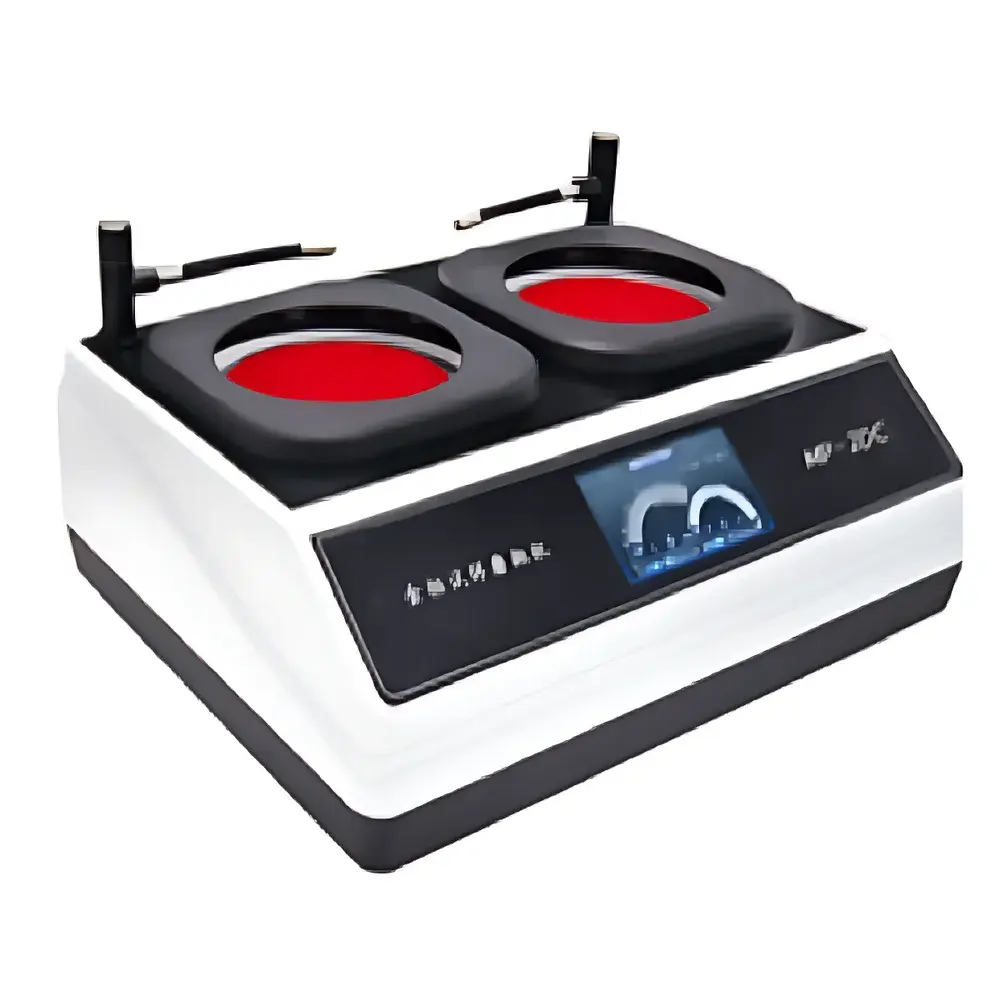
Touchscreen Dual-Plate Dual-Control Grinding and Polishing Machine WEIYEE MP-2DC
| Brand | WEIYEE |
|---|---|
| Origin | Guangdong, China |
| Manufacturer Type | Authorized Distributor |
| Country of Origin | China |
| Model | MP-2DC |
| Speed Range | 50–1500 rpm (infinitely variable + five preset speeds) |
| Platen Diameter | 203 mm (8") |
| Number of Platens | 2 |
| Control Interface | 7-inch industrial touchscreen |
| Rotation | Bidirectional (forward/reverse selectable) |
Overview
The WEIYEE MP-2DC is a precision-engineered dual-platen grinding and polishing system designed for consistent, repeatable sample preparation in metallurgical, ceramic, geological, and advanced materials laboratories. Built upon a robust mechanical architecture with independent motor-driven platens, the MP-2DC implements a dual-control paradigm—each 203 mm (8″) platen operates with fully decoupled speed and direction settings. This configuration enables simultaneous yet functionally distinct operations: e.g., coarse grinding on one platen while fine polishing occurs on the other—eliminating cross-contamination risk and reducing total preparation cycle time. The system employs direct-drive brushless DC motors coupled with high-resolution optical encoders to ensure stable rotational velocity across the full 50–1500 rpm range, supporting both continuous variable adjustment and five factory-calibrated fixed-speed presets optimized for common abrasive protocols (e.g., 150 rpm for diamond suspension polishing, 600 rpm for SiC paper grinding). All operational parameters—including rotation direction, dwell time, pressure profile (when used with optional load modules), and speed ramping profiles—are managed via an integrated 7-inch industrial-grade resistive touchscreen interface compliant with IP65 environmental rating.
Key Features
- Dual independent platen control: Each 203 mm platen features separate motor, encoder, and firmware-controlled drive circuitry—enabling asynchronous operation without signal interference.
- Wide-speed capability: 50–1500 rpm infinitely variable speed control with ±0.5% speed stability under rated load; five programmable fixed-speed presets accessible via soft keys.
- Bidirectional rotation: Forward/reverse polarity selection per platen—critical for uniform abrasive wear distribution and removal of directional scratch artifacts.
- Industrial HMI interface: 7-inch touchscreen with glove-compatible operation, multi-language support (English, German, Japanese, Chinese), and real-time parameter visualization including RPM, elapsed time, and motor thermal status.
- Modular mechanical design: Tool-less platen removal, standardized M6 mounting threads for universal consumable compatibility (e.g., Buehler, Struers, LECO backing plates), and integrated coolant channel routing ports.
- Structural integrity: Cast aluminum base frame with vibration-dampening elastomeric feet; static load capacity ≥45 kg per platen; CE-compliant electrical enclosure (EN 61000-6-2/6-4).
Sample Compatibility & Compliance
The MP-2DC accommodates standard ISO/ASTM-compliant specimen holders (up to 40 mm diameter mounted in phenolic or aluminum mounts) and supports all conventional metallographic consumables—including silicon carbide papers (P80–P2500), diamond suspensions (0.25–9 µm), alumina slurries, and colloidal silica dispersions. Its dual-platen architecture conforms to ASTM E3-22 (Standard Guide for Preparation of Metallographic Specimens) and ISO 15510:2021 (Metallographic grinding and polishing equipment—Performance requirements and test methods). The unit meets electromagnetic compatibility (EMC) and low-voltage directive requirements per EU Directive 2014/30/EU and 2014/35/EU. Optional accessories—including digital force feedback modules, automated dispensing nozzles, and humidity-controlled enclosure kits—enable alignment with GLP/GMP workflows requiring audit-trail-capable process documentation.
Software & Data Management
While the MP-2DC operates as a standalone instrument, its embedded controller supports RS-485 Modbus RTU and USB-C host interfaces for external integration. Lab management systems (LIMS) or MES platforms may log operational metadata—including start/stop timestamps, selected speed profiles, platen usage cycles, and thermal event flags—via ASCII-based serial protocol. Firmware version 2.3.1 introduces CSV export functionality for session logs (accessible via USB flash drive), enabling traceability for ISO 17025-accredited laboratories. No proprietary cloud service is required; all data remains resident on-device or user-managed storage media. Audit trail records comply with FDA 21 CFR Part 11 principles when paired with validated third-party electronic signature modules.
Applications
- Preparation of ferrous and non-ferrous alloys for optical microscopy and SEM imaging—particularly where phase boundary resolution demands minimal deformation layer depth.
- Routine quality control of sintered ceramics and powder metallurgy components, including porosity assessment and grain size analysis per ASTM E112.
- Geological thin-section fabrication for petrographic analysis, where differential hardness between mineral phases necessitates staged abrasion protocols.
- Failure analysis labs performing cross-sectional evaluation of solder joints, PCB laminates, and thermal barrier coatings.
- Academic research facilities requiring reproducible surface finish generation for tribological testing (e.g., coefficient-of-friction benchmarking per ASTM G99).
FAQ
Can the two platens operate at different speeds simultaneously?
Yes—the MP-2DC’s dual-motor architecture allows independent speed setting for each platen, ranging from 50 to 1500 rpm, with no interdependence.
Is the touchscreen interface compatible with laboratory glove use?
Yes—the 7-inch industrial resistive touchscreen responds reliably to gloved fingertips and stylus input, meeting EN 420 glove compatibility guidelines.
What consumables are supported out of the box?
All industry-standard 203 mm backing plates, adhesive discs, and cloth-backed polishing cloths with 203 mm outer diameter are mechanically compatible; no adapter required.
Does the system include built-in coolant delivery?
No—coolant delivery is manual by default; however, threaded inlet/outlet ports are provided on the base for integration with OEM or third-party recirculating dispensing systems.
Is firmware update capability available remotely?
Firmware updates require local USB flash drive upload; remote OTA updates are not implemented for security and validation integrity reasons.



