
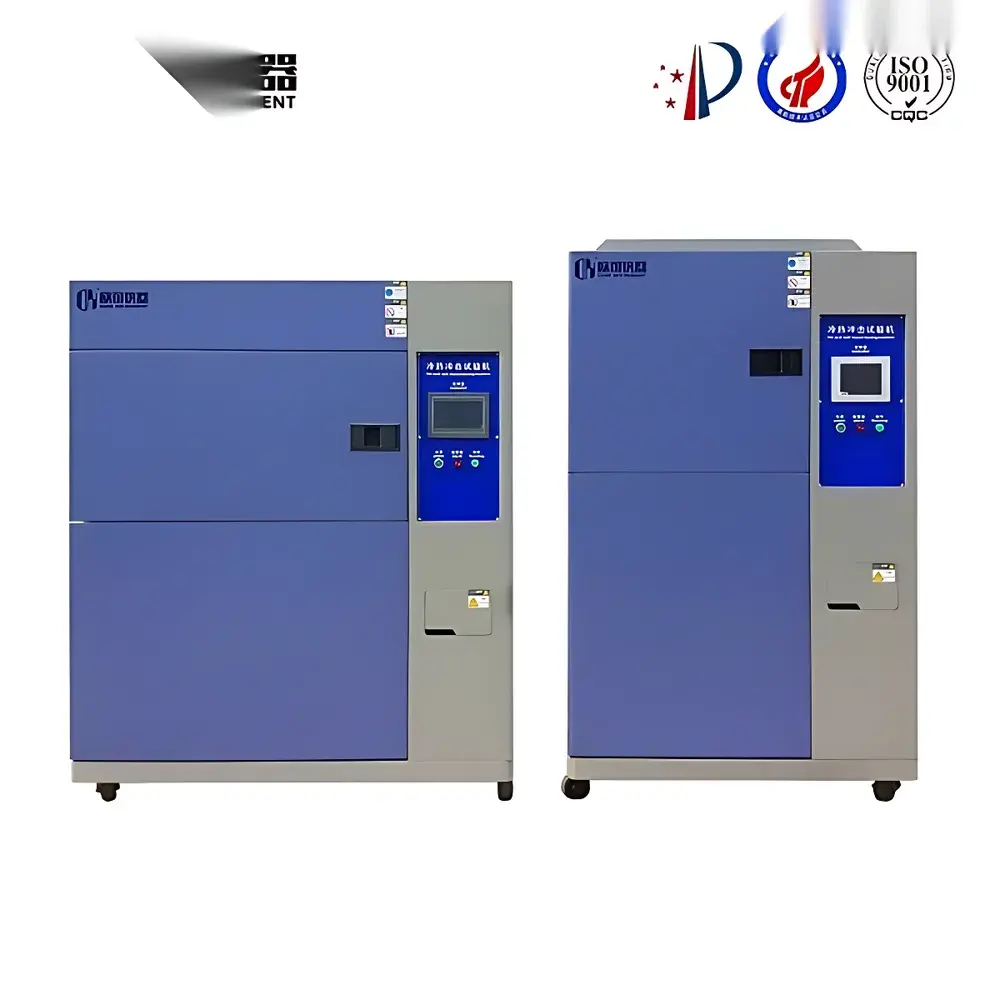
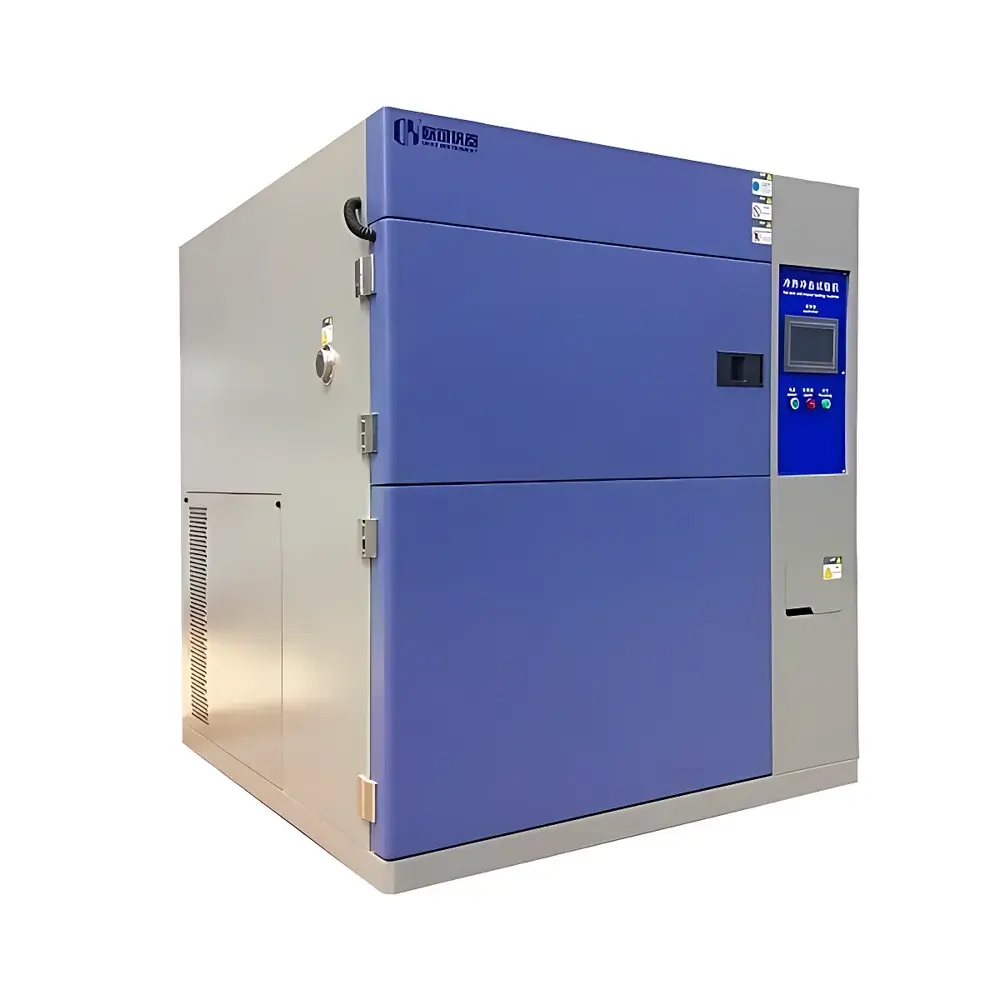
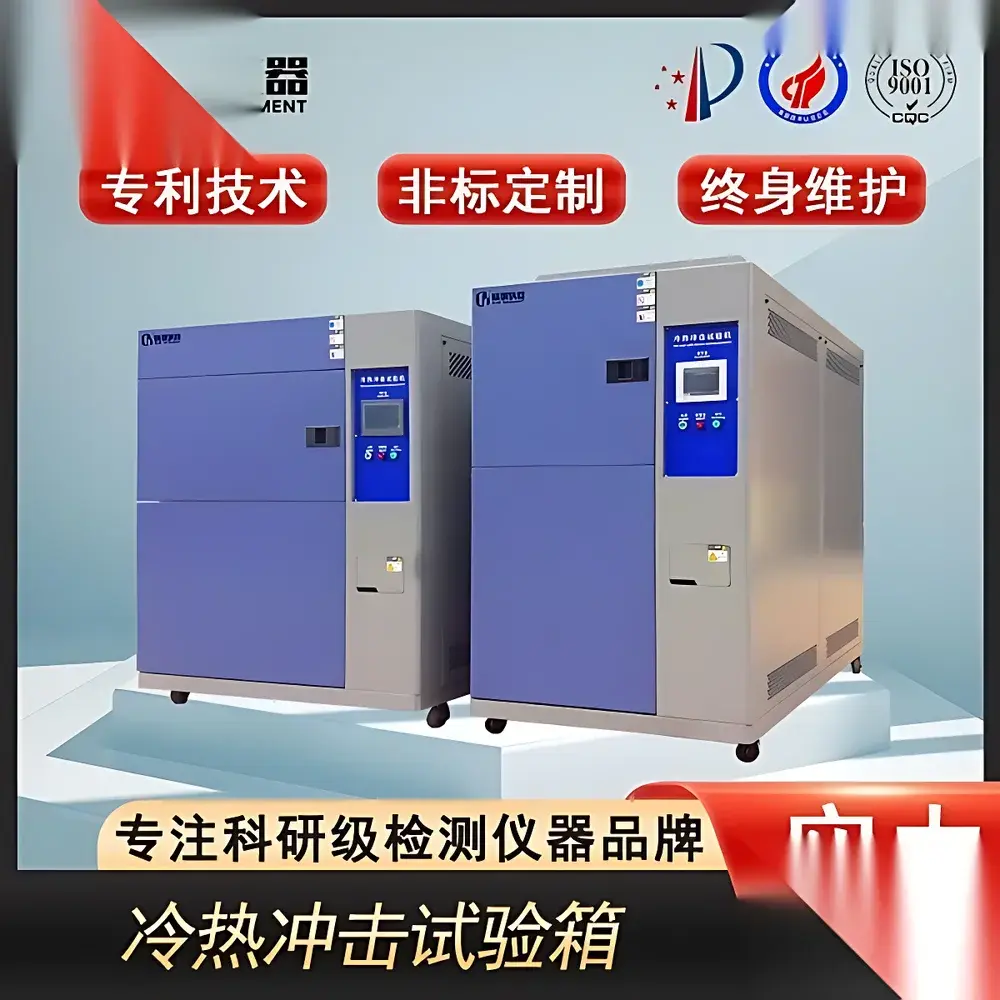
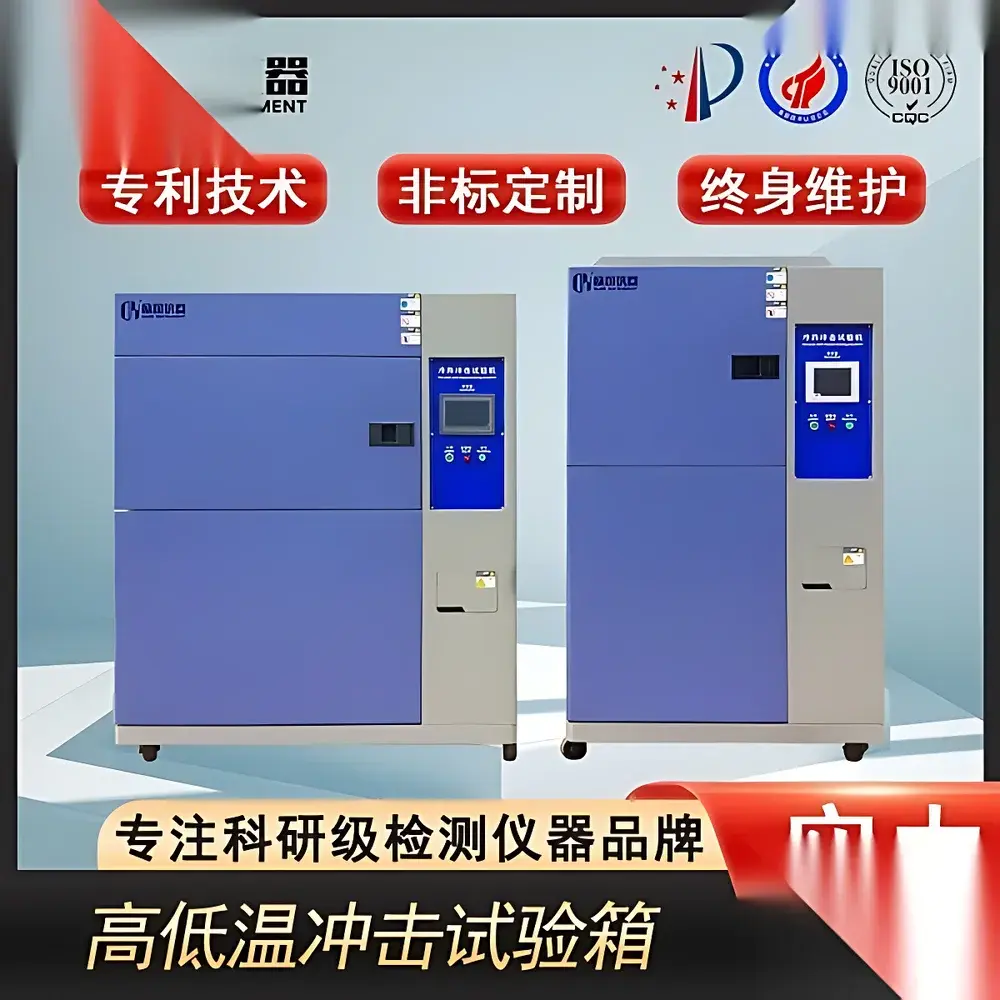
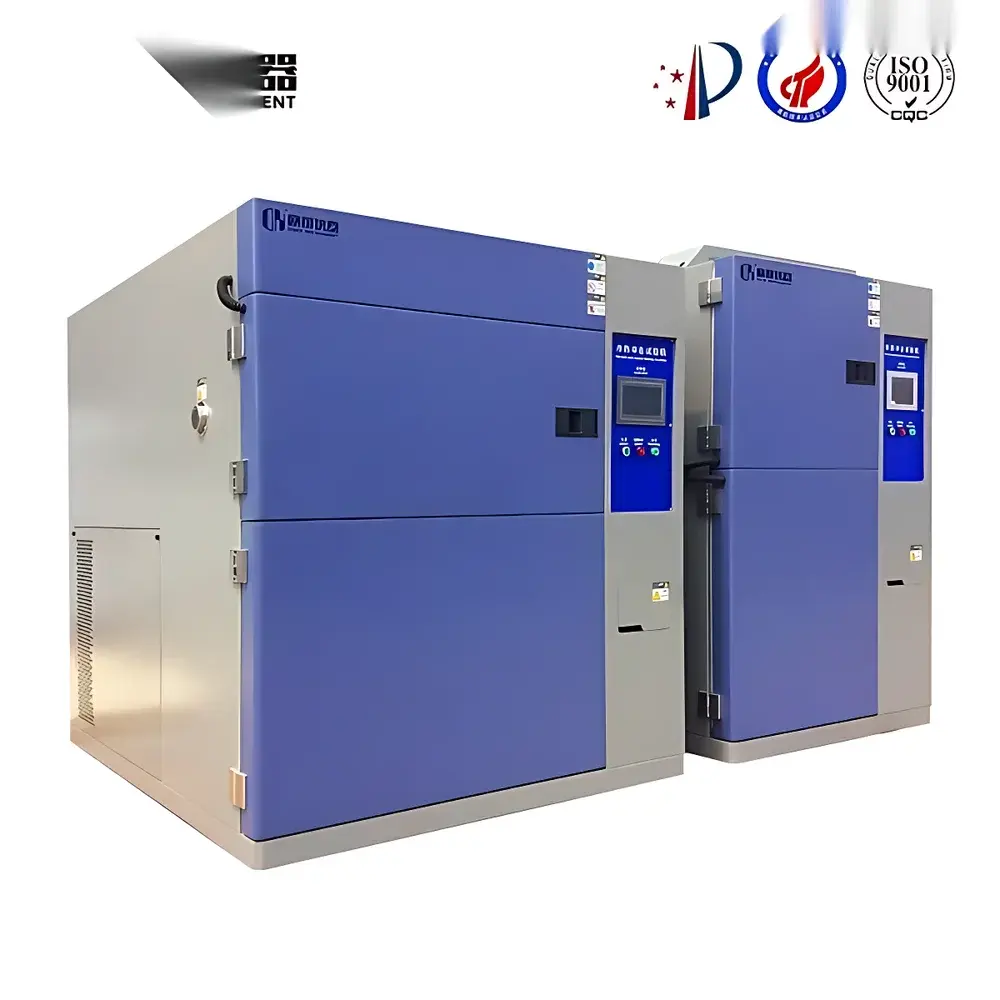
Touchscreen Low-Temperature Thermal Shock Test Chamber
| Brand | Other Brands |
|---|---|
| Origin | Imported |
| Manufacturer Type | Authorized Distributor |
| Price | USD 12,500 (FOB China) |
| Internal Dimensions (W×H×D) | 40×35×30 cm to 70×60×60 cm |
| External Dimensions (W×H×D) | 145×180×140 cm to 190×170×270 cm |
| Hot Zone Temperature Range | RT to +200 °C |
| Cold Zone Temperature Range | RT to −70 °C |
| Test Zone Temperature Range | +60 °C to +150 °C (hot shock) |
| Switching Mechanism | Pneumatic air-door actuated, static sample placement |
| Preheat Time (RT → 150 °C) | ~30 min |
| Precool Time (RT → −70 °C) | ~85 min |
| Recovery Time | <5 min |
| Temperature Control Accuracy | ±0.5 °C |
| Temperature Uniformity | ±2.0 °C |
| Refrigeration System | Dual-stage cascade refrigeration with semi-hermetic German compressors (R404A/R23), water-cooled condenser requiring external 10 m³/h cooling tower |
| Inner Chamber Material | Mirror-finish SUS#304 stainless steel |
| Outer Chamber Material | SUS#304 stainless steel or powder-coated steel |
| Insulation | High-density, fire-retardant PU foam |
| Standard Accessories | One 50 mm diameter cable port |
| Power Supply | AC 380 V ±5 %, 50 Hz ±0.5 Hz, 3-phase 5-wire, 2.5 m cable |
Overview
The Touchscreen Low-Temperature Thermal Shock Test Chamber is an engineered environmental stress screening (ESS) system designed for accelerated reliability validation of electronic components, automotive modules, aerospace subsystems, and structural materials under rapid, repetitive thermal transitions. It operates on the principle of controlled thermal shock—subjecting test specimens to abrupt, high-magnitude temperature shifts between extreme hot and cold reservoirs—thereby inducing thermally driven mechanical strain, interfacial delamination, solder joint fatigue, and phase-change-induced microstructural degradation. Unlike steady-state thermal cycling chambers, this system implements a three-zone architecture (hot soak chamber, cold soak chamber, and test chamber), enabling true static-sample testing with zero mechanical displacement during transition. This eliminates motion-induced artifacts and ensures measurement fidelity in failure analysis workflows aligned with MIL-STD-810, JEDEC JESD22-A104, and IEC 60068-2-14 standards.
Key Features
- Intuitive 10.1-inch industrial-grade touchscreen HMI with multi-language UI (English, German, French, Japanese), real-time trend graphs, and configurable alarm thresholds.
- Dual-stage cascade refrigeration system utilizing semi-hermetic German compressors and environmentally compliant refrigerants (R404A for high stage, R23 for low stage), delivering stable operation down to −70 °C without cryogenic consumables.
- Pneumatically actuated high-speed air doors (≤1.5 s full open/close) ensure precise, repeatable thermal transfer between zones—validated at <5-minute recovery time per ASTM E1545 and IEC 60068-2-14 Annex B.
- High-efficiency insulation using imported fire-rated polyurethane (PU) foam (λ ≤ 0.022 W/m·K) minimizes thermal leakage and improves energy stability across extended dwell cycles.
- Robust chamber construction: mirror-polished SUS#304 stainless steel interior (electropolished option available), corrosion-resistant outer casing, and reinforced door sealing with dual-silicone gasket compression.
- Integrated energy modulation logic dynamically adjusts compressor capacity and refrigerant flow to maintain setpoint accuracy while optimizing power consumption and reducing mechanical wear.
Sample Compatibility & Compliance
This chamber accommodates test samples up to 70 × 60 × 60 cm (OK-HH-225 model), with optional custom cavity configurations available upon engineering review. Sample mounting is fully static—no moving baskets or lift mechanisms—ensuring inertial neutrality critical for optical assemblies, MEMS devices, and precision sensors. The system complies with over 15 international and industry-specific standards, including GB/T 2423.1–2022 (cold test), GB/T 2423.2–2022 (dry heat), GB/T 2423.22–2012 (temperature change), GJB 150.3A–2009 (military thermal shock), IEC 60068-2-14 (change of temperature), and EIA-364-32 (connector thermal shock). All control firmware and data logging meet GLP/GMP traceability requirements, supporting audit-ready calibration records and 21 CFR Part 11-compliant electronic signatures when integrated with validated software packages.
Software & Data Management
The embedded controller supports RS485/Modbus RTU, Ethernet TCP/IP, and optional USB data export. Optional PC-based software (sold separately) provides full remote monitoring, automated test sequencing, statistical process control (SPC) charting, and PDF report generation—including timestamped temperature profiles, deviation logs, and pass/fail annotations per test step. Raw data is stored in CSV format with millisecond-level resolution; historical datasets are retained for ≥12 months onboard and indefinitely via network-attached storage (NAS) integration. Firmware updates are performed via secure HTTPS download with SHA-256 signature verification to ensure integrity and regulatory compliance.
Applications
- Qualification testing of PCBAs, IC packages, and wafer-level chip-scale packages (WLCSP) per JEDEC JESD22-A106.
- Validation of battery module thermal interface materials (TIMs) and cell-to-pack adhesion under repeated −40 °C ↔ +85 °C cycling.
- Aerospace avionics housing certification per DO-160 Section 4.5 (thermal shock).
- Automotive ECU and ADAS sensor endurance assessment per ISO 16750-4 and QC/T 17–2022.
- Material science research on polymer crystallinity shifts, elastomer hysteresis, and metal alloy embrittlement kinetics.
- Accelerated life testing (ALT) of medical device enclosures, especially those incorporating bonded glass-to-metal seals or silicone gaskets.
FAQ
What is the difference between two-chamber and three-chamber thermal shock configurations?
In a two-chamber system, the test specimen moves between hot and cold zones via a mechanical basket—introducing vibration and positional uncertainty. Our three-chamber design maintains sample stationarity, eliminating motion-related variables and improving repeatability for metrology-critical applications.
Is external cooling infrastructure mandatory?
Yes. The water-cooled condenser requires a dedicated closed-loop cooling tower rated at ≥10 m³/h flow rate and ≤32 °C inlet temperature. Air-cooled variants are available upon request but impose higher ambient temperature limits and reduced low-temperature performance.
Can the chamber be calibrated to ISO/IEC 17025 standards?
Yes. Third-party accredited calibration services—including sensor mapping (16-point uniformity verification), ramp-rate validation, and dwell-time stability assessment—are available through our global partner network.
Does the system support programmable dwell times and variable transition rates?
Yes. Users can define independent dwell durations (1 min to 999 h), number of cycles (1 to 9999), and select from standard or user-defined transition profiles (e.g., linear ramp, step-and-hold) via the touchscreen interface or remote software.
What maintenance intervals are recommended for long-term reliability?
Compressor oil analysis every 2,000 operating hours; refrigerant leak check quarterly; door gasket inspection and cleaning monthly; full system performance verification annually per manufacturer’s service manual.



