
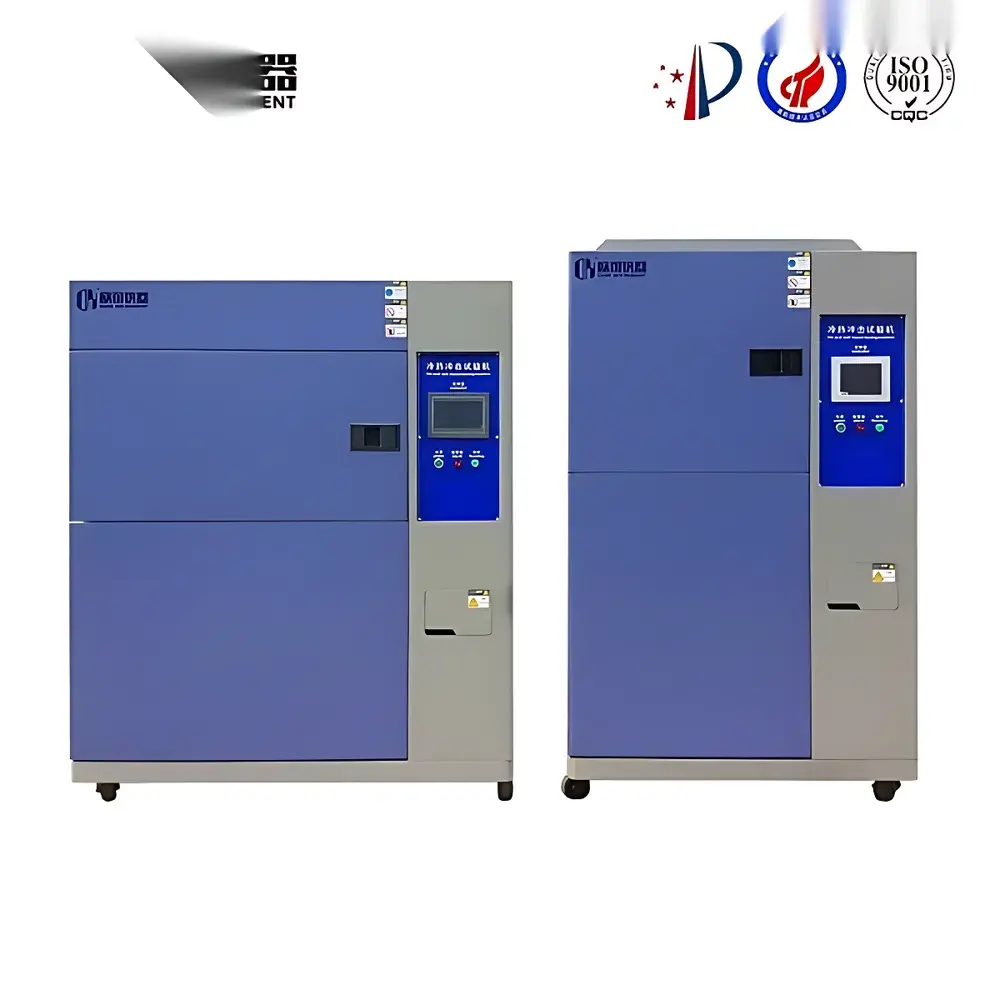
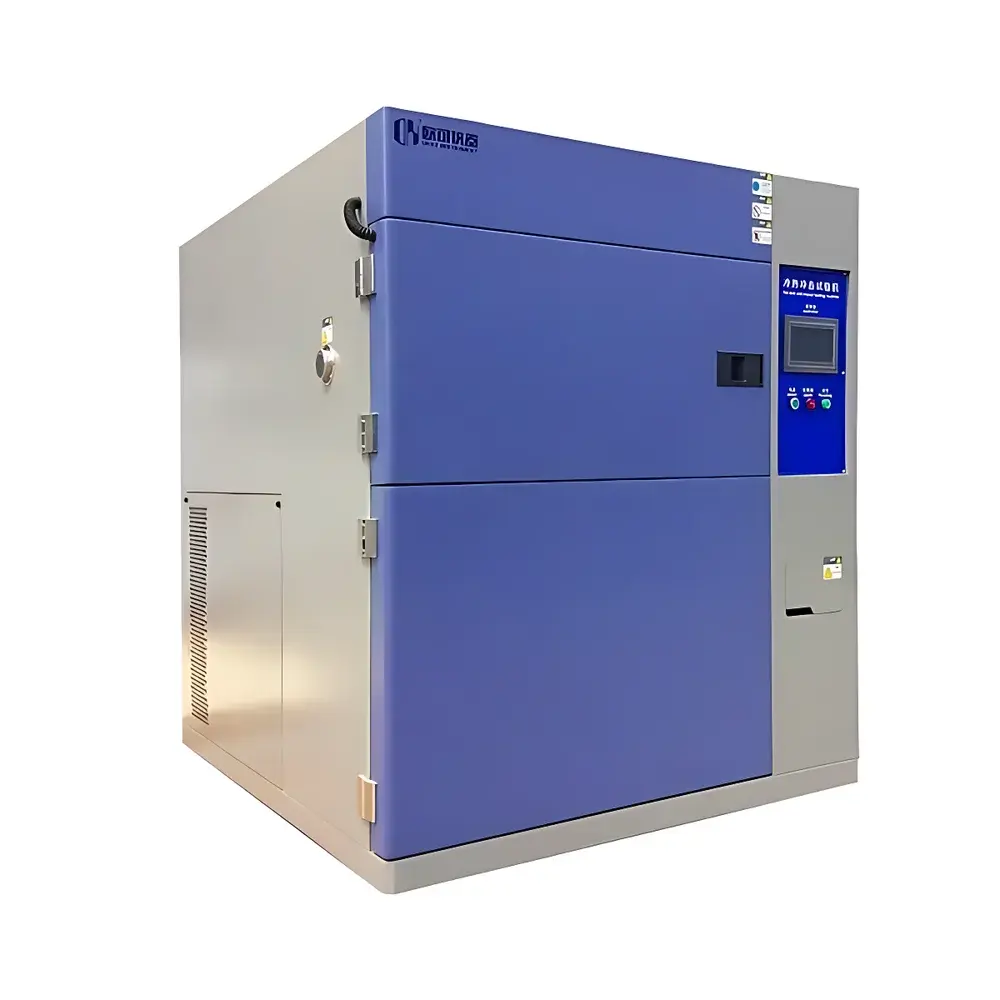
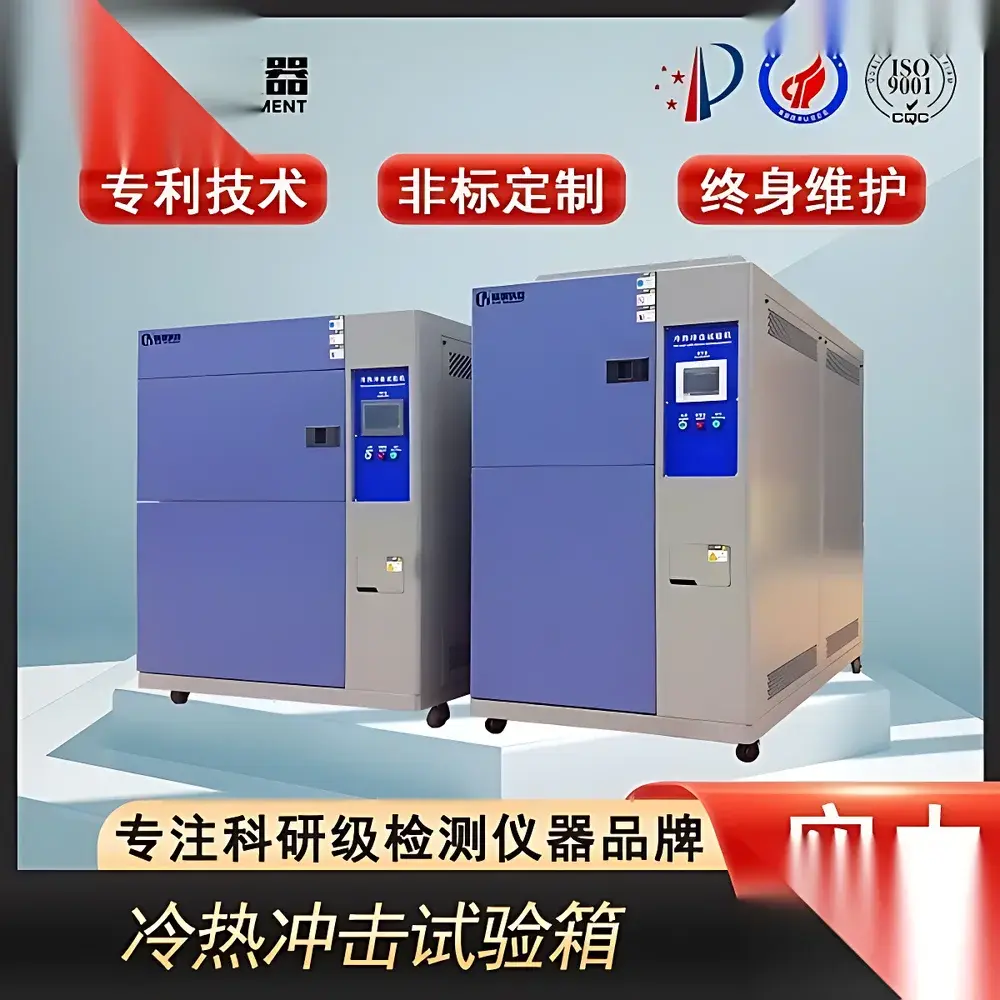
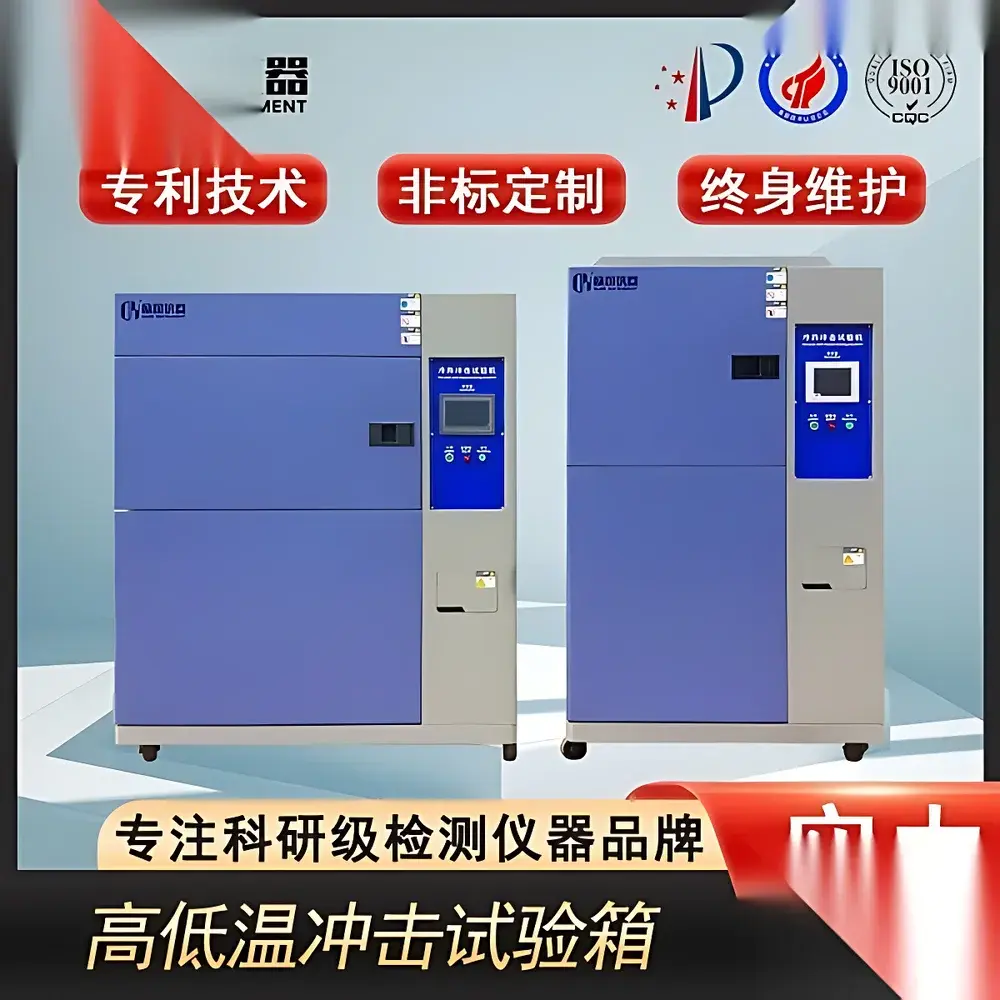
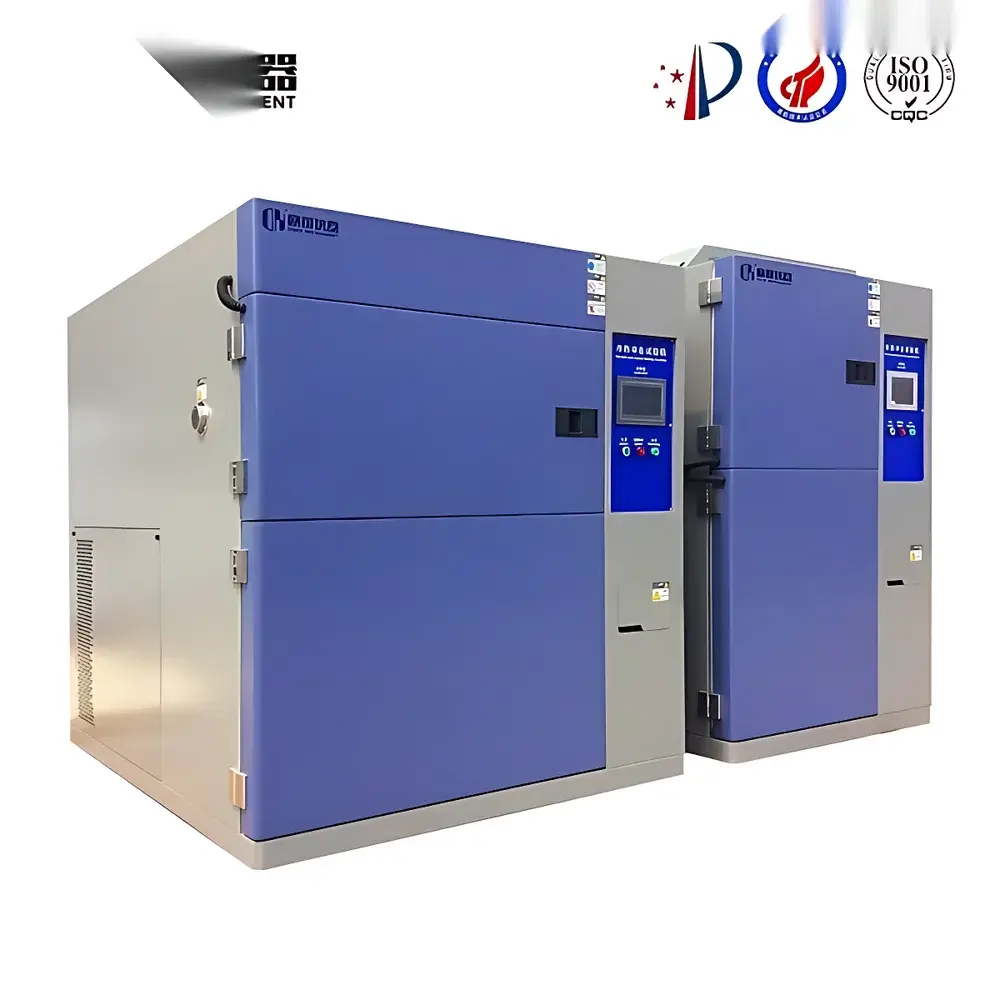
Touchscreen Thermal Shock Test Chamber OK-HH Series
| Brand | OK |
|---|---|
| Model | OK-HH-49 / OK-HH-80 / OK-HH-150 / OK-HH-225 |
| Type | Three-Zone (Hot/Cold/Test) or Two-Zone (Hot/Cold with Basket Transfer) Thermal Shock Test Chamber |
| Internal Dimensions (W×H×D, cm) | 40×35×30 to 70×60×60 |
| External Dimensions (W×H×D, cm) | 145×180×140 to 190×170×270 |
| Hot Zone Temperature Range | RT to +200 °C |
| Cold Zone Temperature Range | RT to −70 °C |
| Test Zone Temperature Range | +60 °C to +150 °C (hot shock) |
| Temperature Uniformity | ±2.0 °C |
| Temperature Control Accuracy | ±0.5 °C |
| Shock Transition Time (Door Switching) | <5 min |
| Hot Zone Preheat Time (RT→150 °C) | ~30 min |
| Cold Zone Precool Time (RT→−70 °C) | ~85 min |
| Refrigeration System | Dual-stage cascade refrigeration with imported semi-hermetic compressors (Germany), R404A/R23 refrigerants |
| Cooling Water Requirement | 10 m³/h external cooling tower (user-supplied) |
| Construction | Interior – mirror-finish SUS#304 stainless steel |
| Power Supply | AC 380 V ±5%, 50 Hz ±0.5 Hz, 3-phase 5-wire |
| Accessories | One φ50 mm cable port |
Overview
The OK-HH Series Touchscreen Thermal Shock Test Chamber is an engineered environmental test system designed for rapid, repeatable thermal cycling between extreme temperature extremes—specifically to evaluate material integrity, solder joint reliability, coating adhesion, and packaging performance under abrupt thermal transitions. It operates on the principle of controlled, high-speed thermal transfer via pneumatic door actuation (three-zone configuration) or mechanical basket transfer (two-zone configuration), enabling precise exposure of test specimens to alternating hot and cold environments without physical handling. Unlike conventional temperature cycling chambers, this system isolates thermal mass in dedicated hot and cold reservoirs—minimizing thermal inertia and ensuring reproducible shock profiles per IEC 60068-2-14 (Test N: Change of Temperature) and MIL-STD-810G Method 503.5. Its architecture supports both static test specimen positioning (in the central test chamber) and dynamic specimen movement (via motorized basket), allowing users to select the configuration best suited for product geometry, thermal mass, and qualification protocol requirements.
Key Features
- Intuitive 10.1-inch capacitive touchscreen HMI with multi-language interface (English, Chinese, Spanish), real-time trend graphing, and user-level access control (operator, engineer, administrator)
- Dual-stage cascade refrigeration system using imported semi-hermetic compressors (Germany), optimized for stable operation at −70 °C cold zone and +200 °C hot zone
- High-efficiency evaporative condenser design enables energy modulation—reducing compressor cycling and extending service life while maintaining ±0.5 °C temperature control accuracy
- Fire-retardant, high-density polyurethane (PU) insulation (≥150 mm thickness) ensures low heat leakage and stable chamber uniformity (±2.0 °C across test volume)
- Robust mechanical construction: interior chamber fabricated from electropolished SUS#304 mirror-finish stainless steel; exterior panels in corrosion-resistant SUS#304 or industrial-grade powder-coated steel
- Integrated safety systems: over-temperature cutoff, refrigerant pressure monitoring, door interlock, phase sequence protection, and emergency stop circuit compliant with IEC 61000-6-2/6-4 EMC standards
Sample Compatibility & Compliance
The OK-HH Series accommodates a broad range of sample types—including PCB assemblies, automotive ECUs, aerospace composites, medical device housings, and polymer-based consumer electronics—within internal volumes ranging from 42 L to 252 L. Its configurable chamber layout supports both rigid fixtures and free-standing samples up to 30 kg per test cycle. The system fully complies with international thermal shock testing standards, including IEC 60068-2-14 (Test N), MIL-STD-810G Method 503.5, GJB 150.5-2009 (China’s military standard for temperature shock), GB/T 2423.22–2012 (China national standard for temperature change testing), and EIA-364-32 (thermal shock evaluation of electrical connectors). All models are designed for GLP-compliant validation: traceable calibration paths, documented sensor placement, and audit-ready operational logs support ISO/IEC 17025 laboratory accreditation requirements.
Software & Data Management
The embedded controller firmware supports full-cycle data logging at user-selectable intervals (1–60 seconds), storing temperature readings from up to six independent PT100 sensors (hot zone, cold zone, test zone center, top/bottom corners). Export formats include CSV and PDF reports with timestamped metadata, pass/fail flags per test step, and deviation alerts. Optional PC-based software (OK-DataLink v3.2) enables remote monitoring via Ethernet, automated report generation aligned with ASTM E29-23 rounding rules, and integration into enterprise LIMS platforms via Modbus TCP or OPC UA. Audit trail functionality records all parameter changes, user logins, and calibration events—meeting FDA 21 CFR Part 11 requirements for electronic records and signatures when configured with role-based authentication and digital signature modules.
Applications
This thermal shock chamber serves critical roles across R&D, quality assurance, and production validation workflows. In electronics manufacturing, it validates intermetallic growth resistance in lead-free solder joints subjected to repeated thermal excursions. Automotive suppliers use it to assess seal integrity and dimensional stability of ADAS housings under simulated under-hood thermal cycling. Aerospace component manufacturers apply it to qualify composite layups for thermal gradient-induced delamination. Materials scientists employ it to study glass transition shifts in thermoplastics and embrittlement thresholds in elastomers. Additionally, it supports accelerated aging protocols for battery enclosures, LED modules, and MEMS sensors—where cumulative thermal stress correlates strongly with field failure modes such as crack propagation, void formation, or interfacial debonding.
FAQ
What is the difference between two-zone and three-zone thermal shock configurations?
Two-zone systems use a single test chamber alternately connected to hot and cold reservoirs via a moving basket; three-zone systems maintain separate hot/cold/test chambers, with specimens remaining stationary while air gates switch exposure—reducing mechanical stress on delicate samples.
Does the system require external cooling water infrastructure?
Yes. A dedicated 10 m³/h closed-loop cooling tower must be installed outdoors and plumbed to the chamber’s water-cooled condenser. This is mandatory for sustained operation at −70 °C cold zone temperatures.
Can test parameters be exported for regulatory submission?
Yes. Raw sensor data, event logs, and summary reports export in CSV and PDF formats—with timestamps, operator IDs, and calibration certificate references—fully traceable for ISO 9001, IATF 16949, or AS9100 audits.
Is the chamber suitable for testing lithium-ion battery modules?
It meets UN 38.3 Section 4.4 (thermal shock) requirements when operated within defined limits (e.g., −40 °C to +75 °C, 30-minute dwell per zone), provided appropriate safety containment (vented enclosure, gas detection) is externally integrated.
How is temperature uniformity validated during IQ/OQ?
Validation follows ISO 17025 Annex B guidelines: nine-point sensor mapping per zone, 3-hour stabilization, and statistical analysis of mean deviation, standard deviation, and spatial gradient—all documented in the supplied Factory Acceptance Test (FAT) report.



