
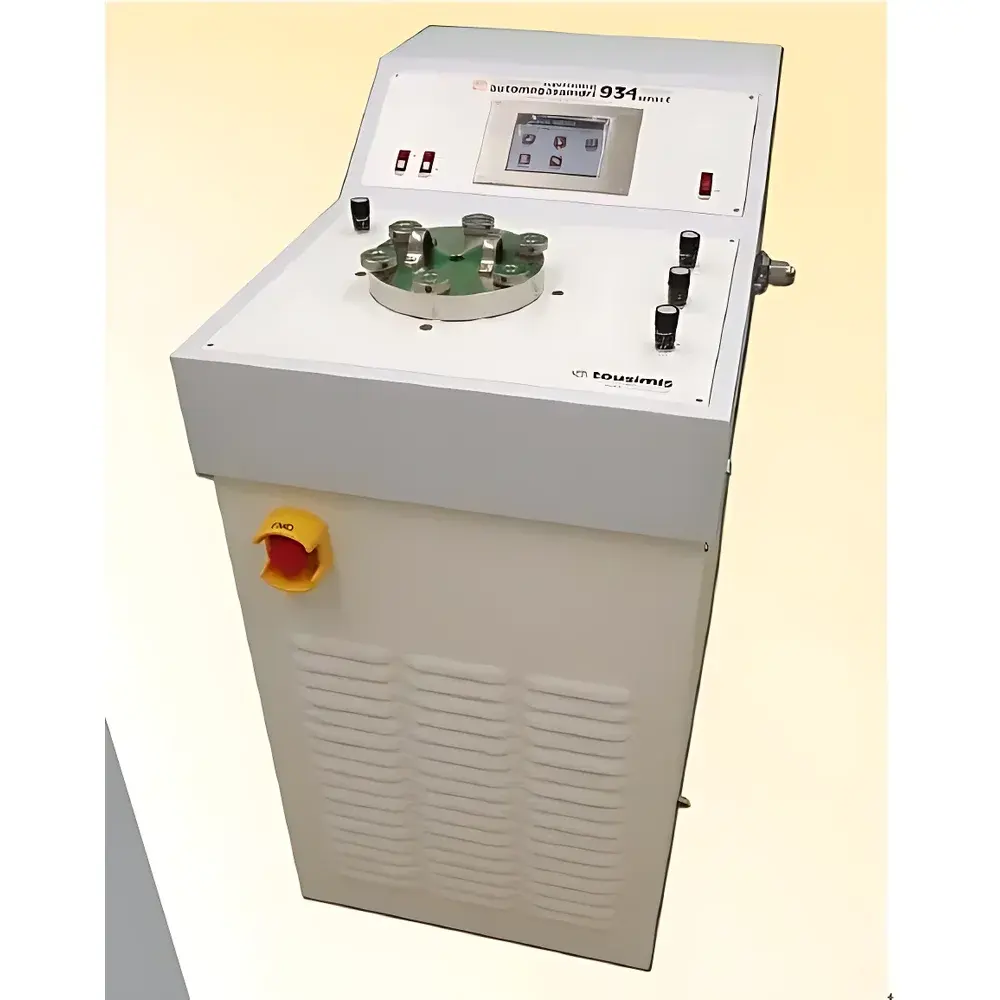
Tousimis AutoSamdri-934 Series C Supercritical Point Dryer
| Brand | Tousimis |
|---|---|
| Origin | USA |
| Manufacturer Type | Authorized Distributor |
| Origin Category | Imported |
| Model | AutoSamdri-934, Series C |
| Pressure Range | 0–2000 psi |
| Temperature Range | −30 °C to 60 °C |
Overview
The Tousimis AutoSamdri-934 Series C is a vertically oriented, fully automated supercritical point dryer engineered for high-fidelity sample preservation in electron microscopy (SEM, TEM), MEMS fabrication, nanomaterial characterization, and semiconductor R&D. It employs carbon dioxide (CO₂) as the supercritical fluid medium, operating above its critical point (31.1 °C, 1070 psi) to eliminate liquid–gas interfacial tension during drying—thereby preventing capillary collapse, surface shrinkage, or structural deformation of delicate hydrated or solvent-laden specimens. Designed for integration into Class 100–1000 cleanrooms, the system meets stringent requirements for particulate control, electrostatic discharge (ESD) safety, and material compatibility with aggressive solvents including ethanol, acetone, and CO₂ itself. Its closed-loop cooling architecture, integrated SOTER condenser, and Vortex Swirl purge mechanism collectively ensure reproducible, low-damage drying cycles across diverse micro- and nano-scale samples.
Key Features
- 4.5-inch vertical sample chamber with internal LED illumination and optical viewport lid for real-time visual monitoring
- Stasis software-enabled static hold function for controlled CO₂ saturation and phase equilibration prior to transition
- Patented Vortex Swirl non-mechanical agitation—eliminates shear stress while ensuring complete solvent displacement during purge
- Dedicated “slow-fill” CO₂ delivery protocol optimized for fragile biological tissues, aerogels, and lithographically patterned wafers
- Integrated closed-loop chiller system enabling rapid chamber cooldown (−30 °C to 60 °C range) and cycle time reduction
- SOTER condenser for efficient separation of waste ethanol vapor and exhaust gas—reducing acoustic emissions and improving lab ambient conditions
- 0.08 µm inline particulate filtration on all CO₂ inlet paths; dual-stage PURGE filter assembly with field-replaceable cartridges
- Modular Teflon-compatible chamber inserts (1.25″, 2″, 3″, 4″ diameters) enabling volume optimization and reduced LCO₂ consumption per run
- Pre-configured wafer handling: supports simultaneous processing of five 4″ wafers—or three 3″, six 2″, or ten 10 mm square substrates per cycle
- UL-, CE-, and U.S. Military-spec compliant electrical architecture; ESD-safe housing and grounding provisions
- Touchscreen HMI (4.5″ LCD) with preloaded SOPs and user-definable, timestamped protocol storage
Sample Compatibility & Compliance
The AutoSamdri-934 Series C accommodates a broad spectrum of sensitive specimens, including but not limited to: freeze-substituted biological tissues, silica aerogels, polymer hydrogels, nanoporous thin films, MEMS devices, and photolithographically defined silicon wafers. All wetted surfaces—including chamber walls, valves, seals, and sample holders—are chemically inert to CO₂, anhydrous ethanol, and acetone, supporting compatibility with standard SEM dehydration workflows (e.g., graded ethanol series). The system conforms to ISO 14644-1 (cleanroom classification), ANSI/ESD S20.20 (electrostatic control), and ASTM F2616-21 (standard guide for critical point drying of biological specimens). Optional audit trail logging and electronic signature support align with GLP/GMP documentation requirements under FDA 21 CFR Part 11 when integrated with validated networked data management systems.
Software & Data Management
Stasis control software provides intuitive touchscreen operation with full parameter logging (temperature, pressure, time, valve status, cooling stage output). Each drying cycle generates a timestamped .csv log file containing all setpoints and real-time sensor readings at 1-second resolution. Users may define, name, save, and recall up to 99 custom protocols—each with independent ramp rates, dwell times, purge durations, and thermal profiles. Software supports password-protected operator levels (Operator, Technician, Administrator) and includes built-in diagnostic routines for pressure transducer calibration verification, chiller performance validation, and filter life estimation based on cumulative flow metrics. Exported logs are compatible with LIMS integration via standard USB or Ethernet interfaces.
Applications
- High-resolution SEM/TEM sample preparation for soft biological tissues, biofilms, and extracellular matrices
- Drying of low-k dielectric films and porous organosilicate glasses in advanced node semiconductor process development
- Preservation of nanostructured aerogels and metal–organic frameworks (MOFs) without pore collapse
- MEMS device release drying where stiction mitigation is critical for functional yield
- Microfluidic chip fabrication involving hydrogel-based channels or suspended membranes
- Quality control of lithographic resist profiles and etch uniformity on 2″–4″ wafers
FAQ
What solvents are compatible with the AutoSamdri-934 Series C?
Ethanol, methanol, acetone, and other low-surface-tension solvents commonly used in graded dehydration protocols are fully supported. All fluid paths are PTFE-lined or constructed from 316 stainless steel.
Is remote monitoring or network connectivity available?
Yes—the system includes Ethernet and USB ports for external data export and optional integration with facility-wide monitoring platforms. Remote diagnostics require local IT policy approval and firewall configuration.
How often must the 0.08 µm filters be replaced?
Filter replacement frequency depends on usage intensity and solvent purity. Under typical lab conditions (5–10 runs/week), primary inlet filters last 3–6 months; PURGE-stage filters are inspected quarterly and replaced as needed based on differential pressure monitoring.
Can the system be validated for regulated environments (e.g., ISO 13485, GMP)?
Yes—Tousimis provides IQ/OQ documentation templates, calibration certificates for pressure and temperature sensors (NIST-traceable), and traceability records for all critical components. Full PQ support requires site-specific operational qualification by qualified personnel.
What maintenance is required beyond filter changes?
Annual preventive maintenance includes chiller refrigerant level verification, O-ring integrity inspection, pressure transducer recalibration, and verification of purge/vacuum pump performance against manufacturer specifications.



