
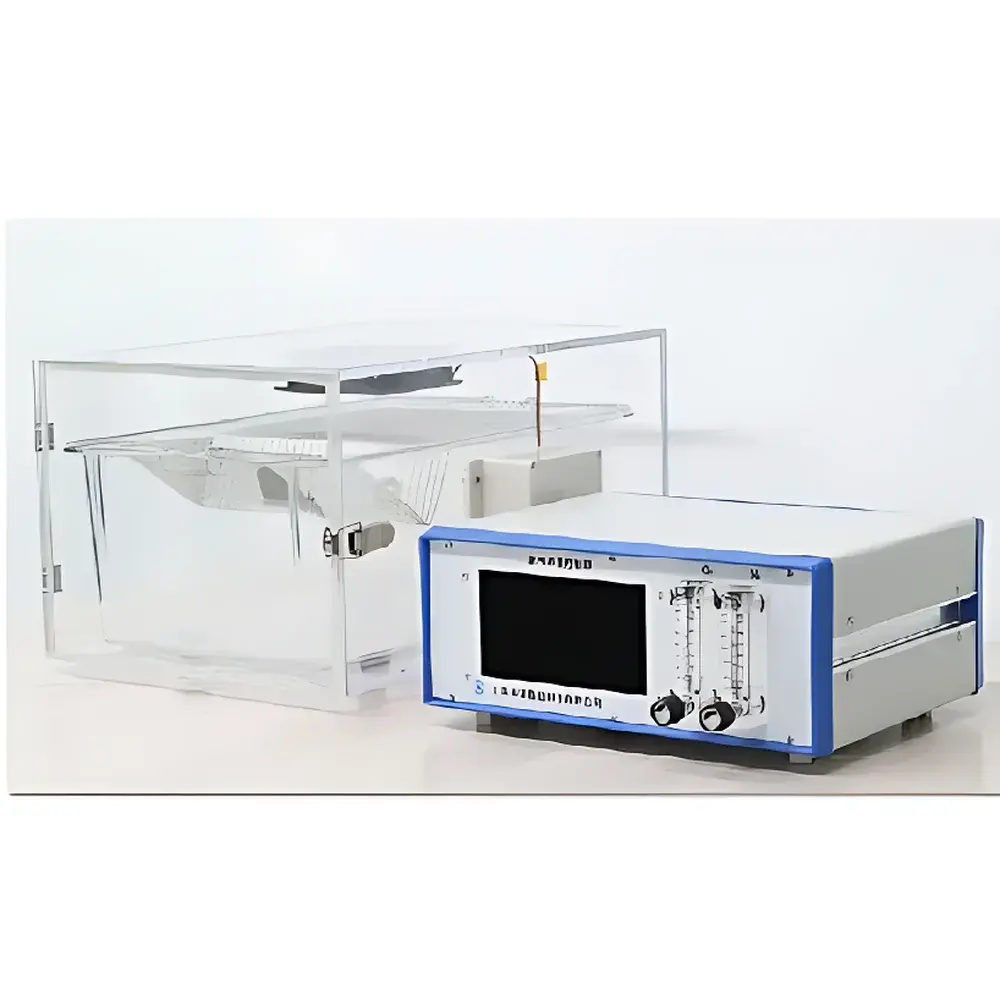
TOW-INT Ox-100 Animal Hypoxia Exposure System
| Brand | TOW-INT |
|---|---|
| Origin | Shanghai, China |
| Manufacturer Type | Original Equipment Manufacturer (OEM) |
| Product Category | Domestic |
| Model | Ox-100 |
| Instrument Type | Hypoxia Control System |
| Measured Parameters | Temperature, Relative Humidity, O₂ Concentration, CO₂ Concentration |
| O₂ Sensor | Electrochemical, 0–25% vol, resolution 0.01%, with temperature compensation |
| CO₂ Sensor | NDIR, 0–5000 ppm, accuracy ±30 ppm |
| Temperature Sensor | Platinum RTD (Pt100), high-precision digital |
| Humidity Control | Integrated humidity sensing + active dehumidification module |
| O₂ Control Accuracy | ±0.1% vol (steady-state) |
| Gas Mixing | Onboard proportional mixing with feedback-closed-loop regulation |
| Chamber Material | Optical-grade PMMA (acrylic), gas-tight, static-dissipative |
| Interface | 7-inch capacitive touchscreen HMI with intuitive workflow navigation |
| Chamber Configurations | Standard (1 rat cage / 2 mouse cages), Ox-100-D (2 rat / 4 mouse cages), Ox-100-F (4 rat / 8 mouse cages), Ox-100-MC-* (multi-channel independent control) |
Overview
The TOW-INT Ox-100 Animal Hypoxia Exposure System is an engineered environmental control platform designed for preclinical research requiring precise, reproducible, and physiologically relevant hypoxic conditions in vivo. It operates on a closed-loop gas regulation principle, dynamically blending medical-grade nitrogen and compressed air (or optional O₂/CO₂/N₂ mixtures) to maintain user-defined oxygen partial pressures within the exposure chamber. Unlike open-flow or passive diffusion systems, the Ox-100 employs real-time electrochemical O₂ sensing coupled with non-dispersive infrared (NDIR) CO₂ monitoring and high-fidelity platinum resistance thermometry (Pt100) to drive proportional valve actuation—ensuring stable setpoint adherence across variable metabolic loads. This architecture eliminates concentration drift between controller output and intra-chamber environment, a known source of experimental variance in chronic or intermittent hypoxia studies. The system supports both continuous and programmable intermittent hypoxia protocols—critical for modeling pathophysiological states such as obstructive sleep apnea, high-altitude acclimatization, ischemic preconditioning, and tumor microenvironment simulation.
Key Features
- Real-time closed-loop O₂ control with ±0.1% vol steady-state accuracy, validated under dynamic respiratory load conditions
- Integrated multi-parameter sensing suite: electrochemical O₂ (0–25% vol, 0.01% resolution), NDIR CO₂ (0–5000 ppm, ±30 ppm), Pt100 temperature (±0.2°C), and capacitive relative humidity (20–90% RH, ±3% RH)
- Onboard gas mixing engine with precision solenoid valves and laminar flow optimization—eliminates need for pre-mixed cylinder gases and reduces operational cost
- Optical-grade PMMA exposure chamber: gas-impermeable, UV-stable, static-dissipative, and compatible with standard IVC-compatible caging (rat: up to 10 animals; mouse: up to 30 animals in base configuration)
- 7-inch industrial-grade touchscreen HMI with ISO-compliant UI hierarchy—supports protocol scheduling, alarm logging, and sensor calibration without external software
- Active humidity management: integrated desiccant-based dehumidification prevents condensation and mitigates hypercapnia from animal respiration
- Exhaust scrubbing module: catalytic oxidation of residual CO and NO (optional add-on), compliant with laboratory fume hood integration standards
- Modular scalability: Ox-100-D (dual-cage), Ox-100-F (quad-cage), and Ox-100-MC-* (multi-channel independent control) variants available for parallel cohort studies
Sample Compatibility & Compliance
The Ox-100 accommodates standard rodent housing configurations—including individually ventilated cages (IVCs), metabolic cages, and restraint-compatible enclosures—without modification to airflow dynamics or gas homogeneity. Chamber geometry and internal circulation design ensure <1.5% spatial O₂ gradient (measured per ASTM D6186-22 Annex A3). All sensors comply with IEC 61000-6-3 (EMC immunity) and ISO 13485:2016 (medical device quality management). Data integrity meets FDA 21 CFR Part 11 requirements via audit-trail-enabled event logging, electronic signature support, and tamper-proof timestamping. The system is routinely deployed in GLP-compliant toxicology facilities and AAALAC-accredited vivaria for studies aligned with NIH Guide for the Care and Use of Laboratory Animals and OECD Test Guidelines 407/408.
Software & Data Management
No proprietary PC software is required for operation—the Ox-100 functions autonomously via its embedded Linux-based controller. All experimental parameters, sensor readings, and alarm events are stored locally on encrypted SD card (≥16 GB, 10-year retention). Data export is supported in CSV and XML formats, compatible with MATLAB, GraphPad Prism, and LabArchives ELN integration. Optional Ethernet/Wi-Fi connectivity enables remote monitoring through secure HTTPS API (RESTful endpoints for GET/PUT commands) and TLS 1.2–encrypted data streaming to institutional LIMS. Calibration logs, maintenance records, and user access history are retained with immutable SHA-256 hashing for regulatory traceability.
Applications
The Ox-100 serves as a foundational tool in mechanistic studies of hypoxia-driven pathophysiology, including but not limited to: pulmonary arterial hypertension (PAH) modeling via chronic hypobaric or normobaric hypoxia; myocardial ischemia-reperfusion injury mitigation; neurocognitive deficits in intermittent hypoxia (e.g., OSA models); tumor angiogenesis and metastasis under low-O₂ microenvironments; hematopoietic stem cell niche modulation; and high-altitude medicine research (e.g., CMS, HACE, HAPE). Its compatibility with concurrent interventions—including intravenous catheterization, telemetry implantation, behavioral assays (e.g., Morris water maze inside chamber), and optical imaging—enables longitudinal, multimodal phenotyping. Peer-reviewed applications span journals including Cell Metabolism, Advanced Science, European Journal of Pharmacology, and Frontiers in Physiology.
FAQ
Can the Ox-100 be used for hyperoxia or normoxia control?
Yes—the system supports O₂ setpoints from 1% to 21% (hypoxia) and up to 100% (hyperoxia) when configured with optional O₂ supply manifold and pressure-regulated delivery.
Is temperature control available as a standard feature?
Temperature regulation (±0.3°C, range 20–30°C) is an optional add-on module, certified to ISO 15197:2013 thermal stability requirements.
Does the system meet international biosafety standards for exhaust handling?
The standard exhaust port connects directly to building ductwork or chemical fume hoods; optional catalytic converter module (CatEx-100) treats CO, NO, and volatile organics to EPA Method TO-15 compliance levels.
Can multiple Ox-100 units be synchronized for cohort-level studies?
Yes—via Ethernet-based master-slave protocol, enabling identical timing, ramp profiles, and alarm propagation across up to 16 units with sub-second synchronization.
What validation documentation is provided?
Each unit ships with Factory Acceptance Test (FAT) report, sensor calibration certificates (NIST-traceable), IQ/OQ templates, and ISO 17025-accredited verification data for O₂/CO₂ linearity, repeatability, and response time.
Related Products





